 By st20113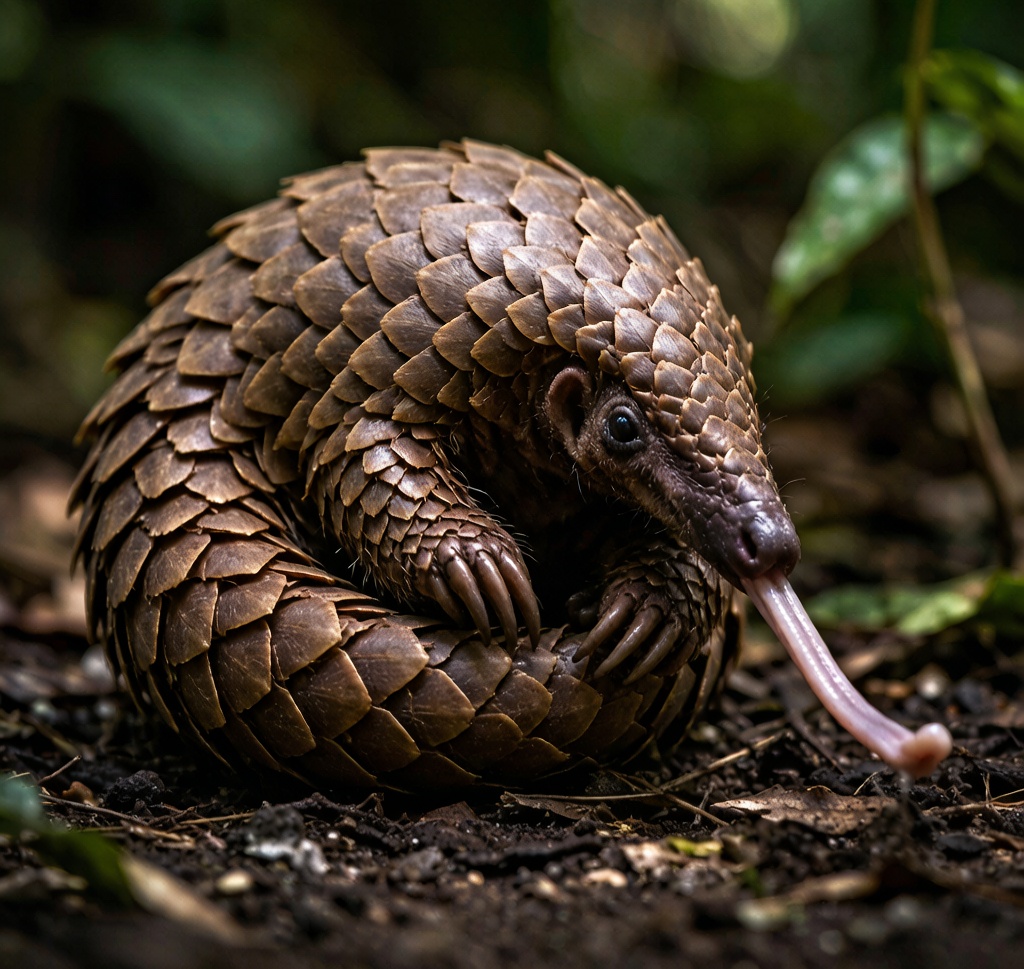
The Indian pangolin (Manis crassicaudata) — also called the thick-tailed pangolin — is one of the most ancient and bizarre mammals on Earth: a solitary, nocturnal, scaly anteater that looks like a walking pinecone and represents an entire mammalian order (Pholidota) that has existed for approximately 80 million years with little change. Covered from nose to tail tip in overlapping scales made of keratin, the pangolin’s armor is its primary defense: when threatened, it rolls into a tight ball, protected on all sides by a layer of sharp, interlocking scales. Found across the Indian subcontinent and Sri Lanka, the Indian pangolin is a burrowing, insectivorous specialist that consumes enormous quantities of termites and ants using its extraordinarily long, sticky tongue. Despite its remarkable adaptations, the Indian pangolin is now one of the most trafficked mammals on Earth, targeted by one of the world’s most lucrative illegal wildlife trades.
## Physical Characteristics
The Indian pangolin has a robust, elongated body measuring 45 to 75 centimeters, plus a prehensile tail of 35 to 45 centimeters, and weighing 5 to 10 kilograms, with males larger than females. Its body, tail, and limbs are almost entirely covered in large, overlapping, blade-shaped scales — between 100 and 130 of them — composed of keratin. The scales are brownish to dark brown in color. The underside of the body and the inner surfaces of the limbs are covered in coarse white hair rather than scales. The head is small, pointed, and cone-shaped, with a tiny mouth opening containing a long, worm-like tongue coated in sticky saliva. The forelimbs are extraordinarily powerful, equipped with three large, curved claws on each foot.
## Habitat and Distribution
The Indian pangolin is found across the Indian subcontinent — from southeastern Pakistan through India, Nepal, Bangladesh, and Sri Lanka — in a wide variety of habitats including tropical rainforests, dry scrublands, grasslands, agricultural areas, and rocky hillsides up to approximately 2,500 meters elevation. The species is highly adaptable to modified landscapes, provided that suitable burrowing sites and sufficient termite and ant prey are available. Pangolins excavate burrows in the ground — typically in forest edges, agricultural fields, or termite mounds — or may shelter in rock crevices or hollow logs. A single pangolin may maintain multiple burrows within its home range spanning 0.5 to 6 square kilometers.
## Behavior and Diet
The Indian pangolin is primarily nocturnal and terrestrial. It feeds almost exclusively on termites and ants — consuming up to 200,000 insects per night. The pangolin uses its powerful front claws to break open termite mounds and rotting logs, then inserts its extraordinarily long, sticky tongue into the galleries to collect insects. When threatened, the Indian pangolin rolls into a tight ball — a defense so effective that even large predators such as leopards and tigers struggle to penetrate it. It may also spray a noxious acidic liquid from its anal glands. Pangolins are generally silent and solitary, coming together only to breed.
## Reproduction
Indian pangolins breed year-round. After a gestation of approximately 65 to 70 days, the female gives birth to one to three (typically one) offspring in a burrow lined with grasses and leaves. Newborn pangolins are miniature replicas of the adults, covered in soft, pale scales that harden within a few days. The mother carries the young on her back or tail — the only time multiple pangolins are seen together — for approximately three to six months. The young begins consuming solid food at approximately one month of age and is fully weaned at approximately three to four months. Sexual maturity is reached at approximately one year of age for females and approximately two years for males.
## Conservation
The Indian pangolin is classified as Endangered on the IUCN Red List and is listed on CITES Appendix I, which prohibits international commercial trade. All eight pangolin species worldwide are threatened with extinction due to relentless poaching and illegal trade. The Indian pangolin is targeted primarily for its scales, which are used in traditional Asian medicines despite having no proven therapeutic value, and for its meat. Estimates suggest that over one million pangolins have been trafficked globally in the past decade alone. Conservation efforts include enhanced law enforcement at borders and markets, habitat protection, community education, and a national pangolin conservation action plan launched in India in 2020.