 By st20113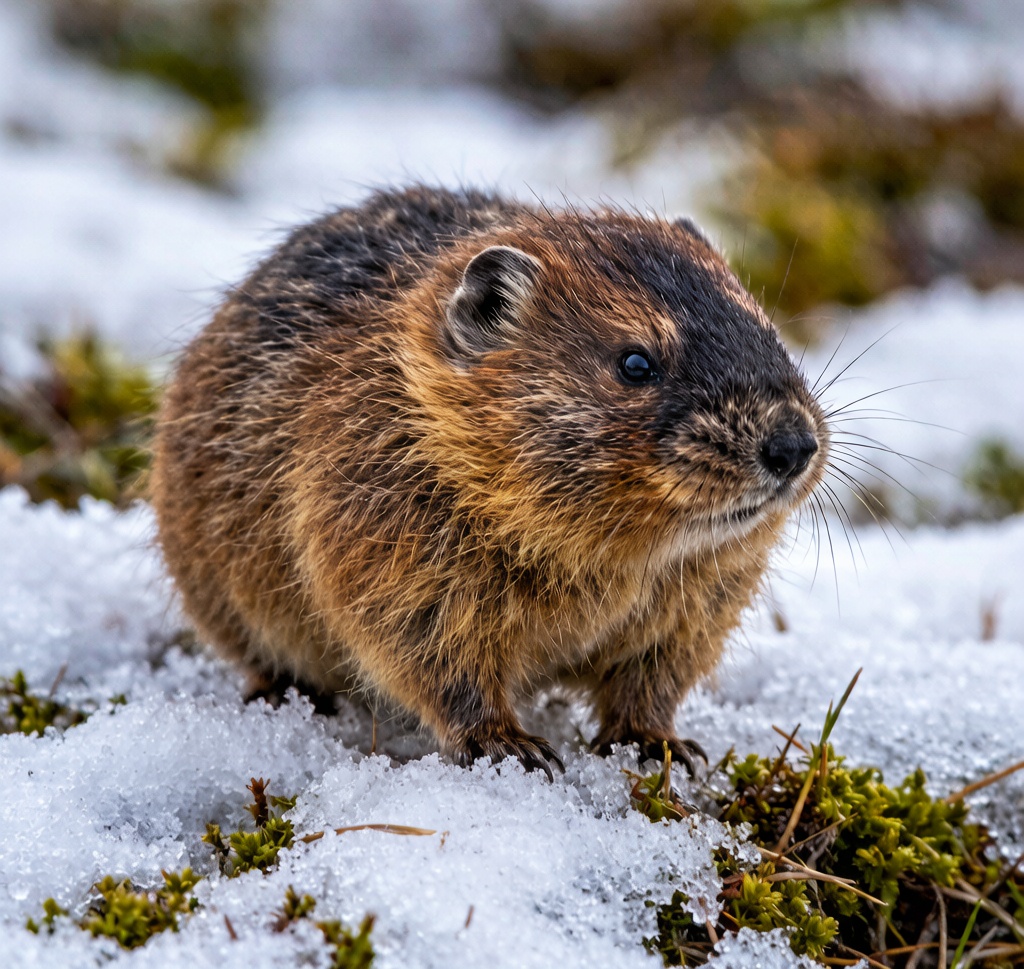
The Norwegian lemming (Lemmus lemmus) is a small, brilliantly colored rodent native to the Arctic and sub-Arctic regions of northern Europe, particularly Fennoscandia. Famous for its dramatic population cycles — in which lemming numbers increase explosively every three to five years before crashing just as dramatically — this species is one of the most ecologically important small mammals in the tundra biome. During peak years, Norwegian lemmings reach extraordinary densities, forming visible colonies across the tundra and serving as the primary prey base for numerous Arctic predators including Arctic foxes, snowy owls, wolverines, and long-tailed skuas. Their migrations, during which thousands of individuals cross landscapes in all directions, have long inspired legends of mass suicide — a misconception perpetuated by their willingness to swim across water bodies, sometimes resulting in drownings.
## Physical Characteristics
The Norwegian lemming is a compact, sturdy rodent with a body length of approximately 11 to 15 centimeters and a short tail of 1.5 to 2 centimeters. Its fur is its most distinctive feature: the dorsal surface is a bold, contrasting pattern of rusty brown, bright yellowish-brown, and black, with a prominent black stripe running along the spine from forehead to rump. The flanks are paler yellowish-buff, and the underparts are greyish-white. The ears are very short and rounded, largely hidden within the dense fur. The feet are broad and equipped with strong claws adapted for digging and burrowing through frozen ground and compacted snow. This vivid coloration serves as aposematic warning to potential predators, signaling that the lemming is unpalatable or toxic — a strategy reinforced by the fact that Norwegian lemmings produce certain chemical compounds that make them less desirable prey.
## Habitat and Distribution
The Norwegian lemming inhabits the alpine and Arctic tundra zones of Fennoscandia — Norway, Sweden, Finland, and the Kola Peninsula of Russia — as well as parts of the Balkan Peninsula and Carpathian Mountains. It occupies a variety of tundra habitats including moss-dominated heathlands, rocky scree slopes, meadow patches, and areas near streams and snowfields. The species is strongly associated with areas of early snowmelt that provide green vegetation for feeding, and it avoids deep forest and waterlogged bogs.
## Diet
The Norwegian lemming is a herbivore with a diet strongly tied to the seasonal availability of Arctic vegetation. During summer, it feeds on the leaves, stems, roots, and bulbs of a wide variety of plants including grasses, sedges, mosses, and dwarf shrubs such as bilberry and crowberry. In winter, it survives primarily by tunnelling beneath the snow to access cached vegetation, mosses, and lichens. The lemming’s continuously growing incisors allow it to gnaw through frozen plant material and even woody stems. During peak population years, lemmings can cause significant local vegetation changes through their intensive grazing.
## Population Dynamics
The Norwegian lemming is best known for its spectacular population cycles. In peak years, densities can reach 100 to 250 individuals per hectare — a dramatic increase from the typical density of fewer than 10 per hectare during low periods. These cycles are driven by a combination of factors including food availability, predation pressure, competition, and intrinsic population regulation mechanisms. During peaks, the overgrazed vegetation cannot sustain the population, triggering a crash in which predator populations — boosted by the lemming bounty — rapidly suppress lemming numbers. These cycles are a cornerstone of tundra ecosystem dynamics, influencing vegetation, soil nutrient cycling, and predator populations across the entire Arctic.
## Conservation
The Norwegian lemming is currently listed as Least Concern, as it maintains a broad range and large overall population. However, climate change poses a significant future threat by altering snow conditions and the timing of spring vegetation growth — factors critical to lemming survival and breeding success.