 By st20113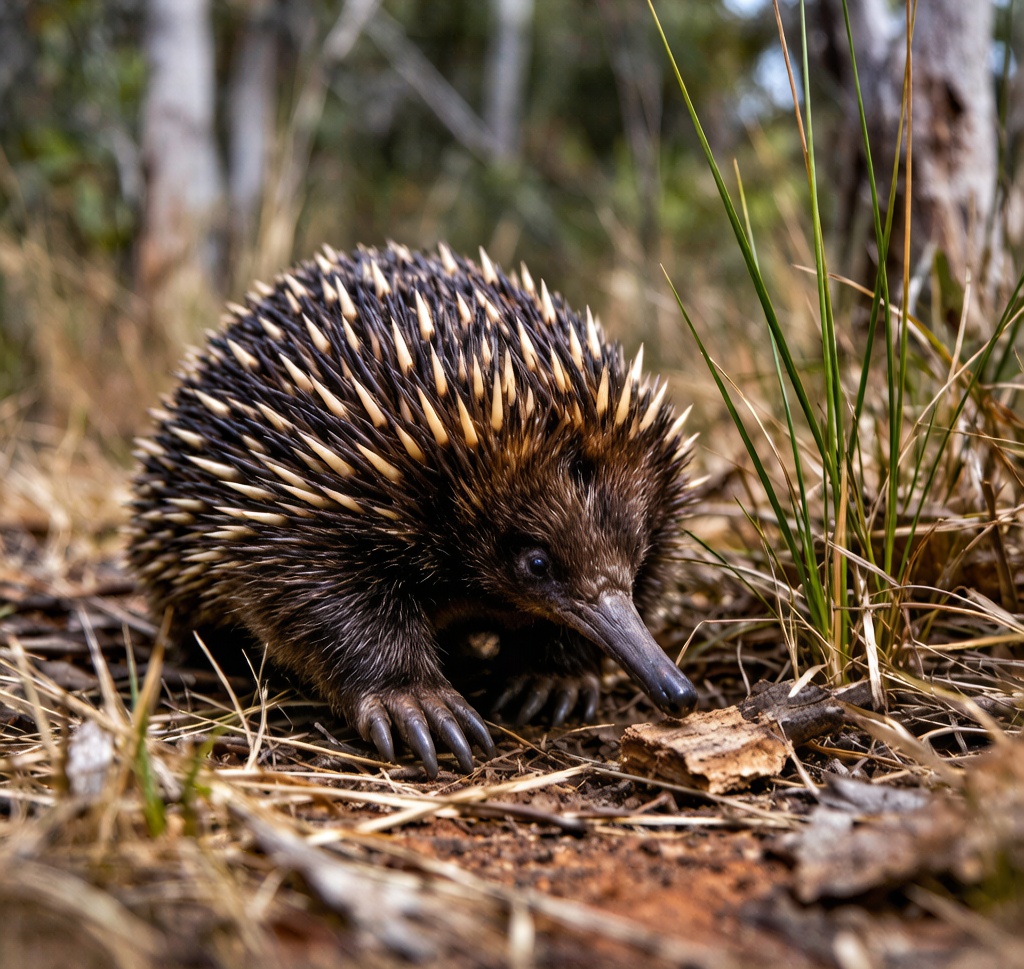
The short-beaked echidna (Tachyglossus aculeatus) is one of the most extraordinary mammals on Earth — a monotreme, or egg-laying mammal, that combines the characteristics of reptiles, birds, and mammals into a uniquely adapted creature. Along with the platypus, the echidna represents one of only five surviving monotreme species, an ancient mammalian lineage that split from other mammals approximately 166 million years ago. Found throughout Australia and New Guinea, the echidna has evolved a remarkable set of adaptations centered around its primary food source: ants and termites. Its body is covered in a dense coat of two types of hair — soft underfur and coarse spines — and it possesses a long, slender, sticky tongue capable of extending up to 18 centimeters to capture insects in narrow tunnels and crevices.
## Physical Characteristics
The echidna’s most striking feature is its protective covering of spines — modified hairs made of keratin — which cover its dorsal surface and can be raised when threatened. Between these spines lies a layer of coarse dark brown to black fur that ranges in color from nearly black to brown or reddish-brown, depending on the individual and region. The spines are typically yellowish with black tips, measuring up to 6 centimeters in length. The echidna’s head is elongated into a tubular snout or beak, accounting for approximately 75 millimeters of its total head-body length. The mouth is a small, narrow slit at the tip of the snout, housing a remarkably long, slender, worm-like tongue coated in sticky saliva. The tongue can be extended and retracted rapidly, allowing the echidna to capture insects at remarkable speed. Echidnas have no teeth; instead, they grind their prey against a hard pad at the base of the tongue and the roof of the mouth.
## Habitat and Distribution
The short-beaked echidna occupies an extraordinary diversity of habitats across its range, which spans most of Australia and the lowland and highland regions of New Guinea. It is found in temperate eucalypt forests, temperate rainforest, arid shrublands, and grasslands — wherever ants and termites are available — as well as in urban gardens and parks. It is absent only from densely populated urban centers and the coldest alpine and desert regions. The echidna shelters in hollow logs, under dense vegetation, or in burrows excavated by other animals, and is capable of curling into a tight ball when threatened, presenting only its spines to potential predators.
## Behavior and Diet
The echidna is primarily a solitary forager, active during cooler parts of the day — dawn, dusk, and overcast weather — while resting during the heat of midday in Australia’s warmer regions. It locates its prey — ants, termites, and occasionally other soil invertebrates — primarily by smell, using its keen sense of smell to detect insects beneath the soil surface, under logs, and within termite mounds. Upon locating a colony, the echidna uses its powerful front claws to tear open nests and mounds, then extends its long, sticky tongue to collect insects. A single echidna may consume up to 40,000 ants and other insects per day. During cold weather or food scarcity, echidnas enter a state of torpor, reducing their metabolic rate and body temperature to conserve energy for extended periods.
## Reproduction
The echidna’s reproductive biology is among the most unusual in the mammalian world. During the breeding season, females develop a temporary abdominal pouch — induced by the hormone progesterone — into which they lay a single leathery egg approximately 15 days after mating. The egg hatches after approximately 10 days of incubation, producing a jellybean-sized, undeveloped infant known as a puggle. The mother nurses the puggle in her pouch, producing milk through primitive mammary glands. After several weeks, the puggle develops spines and is left in a burrow while the mother forages, returning periodically to nurse. This period lasts approximately seven months, after which the juvenile is fully independent.
## Conservation
The short-beaked echidna is listed as Least Concern. Its adaptability to diverse habitats and diet breadth provide resilience against most threats. However, localized population declines occur due to vehicle strikes, predation by introduced dogs and foxes, habitat destruction, and disease.