 By st20113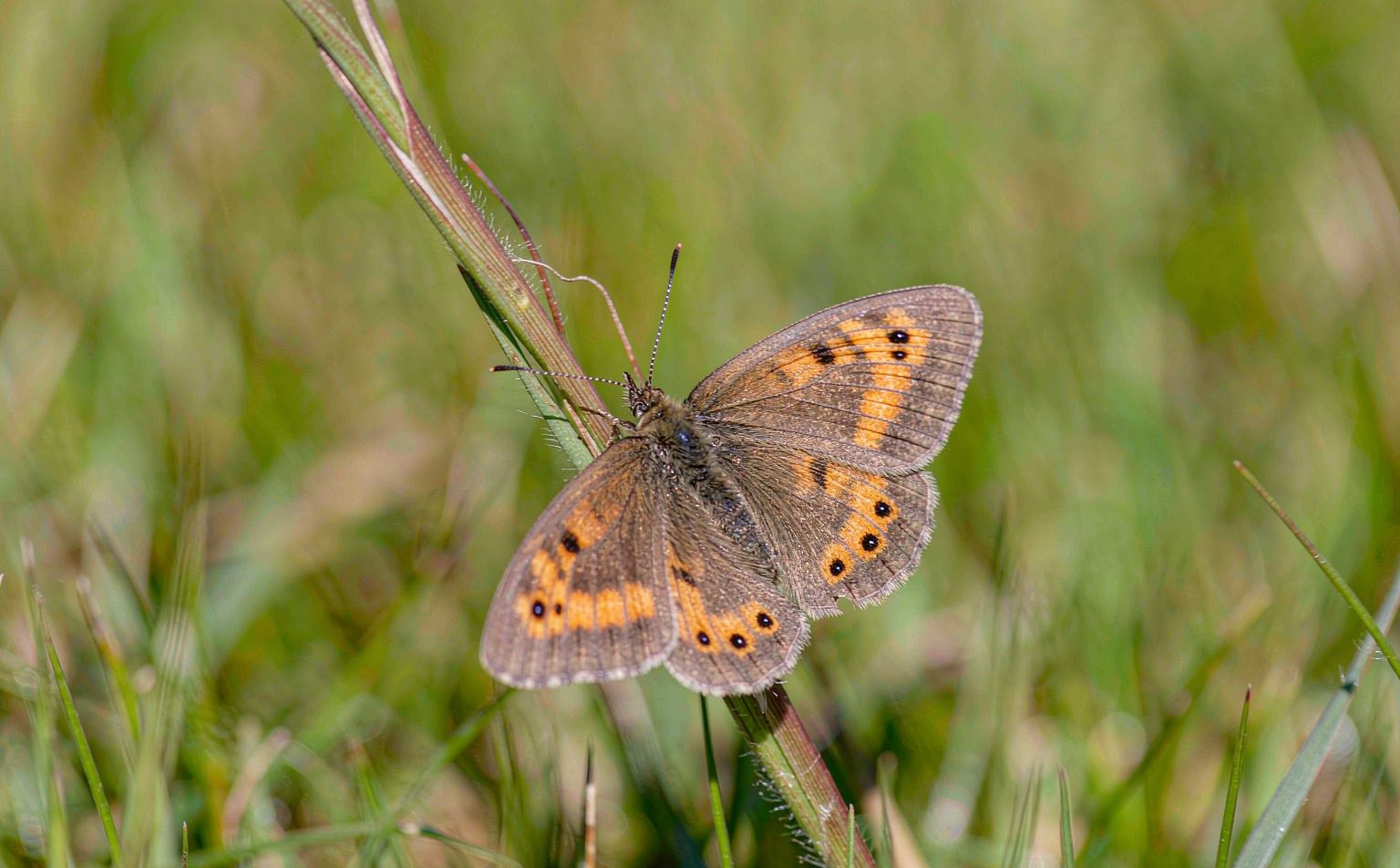
Maniola jurtina | Meadow Brown
Introduction
The Meadow Brown (Maniola jurtina) is the commonest brown butterfly of European grasslands, a quietly coloured insect whose understated wings belie its ecological importance as a widespread pollinator and a favourite subject of population studies. Males are plain brown with a small orange-ringed eye spot, while females show a broader orange band. It thrives in meadow, hedgerow and roadside grass where taller grasses grow.
Taxonomy
The Meadow Brown is a member of the family Nymphalidae and the subfamily Satyrinae, the browns, related to the [Ringlet](https://www.gloencyc.com/peacock-butterfly-aglais-io/) and the [Small Heath](https://www.gloencyc.com/peacock-butterfly-aglais-io/). It belongs to the genus Maniola and is found across temperate Europe and into temperate Asia. Its close relative the gatekeeper shares similar colouring but prefers drier, sunnier spots.
Physical Characteristics
Adults have a wingspan of 44 to 58 millimetres, females markedly larger than males. The upper side is dull brown; males carry one or two small black eye spots ringed with orange on the forewing, females a broader orange patch bearing the spots. The underside is grey-brown with a row of tiny eyespots, the hindwing often with a faint orange flush near the margin.
The body is slender and lightly furred, the antennae tipped with slender clubs. The caterpillar is a pale green larva with a darker green line and a slightly forked tail, well hidden among grass blades. The chrysalis is green at first, later turning brown, and lies loose in a silk shelter at the base of a grass tuft.
Habitat
The Meadow Brown occupies a broad sweep of grassy habitats: meadows, pastures, hedgerows, roadside verges, woodland rides, coastal grasslands and unmanaged gardens. It prefers taller, ranker grass for the caterpillars than many close-cropped butterflies, so it does well where grazing is light. It is absent mainly from intensively farmed arable land without flower margins.
Diet
Adults take nectar from a wide range of low and open flowers, including thistles, knapweeds, bramble, clover, ragwort and hedgerow blooms, and they bask with wings half open between feeds. The caterpillars feed on grasses such as cock’s-foot, fescues, meadow grasses and tufted hair-grass, eating mainly at night and resting low in the sward by day.
Reproduction
Females lay eggs loosely among grass, often simply dropping them in flight over suitable sward rather than placing each one. The tiny caterpillars hatch and begin feeding, growing slowly through the season. There is usually a single generation a year in cooler regions, with the caterpillar overwintering and pupating the following late spring; in warmer southern areas a partial second brood can occur.
Conservation
The Meadow Brown remains abundant across most of its range and is not of conservation concern, serving as a useful baseline species in grassland monitoring. It is, however, sensitive to the loss of unimproved meadow and the over-management of roadside verges. Leaving tussocky grass and a sequence of flowering plants through summer supports both this butterfly and the many species sharing its habitat.
Fun Facts
- Females are noticeably larger and more orange than the drab males, an unusual reversal of showiness.
- The butterfly’s eye spots are thought to deflect bird pecks away from the body.
- It often flies up from grass in a flurry when a walker passes, then settles a few metres on.
- Population spot-checks of this species have informed decades of British butterfly science.
- A single female may lay hundreds of eggs scattered across a wide area of grassland.
[…] shares sunny banks and grass with the Meadow Brown and is often seen near the Red Admiral where flowers are abundant, while the Small Tortoiseshell […]
[…] Grasshopper and the congeneric species of dry grassland, and it is a close ecological cousin of the Maniola jurtina and other meadow fauna that share its tall, flower-rich […]
[…] and many other small grasshoppers of European grass, and it is an ecological counterpart of the Maniola jurtina and other sun-loving invertebrates of open ground, though it favours drier, barer turf than […]
[…] the broader butterfly fauna it is an ecological neighbour of dry-ground species such as the Maniola jurtina of nearby grassland, though the Dingy Skipper itself is a creature of hotter, barer ground and a […]
[…] relatives in the field are the other “grass skippers”, though the broader community of Maniola jurtina and other sun-loving grassland butterflies share the same flower-rich habitat and are frequently […]