 By st20113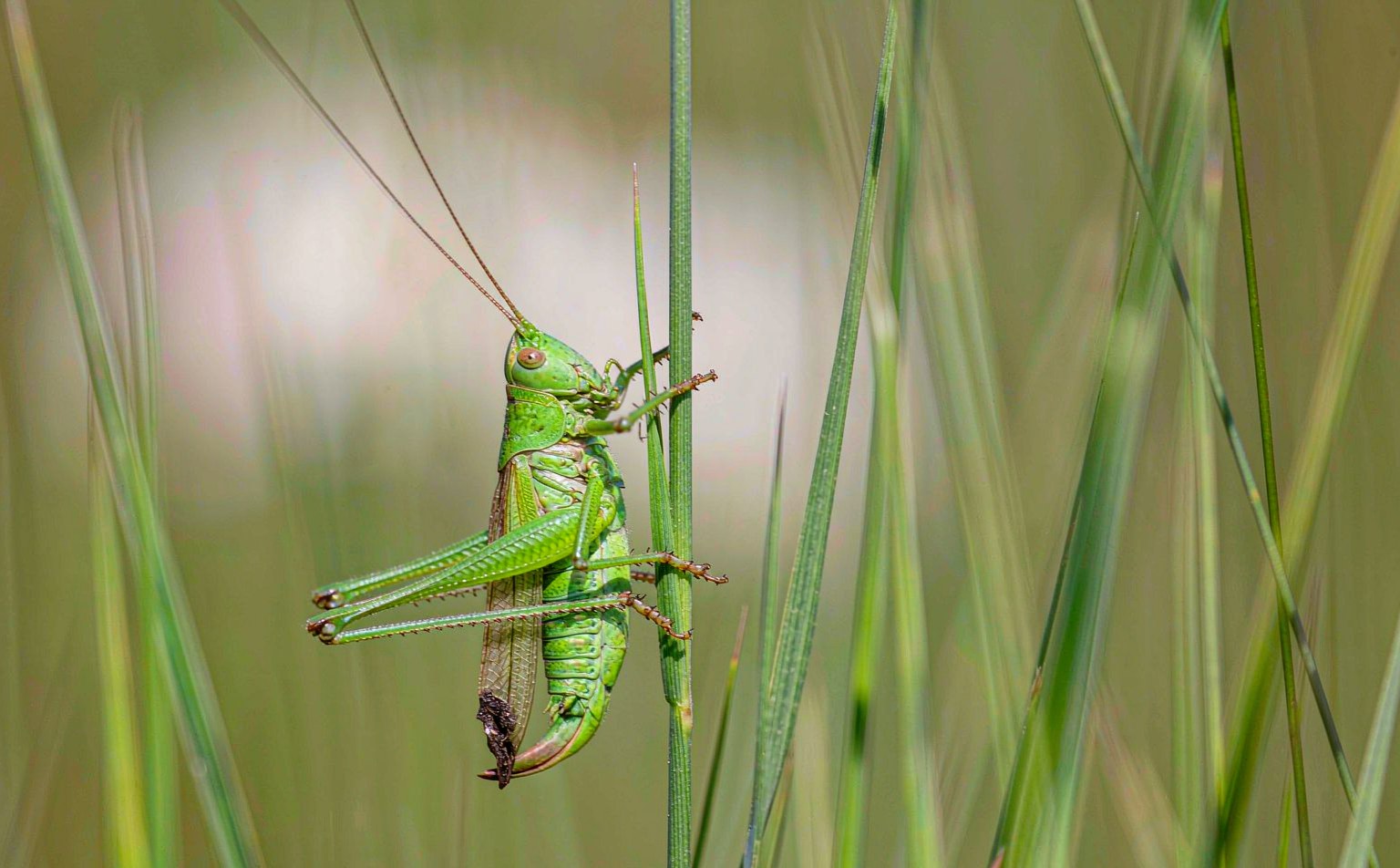
Chorthippus parallelus | Meadow Grasshopper
Introduction
The Meadow Grasshopper (Chorthippus parallelus) is the commonest grasshopper of damp, tall grassland across Britain and much of Europe, a small, softly singing insect whose presence is far more often heard than seen. Reaching about 16 to 22 millimetres in length, with the male the smaller of the two, it inhabits lush meadows, riverbanks, marshy edges and the moist verges where coarser grasses grow thick.
Unlike the louder, more conspicuous grasshoppers of dry ground, the Meadow Grasshopper produces a quiet, continuous song and is a creature of longer herbage, where it clambers through the stems rather than basking in the open. Its highly variable colour — green, brown or even purplish — lets it melt into the sward, and it is a familiar voice of high summer in any untidy, damp corner of the countryside.
Taxonomy
The Meadow Grasshopper belongs to the family Acrididae, the short-horned grasshoppers, and within it to the subfamily Gomphocerinae, the slant-faced grasshoppers. It was described by the German entomologist Carl Zetterstedt in 1821. Its genus Chorthippus is a large northern group of small grasshoppers that also includes the Field Grasshopper and the congeneric species of dry grassland, and it is a close ecological cousin of the Maniola jurtina and other meadow fauna that share its tall, flower-rich swards.
Across its range the species shows marked geographic variation in wing length: northern and montane populations are frequently short-winged or nearly wingless, while southern insects are longer-winged and more mobile. This cline reflects the balance between the need to disperse and the energy cost of full wings in cooler climates.
Physical Characteristics
The body is slender and lightly built, with a smoothly rounded head and short antennae that are only about as long as the body. The colour is extraordinarily variable, from fresh green through straw brown to a striking purple-brown, often with a pale stripe along the upper side. The hind legs, the engine of the grasshopper’s leap, are robust and banded.
A key identification feature is the wing: in most of its range the wings are short, reaching only partway down the abdomen or not at all, so the insect cannot make long flights and escapes mainly by jumping. The song, or stridulation, is produced not by rubbing the legs but by vibrating the hind wings, giving a soft, uninterrupted purring rather than the sharp rasping of related species. The underneath of the body is pale and the underside of the hind femur is often yellowish or red.
Habitat
Meadow Grasshoppers are animals of moist, tall vegetation. They favour unimproved hay meadows, damp roadside verges, the edges of reed beds and ditches, wet heath and any rank grassland that stays green through summer. They avoid dry, open, sun-baked turf, which is the domain of their relative the Field Grasshopper.
Because they need long grass for cover and for the microclimate it provides, they are sensitive to early cutting and to the drainage of damp grassland. Within a meadow they are often commonest along the damper margins and in tussocks where the sward is thickest and the humidity highest.
Diet
Like most grasshoppers it is primarily a herbivore, feeding on the leaves and soft stems of a wide range of grasses and, to a lesser extent, low broad-leaved plants. In the dense sward it eats what is closest, nibbling the blades of cock’s-foot, meadow-grass, fescue and Yorkshire-fog and occasionally taking flower petals or seedling leaves.
It does little damage in natural grassland, but in very high densities it can clip the tops of grass in small lawns and meadows. Feeding is largely by day, and the insect moves only short distances through the herbage, relying on its colour and stillness to avoid predators such as birds and spiders.
Reproduction
Females lay their eggs in small pods pushed into the soil at the base of the sward, usually in late summer. The eggs overwinter in the ground and hatch the following spring into miniature, wingless nymphs that mould several times as they grow. Each moult reveals a slightly larger, more adult-like insect until the final stage bears the short wings and full colours of the adult.
Adults are present from midsummer into early autumn, and the song of the male, a soft continuous vibration, serves to attract females within the dense grass. There is a single generation each year, tightly linked to the growth of the meadow through the warm months.
Conservation
The Meadow Grasshopper remains common and widespread across its European range and is currently of least concern, but it is a useful indicator of intact damp grassland. Where meadows are drained, fertilised or cut early and repeatedly, its numbers fall quickly because the tall, moist sward it depends on disappears.
Maintenance of uncut, unfertilised damp grassland, with a late summer cut that leaves tussocks standing, supports this grasshopper alongside a wide array of meadow insects and the Maniola jurtina and other grassland butterflies that share its world. It is one of the species that benefits directly from reduced-intensity meadow management.
Fun Facts
- Its song is a soft, continuous purr made by vibrating the wings, not the loud rasp of a dry-ground grasshopper.
- Northern populations are often wingless or nearly so and escape predators by jumping rather than flying.
- Individuals can be green, brown or purple, a colour spread that helps them vanish in mixed grassland.
- It sings from inside the grass rather than from an open basking spot, so it is heard far more than seen.
- The eggs survive the winter in the soil and hatch only when the meadow warms the following spring.