 By st20113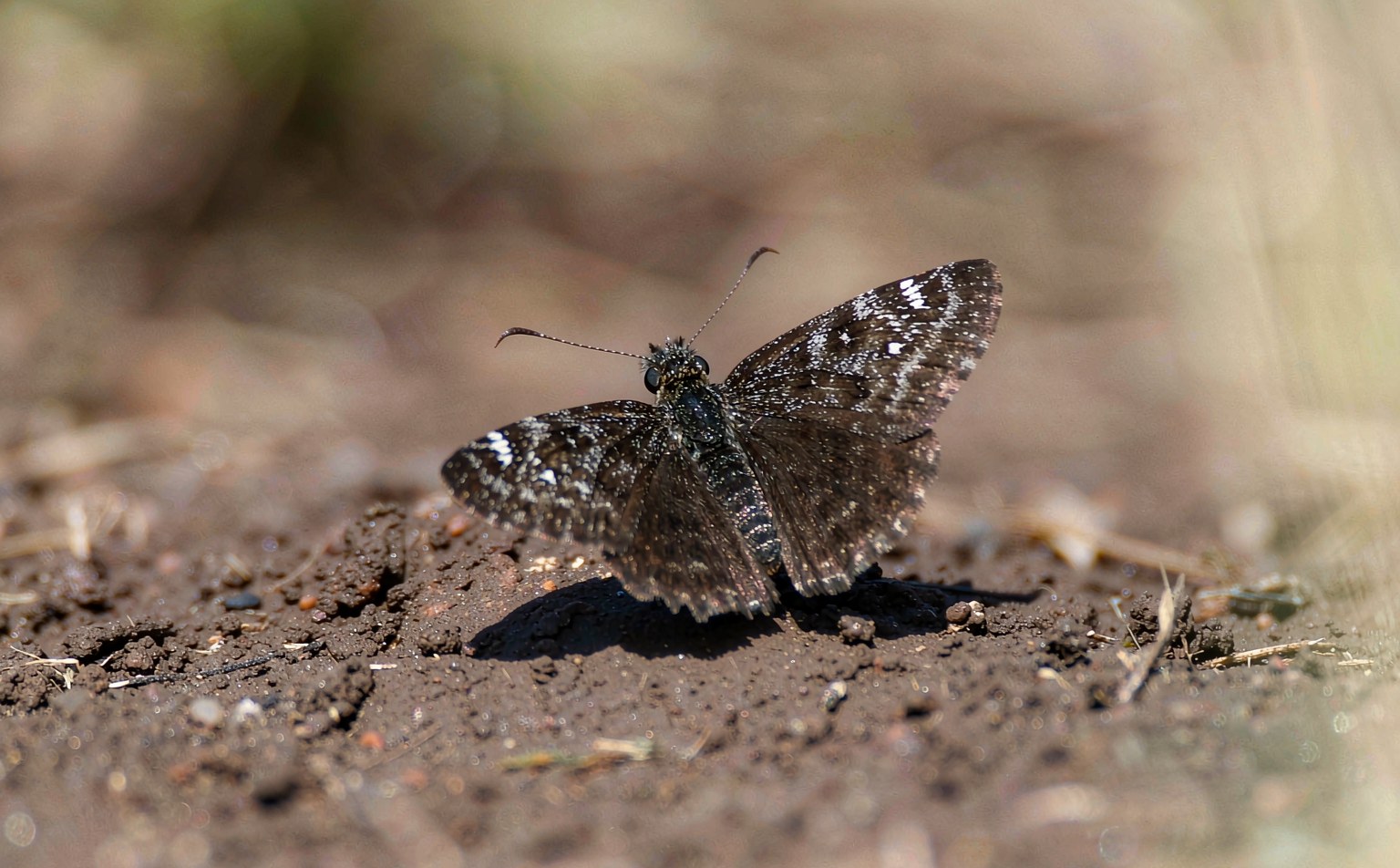
Erynnis tages | Dingy Skipper
Introduction
The Dingy Skipper (Erynnis tages) is one of the most easily missed butterflies in Europe, a small, sooty-brown skipper that rests with wings closed on bare ground and looks for all the world like a fragment of bird dung. Measuring only about 25 to 30 millimetres across, it favours dry, flower-sparse grassland, heath and coastal turf rather than the lush meadows of its relatives, and it flies from May to early June with a smaller second generation in the south.
Its drab colouration is not a weakness but a strategy: when settled on bare soil or a sun-warmed stone it is almost invisible. The Dingy Skipper’s inconspicuousness has led to frequent under-recording, and it is now treated as a species of conservation interest across much of its range even though it can be locally common where conditions suit.
Taxonomy
The Dingy Skipper was first described by the Swedish naturalist Carl Linnaeus in his 1758 edition of Systema Naturae, where he named it Papilio tages. It is now placed in the family Hesperiidae, but unusually for a European skipper it sits in the subfamily Pyrginae, the “spread-winged” skippers, alongside the grizzled and checkered skippers, rather than the grass-skipper subfamily Hesperiinae. Its genus Erynnis groups a number of predominantly grey-brown, ground-resting skippers.
Within the broader butterfly fauna it is an ecological neighbour of dry-ground species such as the Maniola jurtina of nearby grassland, though the Dingy Skipper itself is a creature of hotter, barer ground and a much shorter turf.
Physical Characteristics
The upper wings are dark brown, finely dusted with greyish scales and crossed by a faint pattern of lighter spots and a pale crescent on the forewing, giving a sooty, mottled look that breaks up the outline against soil. The underside is similar but greyer, with a scattering of small pale dots that aid camouflage on bare earth.
There is slight sexual difference: males have a narrow, often obscure dark scent brand on the forewing, while females are a little larger and paler. Both sexes rest with the wings tightly closed over the back, unlike many skippers that hold them half open, and the antennae are short with a blunt, hooked club. In flight the butterfly is fast and low, but it settles abruptly and vanishes against the ground.
Habitat
Dingy Skippers need hot, dry, sparsely vegetated ground: chalk and limestone grassland, stabilised coastal dunes, heathland rides, disused quarries and sunny banks. The defining requirement is a short, warm sward with patches of bare soil in which the caterpillars can develop and the adults can bask.
They are strongly associated with bird’s-foot trefoil (Lotus corniculatus), which grows in just such places, and they avoid lush, tall or shady grassland. In Britain they are concentrated on southern and eastern chalk, with scattered coastal and heathland sites farther north, and they are notably absent from improved agricultural land.
Diet
The caterpillar feeds almost entirely on bird’s-foot trefoil (Lotus corniculatus) and, less often, related legumes such as horseshoe vetch and clover. The egg is laid on the foodplant and the young larva forms a silken shelter on the leaf, feeding within it by day and emerging to eat at night.
Adults take nectar from a limited range of low, open flowers, again favouring bird’s-foot trefoil but also using bugle, hawkbits, thyme and other small blooms of dry grassland. Because their habitat is flower-poor, Dingy Skippers often bask and feed close to the ground, making them easy to overlook.
Reproduction
Depending on latitude the Dingy Skipper is single-brooded in the north and partly double-brooded in warmer southern areas, with a first flight in May and a possible second in late summer. Females lay single eggs on the leaves of bird’s-foot trefoil, and the larva feeds up through summer, hibernating as a half-grown caterpillar in a silken tent among the foliage.
Pupation takes place in spring within a flimsy cocoon on the foodplant, and the adult emerges a few weeks later. The timing of the flight season is closely tied to warm, dry spring weather, and cool wet years can sharply reduce the number of adults seen.
Conservation
Although still locally frequent, the Dingy Skipper has declined sharply across north-west Europe as chalk and limestone grassland has been ploughed, fertilised or succeeded to scrub. In Britain it is listed as a priority species in several regions, and its dependence on short, flower-rich turf makes it a good indicator of healthy calcareous grassland.
Conservation centres on sympathetic grazing and scrub control that maintains a mosaic of short turf and bare ground without eliminating the bird’s-foot trefoil the larvae need. Light autumn grazing or careful cutting, followed by rest in spring, replicates the disturbed, sun-baked conditions this skipper requires, and such management benefits a wide guild of rare dry-ground insects.
Fun Facts
- At rest on bare soil the Dingy Skipper looks so much like a dropping that it is frequently walked past unnoticed.
- It was named by Linnaeus in 1758, one of the original butterflies in Systema Naturae.
- Unlike most skippers it belongs to the spread-winged subfamily and closes its wings flat when settled.
- Its whole life cycle hinges on bird’s-foot trefoil, a plant of hot, dry, flower-poor ground.
- Males perch on bare earth and dart at any small insect that passes, mistaking some for rivals or mates.