 By st20113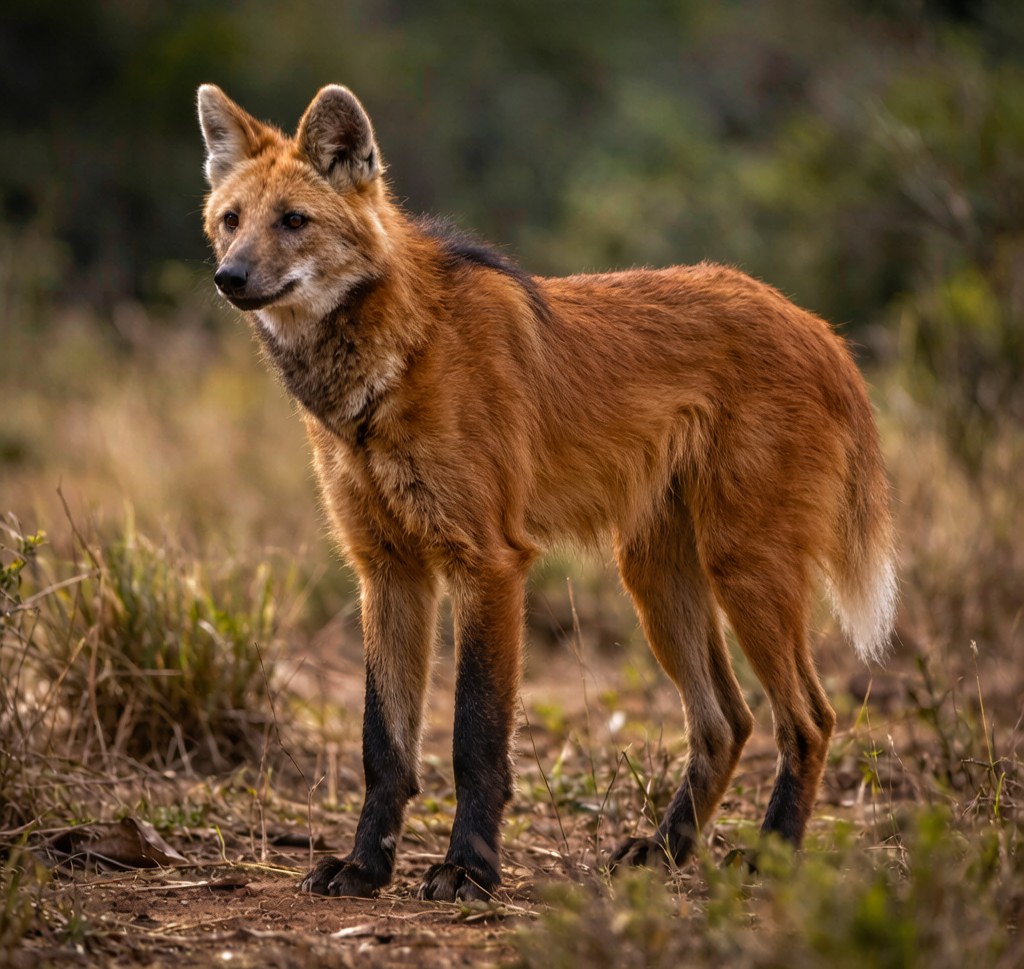
Introduction
The maned wolf (Chrysocyon brachyurus) is the largest canid of South America and the only member of the genus Chrysocyon. Despite its name and fox-like appearance, it is neither a wolf (Canis) nor a fox (Vulpes) but a distinct evolutionary lineage that diverged from other South American canids approximately 6–7 million years ago. Its name derives from the distinctive erectile mane along the neck and back, which is erected during social encounters or when the animal feels threatened. Found only in the cerrado (tropical savanna ecosystem) of central South America—from Brazil and Bolivia through Paraguay and northern Argentina—the maned wolf is a solitary, omnivorous predator that plays a keystone role in seed dispersal and small-mammal regulation across one of the world’s most threatened grassland ecosystems.
Physical Characteristics
The maned wolf is built like no other canid: it stands 80–90 centimetres (31–35 inches) at the shoulder—taller than any true wolf—with disproportionately long, slender legs that are an adaptation for scanning over the tall grass of its savanna habitat, much like the serval cat of Africa. Body length is approximately 100–120 centimetres (excluding the tail), and weight is typically 20–25 kilograms (44–55 pounds). Its coat is a striking reddish-orange to golden-tawny colour, with black legs, muzzle, and ear tips, and a white bib and tail tip. The mane, running from the back of the neck to the base of the tail, is composed of long, coarse black hairs that can be erected to make the animal appear larger.
The skull is unusually narrow and elongated, adapted for a diet that includes small vertebrates and large quantities of fruit. Unlike true wolves, the maned wolf has a weak jaw structure unsuited to killing large prey; instead, it employs a characteristic ‘foot-stamping’ hunting technique to flush small mammals and birds from concealment. It also possesses distinctive enlarged, fox-like ears capable of rotating independently to triangulate sounds of prey in tall grass. The animal is digitigrade (walking on its toes) like other canids, but the long legs give it a characteristic stilted gait when walking.
Habitat and Distribution
The maned wolf’s exclusive habitat is the cerrado, a vast tropical savanna ecosystem covering approximately 2 million square kilometres of central Brazil, with smaller areas extending into Bolivia, Paraguay, and northern Argentina. The cerrado is characterised by a mosaic of grasslands, shrublands, and gallery forests along watercourses, with distinct wet (October–March) and dry (April–September) seasons. Maned wolves require large territories—individual home ranges of 30–80 square kilometres—and are highly dependent on the structural heterogeneity of the cerrado, using both the open grasslands for hunting and the denser vegetation for cover and denning.
Gallery forests and riparian zones are particularly important for denning and resting during the heat of the day, while open grasslands are the primary hunting grounds. The species is largely absent from true forest and agricultural monocultures, and its populations are highly sensitive to habitat fragmentation, with isolated populations in smaller, degraded cerrado fragments showing lower reproductive success and higher rates of vehicle collision mortality.
Diet and Foraging
The maned wolf is an opportunistic omnivore whose diet is split roughly evenly between animal prey and plant matter. Small to medium-sized vertebrates make up the majority of animal intake: rodents (particularly thecerrado’s abundant agoutis and grass mice), small marsupials, birds and bird eggs, reptiles, amphibians, and insects are all taken. Unlike the cooperative hunting wolves, the maned wolf hunts alone and primarily by stealth and ambush, using its keen hearing (aided by the large, independently rotating ears) to locate prey in dense grass and then pouncing with its front feet to flush and capture prey.
Perhaps the most remarkable dietary feature of the maned wolf is its consumption of large quantities of fruit. The lobo-guará banana (Solanum lycocarpum)—a shrub tomato relatives—and other cerrado fruits may constitute up to 50% of the diet by volume in some seasons and regions. The animal is the primary disperser of the lobo-guará banana’s seeds, which are too large for any other local animal to swallow; the wolf passes the seeds intact after gut passage, making it an irreplaceable mutualistic partner for the plant. This seed dispersal role gives the maned wolf a keystone ecological function in the cerrado ecosystem.
Social Behaviour and Reproduction
The maned wolf is primarily solitary, with male and female coming together only briefly for mating and, in some cases, for cooperative territorial defence against same-sex intruders. Each individual maintains a large, non-overlapping home range that may be shared at its edges with neighbouring conspecifics. Home ranges are marked with urine scent marks at regular intervals, a characteristic canid behaviour that conveys information about identity, reproductive status, and territory ownership to other wolves.
Mating pairs form during the breeding season (July–October in the southern hemisphere) and remain loosely associated for several months. After a gestation of approximately 65 days, the female gives birth to a litter of 1–5 (typically 2–3) pups in a den situated in dense vegetation, often within a termite mound or abandoned anteater burrow. Both parents participate in provisioning the pups with food and in defending the den site. Pups develop rapidly, beginning to accompany both parents on foraging trips at approximately 3–4 months of age and reaching independence by 8–12 months. Sexual maturity is reached at approximately 1–2 years.
Conservation Status
The maned wolf is classified as Near Threatened by the IUCN, with populations declining throughout its range. The primary threat is habitat destruction: the cerrado is one of the most heavily converted and threatened ecosystems on Earth, with approximately 50% of its original extent already converted to agriculture (particularly soybean cultivation, cattle ranching, and sugarcane), urban development, and infrastructure. Remaining habitat patches are increasingly fragmented, isolating maned wolf populations and reducing genetic diversity.
Secondary threats include vehicle collisions on roads that bisect the cerrado, diseases transmitted from domestic dogs (including distemper and parvovirus), persecution driven by unfounded beliefs that maned wolves attack livestock (which they do not—they are too small and weak-killed to take livestock), and, in some areas, illegal hunting. Conservation measures include protected area establishment and management, landscape-level corridor planning to connect fragmented habitat patches, and community-based programmes to reduce human-wildlife conflict and promote coexistence with the maned wolf.