 By st20113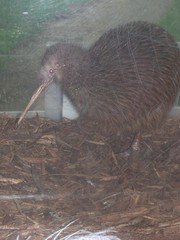
Introduction
The kiwi is one of the world’s most distinctive birds and a powerful national symbol of New Zealand. Despite being classified as a bird, the kiwi is completely flightless and nocturnal, covered in hair-like feathers that resemble fur more than typical plumage. Five species are recognized, with Apteryx mantelli, the North Island brown kiwi, being the most widespread. The kiwi belongs to an ancient order, Apterygiformes, that has no close living relatives, making it one of the most evolutionarily distinct creatures on Earth.
Taxonomy
The kiwi is classified in the order Apterygiformes and the family Apterygidae. The genus name Apteryx comes from the Greek for “without wing,” referring to the bird’s vestigial wings, which are completely hidden beneath the plumage and serve no function in flight. The five kiwi species are the North Island brown kiwi (A. mantelli), tokoeka (A. australis), great spotted kiwi (A. haastii), little spotted kiwi (A. owensii), and Okarito kiwi (A. rowi). Molecular studies confirm that kiwis are most closely related to the extinct moa and to ratite birds such as the common ostrich and emu, all belonging to the clade Palaeognathae.
Physical Characteristics
The North Island brown kiwi is the largest brown kiwi species, with males weighing around 2.2 kilograms and females up to 2.8 kilograms. Standing about 40 to 45 centimeters tall, kiwis have a compact, round body covered in soft, brownish-gray plumage resembling coarse hair. Heavy, muscular legs comprise about a third of the bird’s total body weight, an adaptation for its ground-dwelling, nocturnal lifestyle. The kiwi’s long, slender bill is equipped with sensory receptors that detect buried prey, and the bird is unique among birds in having nostrils at the tip of its bill.
Habitat
North Island brown kiwis inhabit forests, scrubland, and farmland margins across New Zealand’s North Island, from coastal dunes to subalpine zones up to 1,100 meters elevation. They prefer areas with loose, well-drained soils for probing and adequate ground cover. The species has adapted to modified landscapes better than some other kiwi species, persisting in regenerating scrubland where predator control is maintained. Like the flightless kakapo, another New Zealand bird, kiwis face severe challenges from introduced mammals that prey on eggs and chicks. Conservation sanctuaries protect populations alongside other endemic ratites, including the southern cassowary.
Diet
Kiwis are omnivorous ground foragers, with earthworms, insect larvae, beetles, and snails forming the bulk of their diet. They also eat fallen berries and seeds. The kiwi’s long, sensitive bill detects chemical signatures of buried prey, and a single bird may consume hundreds of items in a night. Foraging occurs almost entirely at night, with up to 12 hours spent searching across a home range of 20 to 100 hectares. During the day, the kiwi remains in a burrow or hollow log, emerging at dusk. The bird swallows small grit particles to aid digestion in its gizzard-like chamber, similar to the strategy used by the penguin.
Reproduction
Kiwis are monogamous and form long-term pair bonds. The female lays one of the largest eggs relative to body size of any bird, weighing up to 370 grams. Incubation lasts 63 to 92 days, with both parents sharing this duty, though males typically do most of the work. Chicks are precocial and begin foraging within weeks of hatching, though they remain associated with their parents for several months. The slow reproductive rate makes populations highly vulnerable to increased adult mortality, as females typically produce only one egg per clutch and one to two clutches per year.
Conservation
The North Island brown kiwi is classified as endangered, with fewer than 30,000 individuals remaining. Predation by introduced stoats, ferrets, and domestic cats is the primary driver of decline, compounded by the species’ slow reproductive rate. Conservation programs combine predator control through trapping networks, captive breeding and head-starting programs, and the creation of predator-free sanctuaries. Community-based conservation groups monitor local populations and protect nesting sites. In predator-free sanctuaries, kiwi populations have recovered dramatically, demonstrating that sustained management can reverse decades of decline.
Fun Facts
The kiwi’s closest relatives are the emu, cassowary, and ostrich, yet the kiwi is the smallest ratite by far. Kiwis can detect prey buried up to 15 centimeters underground using their sense of smell. Males produce a distinctive whistling call audible up to a kilometer away, and mated pairs engage in coordinated duets to maintain pair bonds and territorial boundaries. The kiwi has been legally protected in New Zealand since 1896, making it one of the earliest species to receive formal legal protection anywhere in the world. Modern DNA analysis of feathers collected non-invasively from nesting sites has revolutionized long-term population monitoring.