 By st20113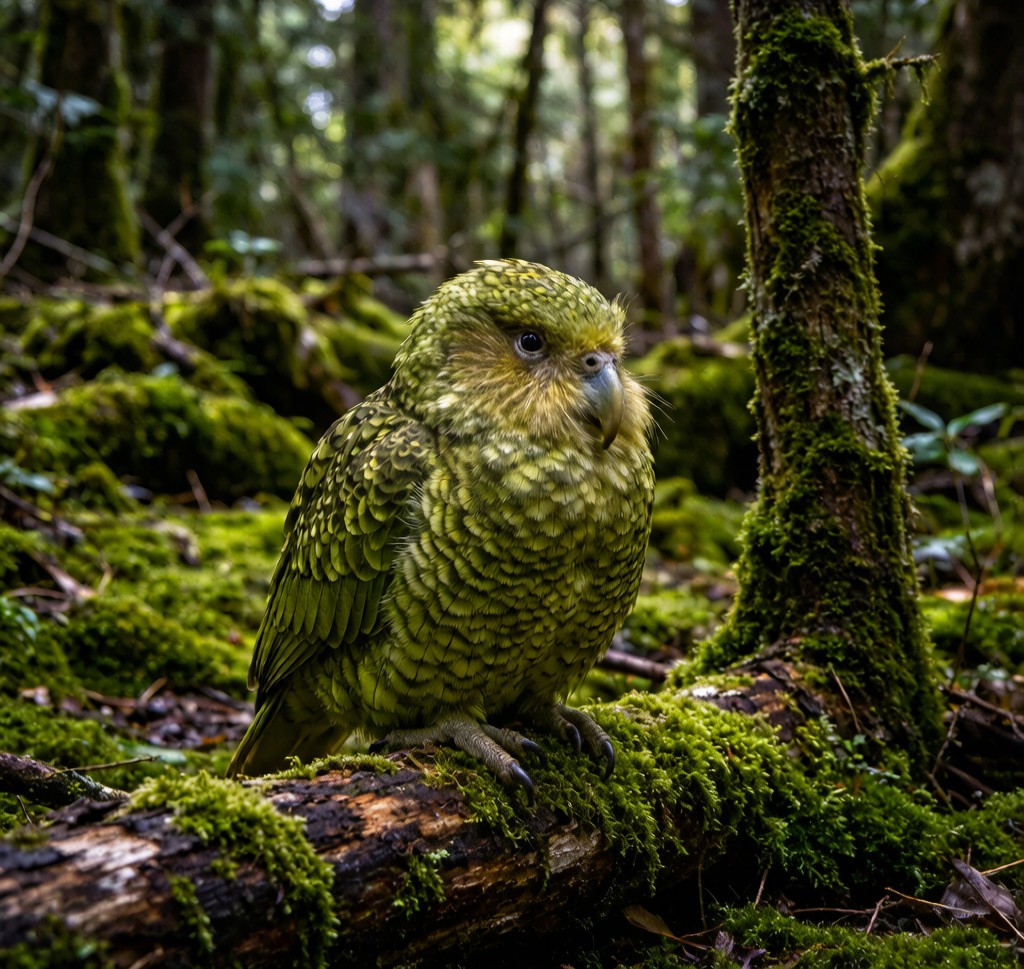
A Kakapo (Strigops habroptila) perched on a mossy log in a New Zealand podocarp forest, displaying its owl-like face and distinctive green plumage
Overview
The Kakapo (Strigops habroptila) is one of the most extraordinary birds on Earth – a flightless, nocturnal, long-lived, and critically endangered parrot that is unlike any other bird in the world. Endemic to New Zealand, the Kakapo is the heaviest parrot that has ever lived, with adult males weighing approximately 3 to 4 kilograms. It is also the only flightless parrot in the world, the only parrot to be nocturnal, and one of the longest-lived birds, with individuals surviving to 90 years or more in some cases. Its common name comes from the Maori words “kaka” (parrot) and “po” (night), and its scientific name translates to “owl-faced night parrot” – a reference to its owl-like facial disc and nocturnal habits.
The Kakapo’s combination of traits – flightlessness, nocturnal behavior, large body size, extreme longevity, and lek breeding system – is without parallel among the world’s approximately 350 parrot species. It is the only parrot to have evolved a lek breeding system, in which males gather in communal display arenas and compete for the attention of females through aerial displays and vocalizations. The species was once widespread throughout New Zealand but is now among the most endangered birds in the world, with only 248 individuals surviving as of the most recent census.
Habitat and Historical Range
The Kakapo was once one of the most widespread birds in New Zealand, occurring throughout both the North and South Islands in a remarkable variety of habitats including coastal dunes, coastal forests, montane forests, and subalpine scrubland. This broad habitat tolerance reflected the Kakapo’s large body size and generalist feeding habits, which allowed it to exploit a wide range of food sources from different plant communities. The arrival of humans and the introduced predators that accompanied them – particularly rats, possums, and cats – devastated Kakapo populations, which had evolved for millions of years in the absence of terrestrial mammals and had no defenses against them.
Today, the Kakapo survives only on three predator-free islands off the coast of New Zealand – Codfish Island (Whenua Hou), Little Barrier Island (Hauturu-o-Toi), and Anchor Island in Fiordland – where intensive management has created conditions for population recovery. These islands were chosen for Kakapo translocation because they are completely free of introduced mammalian predators and provide suitable forest habitat. The management program on each island includes daily monitoring, supplementary feeding, and artificial incubation of eggs, making the Kakapo one of the most intensively managed bird species in the world.
Breeding and Life History
The Kakapo’s breeding system is one of its most remarkable features. Males gather in traditional lek sites – bare patches of ground or elevated ridges – where they inflate thoracic air sacs to produce a deep, resonant, non-directional booming call that can carry up to 5 kilometers through the forest at night. The males display sequentially at multiple bowls within their territory, and females – attracted by the booms – visit the lek to assess and select mates. This system results in a highly skewed mating success, with a small number of dominant males fathering most offspring.
Kakapo breeding is extraordinarily infrequent. The species is a mast nester – it breeds only in years when native beech and podocarp trees produce large seed crops, which may occur at intervals of 2 to 4 years. In such years, females lay 1 to 3 eggs which are incubated for approximately 30 days. Chicks are slow to develop and remain dependent on the mother for several months, making the overall reproductive cycle extremely slow. A female may produce only 1 to 4 chicks in her entire lifetime, contributing to the species’ extreme vulnerability to any additional mortality. The combined effect of this slow reproductive rate and intense management requirements means that every individual Kakapo is critically important to the species’ survival.
Conservation
The Kakapo is listed as Critically Endangered on the IUCN Red List, with only 248 individuals known to exist as of 2024. The species has been the subject of one of the most intensive and sophisticated conservation programs ever undertaken for any animal. The Kakapo Recovery Programme, established in 1995, combines intensive field management, genetic management, supplementary feeding, artificial insemination, and continuous monitoring to give the species the best possible chance of recovery.
Key management interventions include: the translocation of all known Kakapos to three predator-free islands where they can breed safely; supplementary feeding with formula food to improve body condition and breeding frequency; GPS tracking and daily monitoring of all individuals; egg relocation and artificial incubation to protect eggs from accidental breakage; and a sophisticated genetic management program that uses DNA analysis to ensure that mating pairs maximize genetic diversity. Perhaps most remarkably, the team has pioneered artificial insemination in the Kakapo, using sperm from genetically valuable males to inseminate females and maximize the genetic diversity of offspring. The 2024 breeding season saw the hatching of 18 chicks – the most successful breeding year in the program’s history – offering genuine hope for the species’ recovery.