 By st20113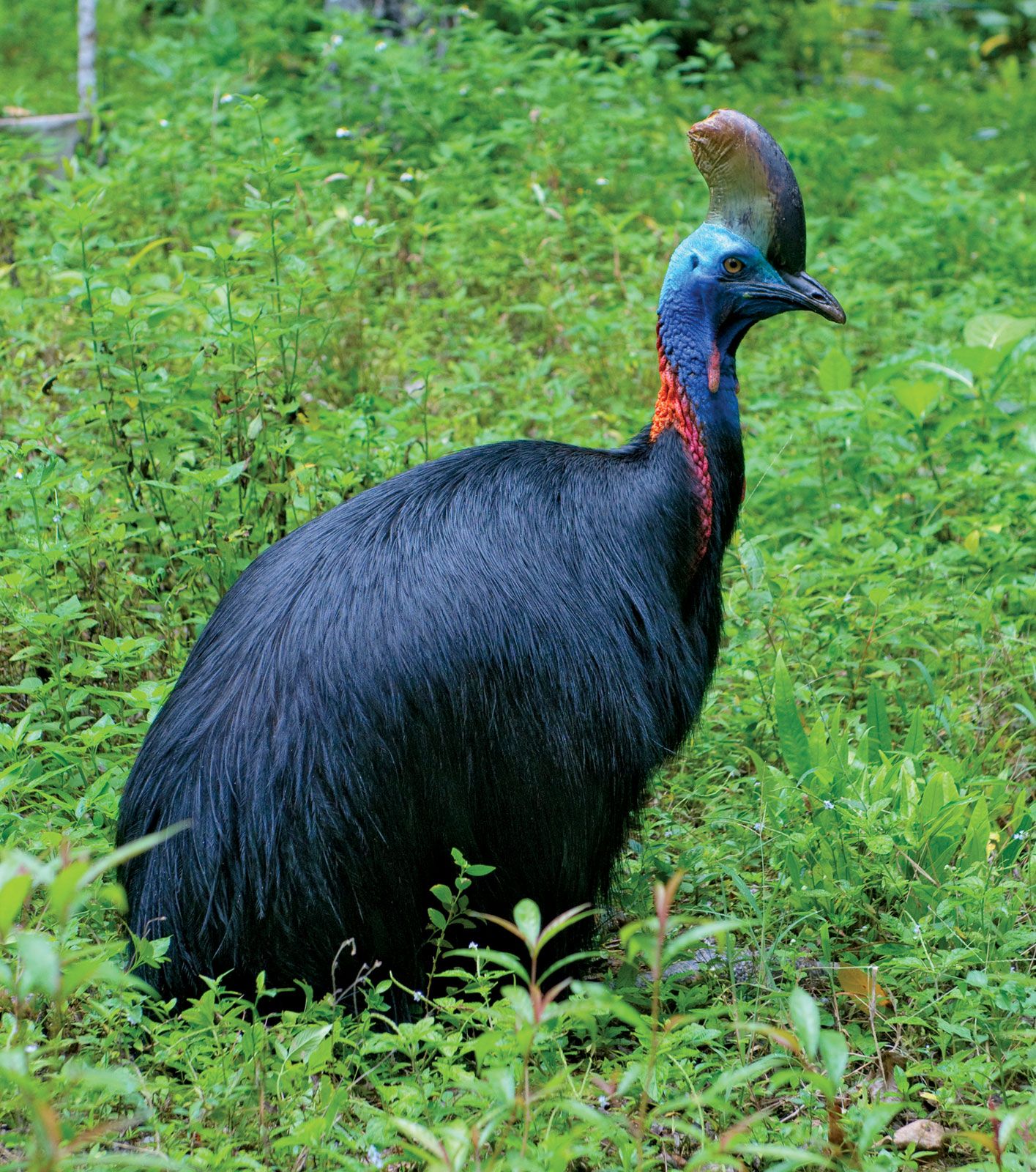
The Southern Cassowary (Casuarius casuarius), also known as the Double-Wattled Cassowary, is the third-largest living bird species on Earth (after the ostrich and emu). Native to the tropical rainforests of northeastern Australia, New Guinea, and nearby islands, it is a keystone species critical for seed dispersal and forest regeneration.
Physical Characteristics: Southern Cassowaries stand 1.5–1.8 meters tall and weigh 32–58 kg. The head and upper neck are adorned with a prominent helmet-like casque—possibly used for pushing through vegetation or producing low-frequency sounds. Vivid blue facial skin and bright red and yellow wattles add to its distinctive appearance. The body is covered in black, hair-like feathers, and the dagger-like claws on the inner toe reach up to 12 cm.
Habitat and Distribution: Found in northeastern Australia’s Far North Queensland rainforests and throughout New Guinea, they inhabit lowland tropical rainforest, swamp forest, and palm forest. They require large areas of intact forest with abundant fruit resources.
Diet: Primarily frugivorous, consuming fruits of more than 70 plant species. They are essential for the regeneration of many rainforest tree species with large seeds that cannot be dispersed by smaller birds. Seeds pass through the digestive system intact and germinate more readily after passage.
Reproduction: Males build ground nests where females lay 3–5 large green eggs. The male alone incubates for approximately 50 days and raises the chicks for 9–16 months. Chicks are striped brown and cream when young, gradually developing black plumage.
Conservation Status: Listed as Vulnerable by the IUCN; Endangered in Australia due to habitat fragmentation, vehicle strikes, and dog attacks.
North Island brown kiwis inhabit forests, scrubland, and farmland margins across New Zealand’s North Island, from coastal dunes to subalpine zones up to 1,100 meters elevation. They prefer areas with loose, well-drained soils for probing and adequate ground cover. The species has adapted to modified landscapes better than some other kiwi species, persisting in regenerating scrubland where predator control is maintained. Like the flightless kakapo, another New Zealand bird, kiwis face severe challenges from introduced mammals that prey on eggs and chicks. Conservation sanctuaries protect populations alongside other endemic ratites, including the southern cassowary.