 By st20113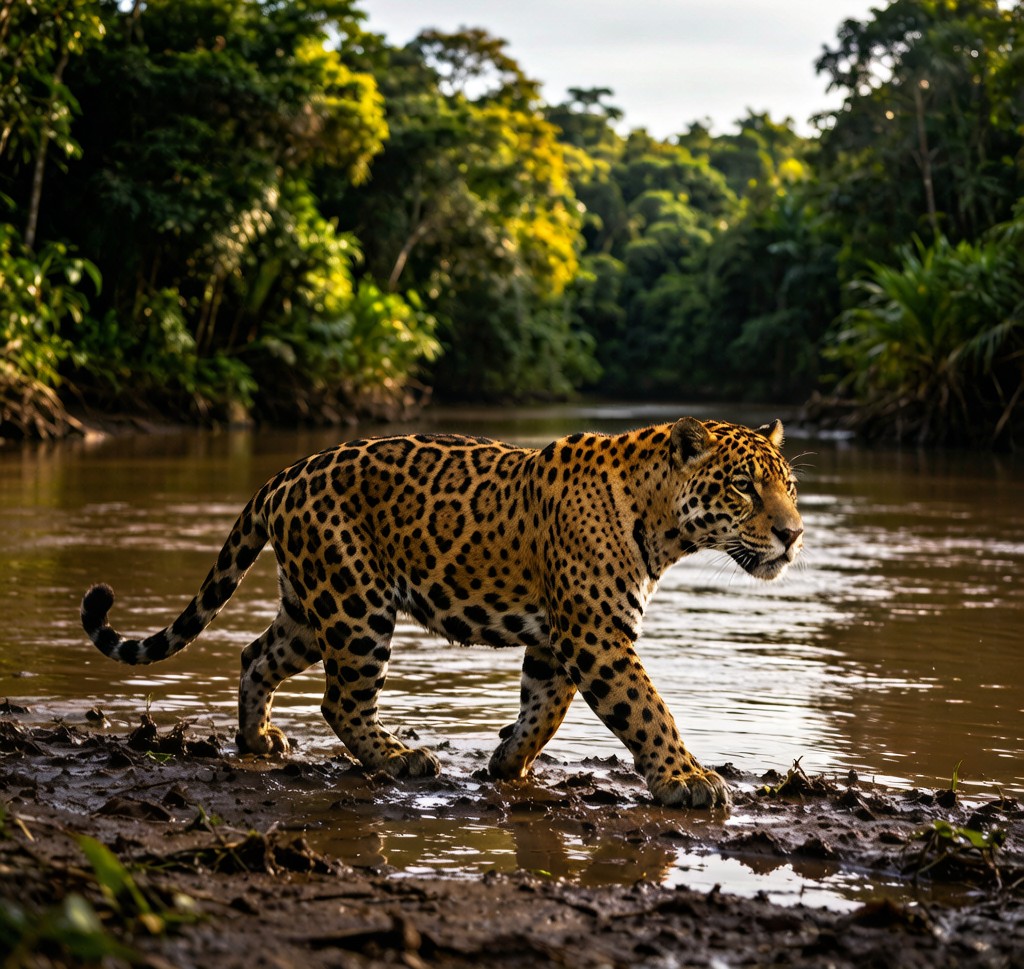
A wild Jaguar (Panthera onca) walking along a tropical riverbank in the Amazon rainforest
Overview
The Jaguar (Panthera onca) is the largest cat in the Americas and the third-largest cat in the world, after tigers and lions. A powerful, compactly built big cat that roams the tropical forests, wetlands, and grasslands of Central and South America, the jaguar is an apex predator that occupies a critical role at the top of the food chain throughout its range. Known for its beautiful golden coat covered in large, distinctive rosette patterns, the jaguar has been revered by indigenous cultures throughout the Americas for millennia as a symbol of power, strength, and the divine.
Jaguars are larger and more robustly built than leopards, with a distinctive broad head, powerful jaws, and a body that appears almost barrel-chested compared to the sleeker leopard. Adults typically weigh 56 to 96 kilograms for females and 90 to 120 kilograms for males, though exceptional individuals can reach 150 kilograms. Their coat varies from pale yellow to deep gold, adorned with large rosette patterns – irregular rings of spots with one or more black dots in the center – and a white to cream chest and underparts. Black panthers (melanistic jaguars) are relatively common in forested regions, their rosette pattern often visible in certain light.
Habitat and Distribution
Historically, jaguars ranged from the southwestern United States through Central America and across most of South America to northern Argentina. Today, their range has been dramatically reduced by habitat destruction and persecution, and they have been eliminated from approximately half of their historic range, particularly in the northern parts and open grassland regions. They remain widely distributed in the Amazon basin, the Pantanal wetlands of Brazil, Bolivia, and Paraguay, the forests of Central America, and in scattered populations in Mexico and the US borderlands.
Jaguars are highly habitat-flexible, found in tropical rainforests, dry thornscrub, savannas, and wetlands, but they are always closely associated with water – unlike most other big cats, jaguars are excellent swimmers and frequently hunt in and around rivers, streams, and lakes. The species is a strong swimmer and is equally comfortable on land, in trees, and in water. Large, contiguous tracts of forest with abundant prey and access to water are the key habitat requirements for viable jaguar populations.
Diet and Hunting
The jaguar has the most powerful bite relative to body size of all the big cats, capable of crushing the carapace of giant river turtles and the thick hide of adult caiman. This remarkable bite force allows jaguars to exploit a wider range of prey than any other big cat in the Americas, including armored reptiles, large mammals, and heavily armored prey that other predators cannot tackle. Their diet includes peccaries, capybaras, deer, tapirs, agoutis, pacas, caimans, anacondas, giant river turtles, fish, and birds.
Unlike most big cats, which kill by strangulation with a throat or neck bite, jaguars often kill with a unique bite directly through the skull of their prey, puncturing the temples to penetrate the brain case. This killing method – unique among living big cats – reflects the jaguar’s evolutionary adaptation to hunting well-armored reptilian prey. Jaguars are also known for their remarkable ability to pursue and capture spectacled caimans in the water, diving beneath the surface and wrestling the reptiles to the bank before delivering a killing bite.
Reproduction and Conservation
Female jaguars give birth to 1 to 4 cubs (typically 2) after a gestation of approximately 93 to 110 days, in a den located in a cave, hollow tree, or dense vegetation. Cubs are born blind and entirely dependent, weighing approximately 700 to 900 grams. They begin eating meat at approximately 3 months of age while continuing to nurse for up to 6 months. The mother raises the cubs alone, moving them between dens and teaching them to hunt over a period of approximately 1.5 to 2 years. Cubs remain with their mother until they are approximately 2 years old, at which point they disperse to establish their own territories.
The jaguar is listed as Near Threatened on the IUCN Red List, reflecting significant population declines driven by habitat loss, fragmentation, and conflict with ranchers who shoot them to protect livestock. Jaguars are particularly vulnerable to the destruction of biological corridors that connect fragmented populations, as isolated populations are at high risk of local extinction. Conservation efforts focus on protecting large habitat blocks, maintaining wildlife corridors, compensating ranchers for livestock losses, and reducing illegal hunting of jaguars for their pelts and body parts.
[…] total length and is used for balance during climbs and rapid direction changes. Unlike the Jaguar that overlaps its range in Central and South America, the cougar has a uniformly colored coat […]
[…] wetlands, shaping vegetation and serving as a critical prey base for predators ranging from jaguars to spectacled […]
[…] It became the sign of the king himself. Kings sat on jaguar-skin thrones and wore jaguar pelts. The jaguar appears again and again in the carvings of every great […]