 By st20113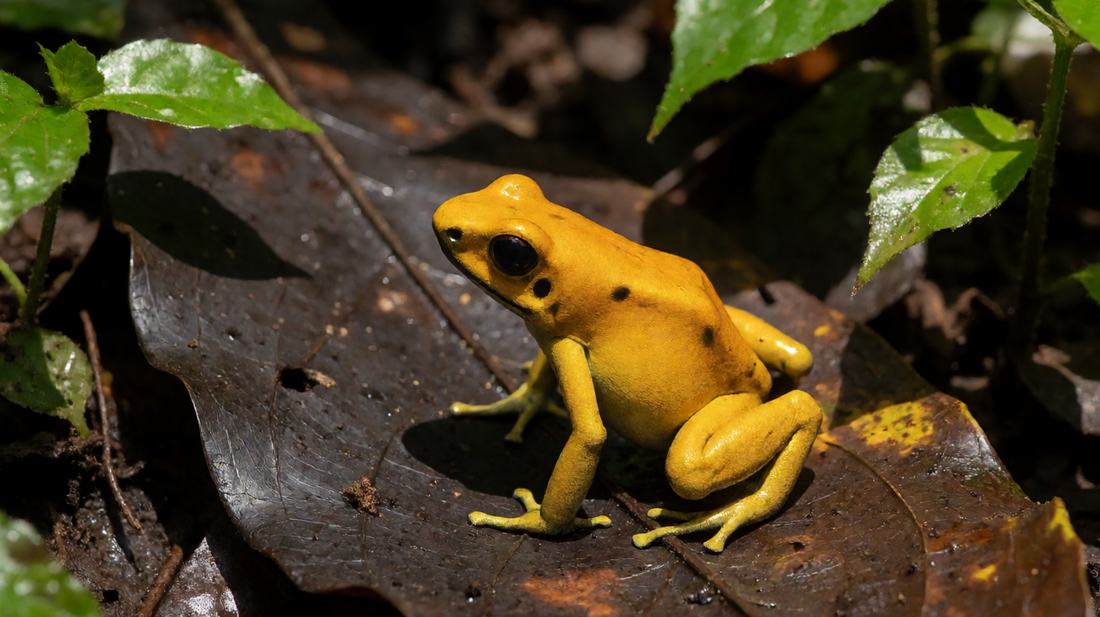
Phyllobates terribilis | Golden Poison Frog
Species Profile · Dendrobatidae
Golden Poison Frog
A small gold frog from a few wet valleys in western Colombia, bright enough to warn every hunter and toxic enough to kill several people.
Endangered
Snout to vent
Eggs
Wild populations
Toxin
Metamorphosis
Rating
The Golden Poison Frog
The most toxic frog on Earth
A small frog glows gold in the leaf litter of western Colombia. Its colour warns every hunter. One bite would be fatal. Batrachotoxin sits in the skin at levels no other frog reaches.
One adult carries enough poison to kill several people. This frog moves in daylight, unlike most of its kin. Insects are hunted on the forest floor. Males call from a low perch.
They defend a small patch of ground. Because the range covers only a few valleys, every patch of standing wild forest matters a great deal to this species.
Family tree
Dendrobatidae, the poison dart frogs
The species belongs to the family Dendrobatidae. Myers, Daly and Malkin described it in 1978. Three species make up the genus Phyllobates.
All three carry poison. Its closest kin are the 2 smaller frogs on the same coast. The common frog sits in a family with almost no skin toxins at all.
Both families look like plain frogs. Only one is armed, though. Colour gives the game away in the end, since bright skin on a small frog nearly always means some kind of chemical defence.
Small, smooth and gold
How to tell one
Adults measure 47 to 55 mm from snout to vent. Females run a little larger than males. Skin is smooth, not warty.
It shines under wet light. Colour runs from pale mint to deep orange-gold. Toe pads are small discs.
They grip wet leaves well. Eyes are large and black, with a horizontal pupil. Nothing about that small, bright, compact body hints at the huge amount of poison held inside the skin.

1
2
3
A few wet valleys only
Where it lives
Lowland rainforest is the only home. Deep shade is needed. So is constant humidity.
Its range lies in a narrow strip west of the Andes. Only about 5 wild populations are known. Steep stream valleys hold the best sites.
Logged forest dries out fast, and the frogs leave. Because the animal will not cross open ground, one cleared road can split a whole population in two and leave both halves too small to last.
Ants and small leaf-litter prey
What it eats
Ants are the staple prey. Mites, springtails and small beetles follow as well. Flies are taken when they land nearby.
The frog hunts by sight. A sticky tongue does the rest. Feeding runs all through the wet season.
Captive frogs raised on crickets lose their poison, in fact. That loss shows where the chemistry comes from. In other words, the toxin is borrowed from the food chain rather than made by the frog itself.
Males carry the tadpoles
The breeding cycle
Males call from the ground with a soft trill. Females lay 10 to 20 eggs in a leaf nest. The male guards the clutch. He keeps it damp.
After about 2 weeks he carries the tadpoles on his back. Each one sticks to a special mucus. Water pools serve as nurseries. So do bromeliad cups.
Metamorphosis follows in 10 to 12 weeks. Unlike the axolotl, which keeps a larval shape for life, this frog always completes the change into a land animal.
Endangered
Conservation
The IUCN lists the species as Endangered. Only a tiny range supports the wild population. Still, mining, logging and cattle clearing cut it every year. Even so, collectors take animals for the pet trade.
Captive breeding now meets much of that demand. Roads open remote valleys to settlers. Because the whole range covers a few thousand square kilometres, one large mine could remove an entire population in a single season.
Side by side
How It Compares
| Trait | Golden Poison Frog | Common Frog |
|---|---|---|
| Skin toxin | batrachotoxin, can kill several people | none of note |
| Colour | gold, a warning | brown or olive, camouflage |
| Range | a few valleys in west Colombia | across Europe |
| Eggs | 10 to 20 in a leaf nest | thousands in a pond mass |
| Activity | diurnal | mostly nocturnal |
| IUCN status | Endangered | Least Concern |
Common misreadings
What People Get Wrong
- The frog makes its own poison. It borrows the toxin from its prey.
- All poison dart frogs are deadly. Only the genus Phyllobates carries batrachotoxin.
- Bright skin is just camouflage. Here it is a warning to predators.
Going further
Sources and Further Reading
- Wikipedia, Golden poison frog
- IUCN Red List, Phyllobates terribilis. The IUCN Red List of Threatened Species.
- Myers, C. W., J. W. Daly and B. Malkin. 1978. A dangerously toxic new frog. Bulletin of the American Museum of Natural History.
- Animal Diversity Web, University of Michigan. Phyllobates terribilis.
Quick hits
Five things to remember
- One frog carries enough toxin to kill several adult humans.
- Lab tests suggest the poison can fell 20000 mice.
- Embera hunters once wiped blowgun darts on its skin.
- The toxin is an alkaloid known as batrachotoxin.
- Males carry tadpoles on their backs to reach water.