 By st20113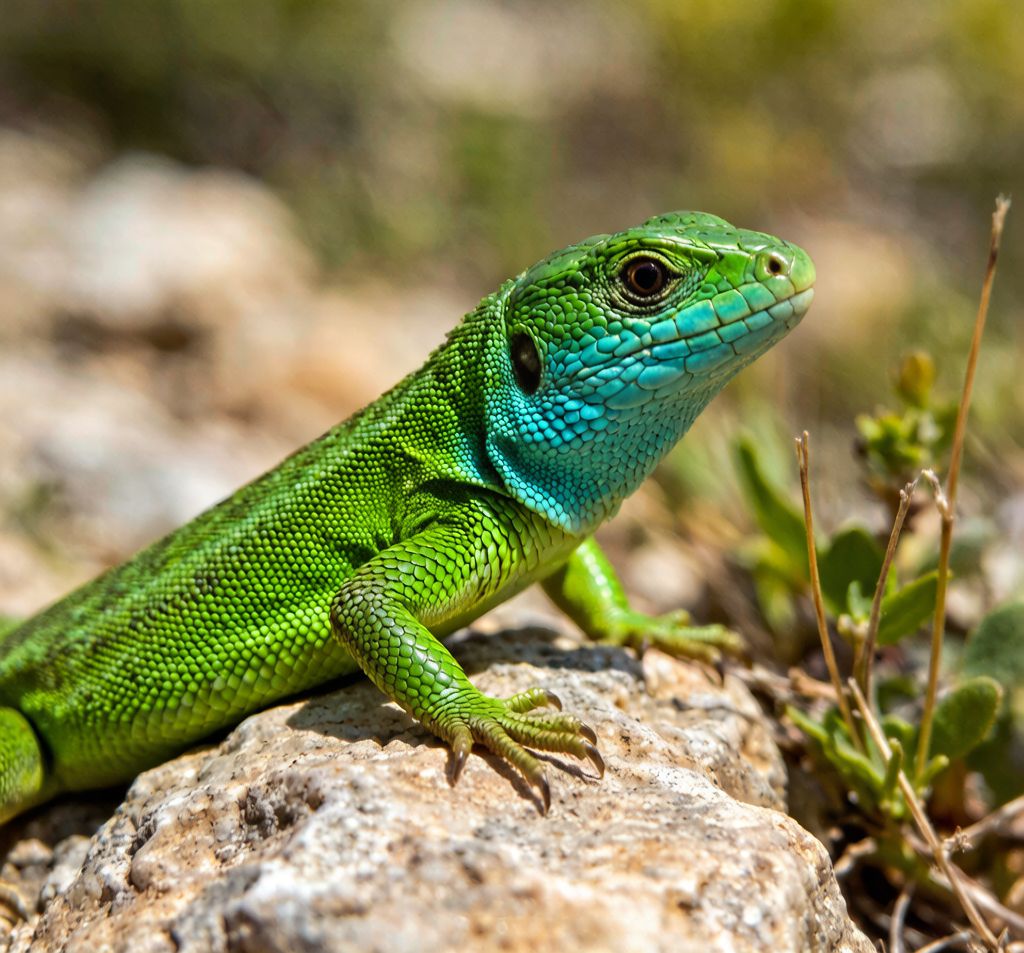
The green lizard is a large, striking lacertid reptile native to central and eastern Europe, from Austria and the Czech Republic eastwards to the Black Sea coast and south to Greece and Turkey. It inhabits sunny woodland edges, scrubland, vineyards, and rocky slopes with Mediterranean vegetation. Males are spectacularly coloured, with vivid bright green bodies and throats that make them among the most eye-catching reptiles in Europe. The green lizard is a skilled climber, often basking on shrubs, low branches, and stone walls where it can be seen displaying its brilliant colouration. The green lizard often shares its scrubland habitat with the grass snake, and both species are preyed upon by the aesculapian snake in some areas..
Taxonomy
The green lizard (Lacerta viridis) belongs to the family Lacertidae, order Squamata. The genus Lacerta contains approximately 25 species of wall lizards distributed across Europe, North Africa, and temperate Asia. Within the green lizard species complex, phylogenetic studies have identified deep genetic divisions leading some authorities to split the western and eastern populations into separate species. The species was formally described by Johann Friedrich Gmelin in 1789. Two subspecies are currently recognised: L. v. viridis in central Europe and L. v. meridionalis in the Balkans and Italy.
Physical Characteristics
Adult males reach 13-15 cm in snout-to-vent length, females 12-14 cm, with a total length including the tail of up to 40 cm. Males are predominantly bright vivid green on the dorsal surface, often with small black and white spots, and have a bright green to blue throat. Females are typically duller green or brownish-green with two to four light longitudinal stripes on the dorsal surface. The belly is yellowish in both sexes. The scales are smooth and glossy, and the tail is long and slender. Males develop broader heads and larger femoral pores than females during the breeding season.
Habitat
The green lizard inhabits warm, open to semi-open habitats with scattered vegetation and ample basking sites. Preferred environments include south-facing scrubland, rocky hillsides, dry meadows, woodland edges, overgrown vineyards, olive groves, and coastal maquis shrubland. It is strongly associated with Mediterranean-type ecosystems and is absent from cool, wet Atlantic climates and high-altitude mountainous regions. The species is largely confined to lowland and hill areas below approximately 1,200 m elevation. It is a proficient climber and frequently basks on low branches, shrubs, hedgerows, and stone walls.
Diet
The green lizard is an active, opportunistic predator with a broad diet dominated by invertebrates. Prey includes beetles, grasshoppers, crickets, caterpillars, spiders, and snails. Larger individuals may take small vertebrates including juvenile rodents, nestling birds, and smaller lizards. Plant material including leaves, flowers, and fruit is consumed occasionally, particularly in late summer. The green lizard is an active forager rather than a sit-and-wait predator, actively pursuing prey through low vegetation and across open ground.
Reproduction
Green lizards emerge from hibernation in March to April, and mating occurs from late April to June. Males engage in combat bouts during the breeding season. Females lay one to three clutches of 5-15 eggs per season, from May to July, buried in sandy or loose soil in warm, sunny locations. Eggs incubate for approximately 8-12 weeks, with hatchlings emerging in late summer and early autumn. Hatchlings measure approximately 6-7 cm in total length and are immediately independent. Sexual maturity is reached at two to three years. Maximum lifespan is approximately 8-12 years in the wild.
Conservation
The green lizard is listed as a species of Least Concern by the IUCN due to its wide distribution and large, stable population. However, localised declines have been documented in parts of western Europe, linked to habitat loss from agricultural intensification, urbanisation, and abandonment of traditional low-intensity grazing regimes that maintained open scrubland. The species is protected in several European countries and is listed on Appendix III of the Bern Convention. Key conservation measures include maintaining hedgerows and scrub edges in agricultural landscapes, reducing pesticide use, and protecting south-facing rocky habitats from development.
Fun Facts
The vivid green colouration of male green lizards is among the most striking of all European reptiles and develops fully only in the breeding season. The species is an exceptionally alert and agile lizard, capable of running at speed across bare ground and leaping between branches to escape predators. Green lizards have been kept as pets since Roman times, and several colour variants have been selectively bred in captivity. In parts of eastern Europe, green lizards are associated with good fortune and are rarely harmed by local people, even when found in gardens and agricultural areas.