 By st20113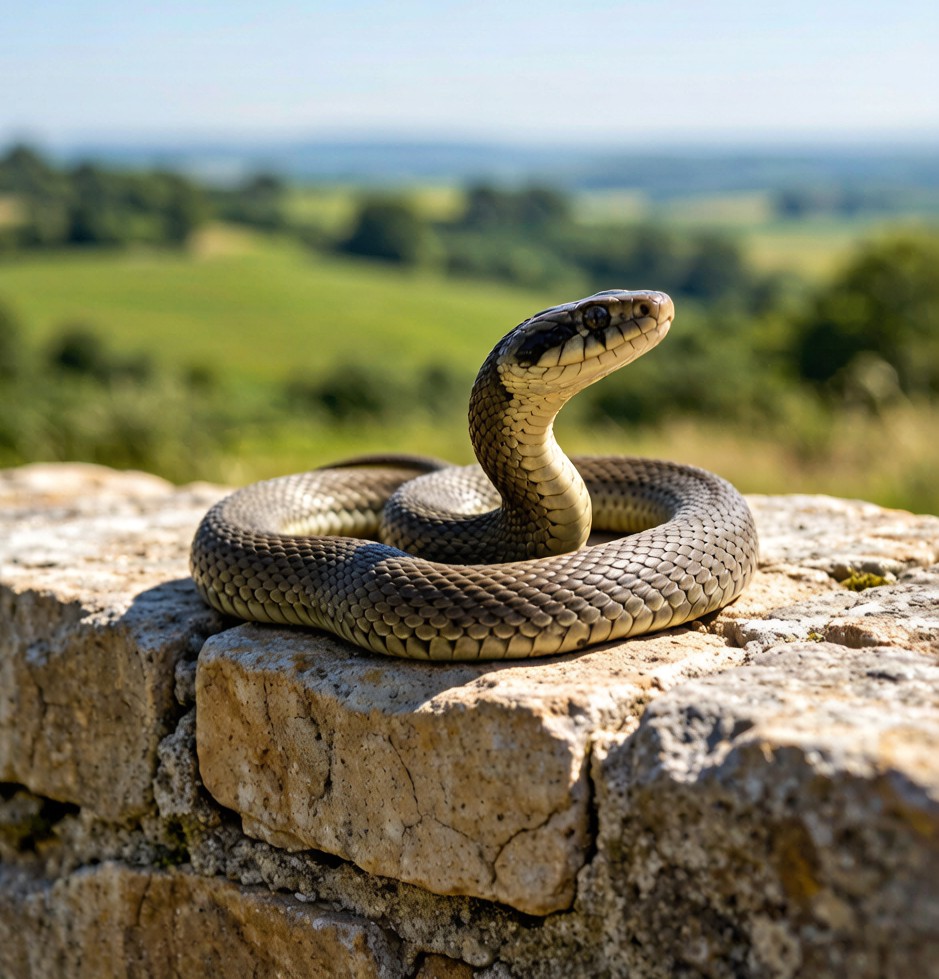
Introduction
The Aesculapian Snake (Zamenis longissimus) is one of the longest snakes in Europe, capable of reaching lengths of up to two metres and weights of several kilograms. Despite its impressive size and powerful build, this non-venomous constrictor is completely harmless to humans and plays a valuable role in controlling rodent populations in the rural and agricultural landscapes it inhabits. The species has an ancient association with human culture, having been linked to the Greek god of medicine Asclepius for over two thousand
Taxonomy
Scientifically classified as Zamenis longissimus within the family Colubridae, the family of typical snakes, the Aesculapian Snake belongs to the genus Zamenis, a group of large, powerful ratsnakes. The species name longissimus means the longest in Latin, a direct and apt reference to its impressive length. Formerly placed in the genus Elaphe, recent molecular phylogenetic work has confirmed its placement in Zamenis alongside the Italian Ratsnake (Zamenis lineatus) and the Persian Ratsnake (Zamenis persicus). Its closest relatives include the Ratsnakes of Europe
Physical Characteristics
The Aesculapian Snake is a slender, graceful species with adults typically reaching 100 to 160 cm in length, and large individuals occasionally exceeding 200 cm. The body is slim and cylindrical, with smooth, glossy scales that reflect light to give the snake an almost metallic sheen. The background colour is uniform olive, greyish-olive or brown, with a series of darker blotches along the back that are often faint or absent in large adults. The belly is lighter, usually yellowish or cream, and
Habitat
Aesculapian Snakes are associated with warm, rocky, south-facing slopes, open deciduous woodlands, scrubland, and the margins of cultivated areas including orchards, vineyards and olive groves. In northern parts of their range in Germany, Poland and the Czech Republic, they are strongly associated with rocky habitats including ruins, stone walls, rocky outcrops and scree slopes that provide suitable hibernation sites below the frost line. They are excellent climbers and are frequently found basking on stone walls, in low tree branches, on rock outcrops
Diet
The Nile Crocodile (crocodylus-niloticus-nile-crocodile) is one of the largest and most formidable reptilian predators in Africa, sharing with the Aesculapian Snake an opportunistic approach to predation and a preference for vertebrate prey. As a skilled predator of small vertebrates, the Aesculapian Snake feeds primarily on rodents including mice and voles, and to a lesser extent birds and their eggs, and occasionally lizards and invertebrates. Prey is killed by constriction, with the snake coiling rapidly around its prey and squeezing until the animal
Reproduction
Aesculapian Snakes are oviparous, with females laying clutches of 3 to 14 eggs in late summer, typically in July or August, following mating in April or May after emergence from hibernation. Eggs are deposited in warm, humid locations such as compost heaps, rotting vegetation, hollow tree stumps and old buildings, where ambient heat and decomposition provides warmth for incubation over approximately six to ten weeks. The eggs are not guarded by the parents. Hatchlings emerge in September and October at approximately 25
Conservation
While classified as Least Concern globally by the IUCN, the Aesculapian Snake has undergone significant local declines in the northern parts of its range, particularly in Germany, Denmark and Poland, where it is considered endangered or threatened. It has been affected by habitat loss including the removal of stone walls and hedgerows from farmland, the modernisation of agriculture, road mortality as snakes are killed crossing roads during their seasonal movements, and persecution by people who fear snakes despite its completely harmless nature. In Austria, Italy and southern Germany, populations appear more stable, and the species has benefited from the preservation of traditional stone walls in vineyards.
Fun Facts
The Aesculapian Snake has been associated with medicine and healing since ancient Roman times, when it was believed to have been introduced to Italy by followers of the Greek god of medicine Asclepius and was kept in temples dedicated to healing. Its name derives from Asclepius, whose staff it is said to resemble in motion when moving through tall grass. In Austria and Switzerland, the species has benefited from the preservation of traditional stone walls in vineyards and agricultural land. It is
[…] often shares its scrubland habitat with the grass snake, and both species are preyed upon by the aesculapian snake in some […]