 By st20113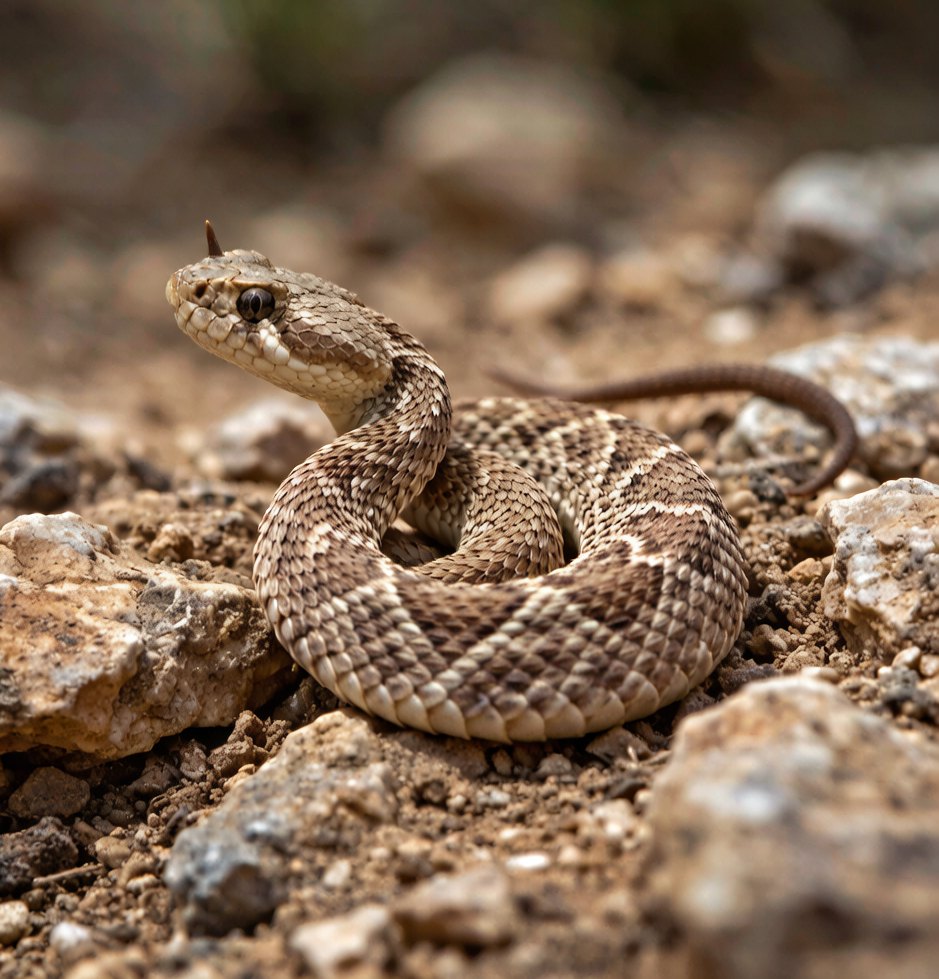
Introduction
The Sand Viper (Vipera ammodytes), also known as the Horned Viper or Long-nosed Viper, is Europe’s most dangerous snake and the only European viper with a distinctive horn-like scale atop its snout. Found from northern Italy through the Balkans to the Caucasus, it is a heavy-bodied ambush predator that delivers potent hemotoxic venom capable of serious harm to humans. Despite its fearsome reputation it is a shy retiring species that prefers to avoid confrontation.
Taxonomy and Evolution
The Sand Viper is classified as Vipera ammodytes within the subfamily Viperinae, the true vipers. Four subspecies are recognized: V. a. ammodytes in the Balkans, V. a. gregorwallneri in Austria and Slovenia, V. a. meridionalis in Greece and western Turkey, and V. a. ruffoi in central Italy. Molecular phylogenetics suggests it diverged from other Vipera some 5 to 8 million years ago. Its closest relative is the Nose-horned Viper complex, and some taxonomists treat eastern populations as a distinct species. The genus Vipera comprises some 20 species across Europe, North Africa, and temperate Asia, all bearing hollow front fangs.
Physical Characteristics
Sand vipers are robust snakes reaching 60 to 90 cm, occasionally 100 cm, with females larger than males. The most distinctive feature is a single horn of 2 to 5 enlarged upturned scales on the snout, unique among European snakes. Coloration is extremely variable: base colors range from gray, beige, and brown to reddish-orange and olive, overlaid with a bold dark zigzag or spot pattern. Some entirely black individuals occur. The head is broad and triangular with vertical slit pupils. The tail is short and abruptly tapered. Like all vipers it has hollow retractable fangs up to 13 mm long housed in the front of the upper jaw.
Habitat and Distribution
Sand vipers occupy rocky hillsides, stone walls, old ruins, dry scrubland, forest edges, and mountain meadows from sea level to 2,500 m in the Alps. Their range spans northeastern Italy, Austria, Slovenia, the Balkans, and parts of western Turkey. They require warm south-facing slopes for thermoregulation and shelter in rock crevices, rodent burrows, or under stones. In the Balkans they coexist with smaller vipers in some areas, though those prefer lower more humid habitats. They are often found near the European rabbit and the wild boar, whose burrows provide shelter.
Diet and Feeding Behavior
An ambush predator, the sand viper lies coiled and motionless for hours, relying on cryptic coloration to remain invisible to passing prey. It feeds primarily on small mammals such as mice, voles, and shrews, as well as birds and their eggs, lizards, and occasionally frogs and large insects. Detection is primarily chemical, flicking the forked tongue to sample scent particles. Upon striking, venom is injected through hollow fangs and the prey released, tracked by scent, and swallowed headfirst. An adult can survive on 6 to 8 substantial meals per year, digesting each over several days in a sheltered retreat away from the red fox.
Reproduction and Life Cycle
Sand vipers mate in April and May after emerging from winter brumation. Males engage in ritualized combat dances, rising and intertwining their anterior bodies while pushing to pin the opponent. After a 3 to 4 month gestation, females give birth to 4 to 20 live young in August or September, each 14 to 20 cm long and independent from birth. Neonates are brightly colored and possess fully functional venom from birth. Sexual maturity is reached at 3 to 4 years for males and 4 to 5 years for females. Unlike most vipers they can produce young every year if food is abundant, otherwise skipping a year.
Conservation Status
Listed as Least Concern due to its wide range and large population, though populations in Austria and northern Italy are small and fragmented. Primary threats include deliberate persecution by humans, habitat loss from agricultural intensification, and road mortality. In some Balkan countries they are collected for the illegal pet trade and for venom extraction. Climate change poses a long-term threat to montane populations, and the species has disappeared from some lowland areas of its former Italian range as farmland expands and scrub is cleared for development.
Fun Facts
The sand viper’s horn is not just decorative, research suggests it may help shade the eyes from bright sunlight, similar to the heat-sensing pits of pit vipers though it is not a true heat organ. Its venom is the most potent of any European snake, containing hemotoxins and neurotoxins that can cause tissue destruction and blood-clotting failure. Despite this, medically significant bites are rare because the snake is shy and gives a warning hiss before striking. In ancient Greece the sand viper was associated with the god Asclepius and appeared on coins and carvings as a symbol of healing.