 By st20113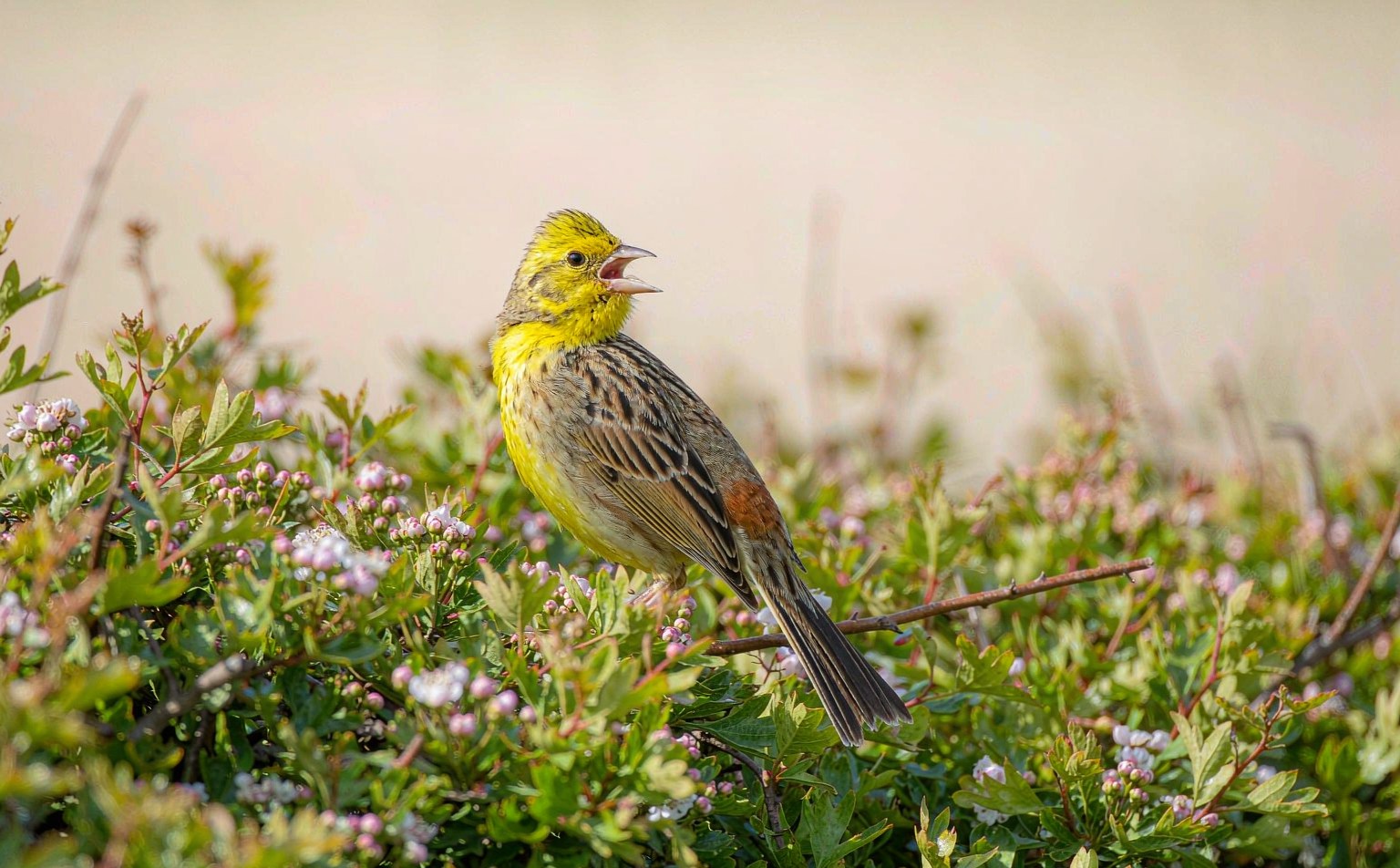
Emberiza citrinella | Yellowhammer
Introduction
The Yellowhammer (Emberiza citrinella) is a cheerful, brightly colored bunting of hedgerows, field margins, and open countryside across Europe, a small bird whose singing male, with his golden head and ringing song, is a familiar sight perched on a wire or stalk through the spring and summer. The species belongs to the buntings, a group of seed-eating songbirds whose modest size belies their ecological importance as consumers of weed seeds and insects across farmed landscapes.
Although still widespread, the Yellowhammer has declined in many intensively farmed regions, where losses of seeding weeds and hedgerow cover have reduced the food and nesting sites on which it depends. It has become a useful indicator of the state of farmland biodiversity, its fortunes rising and falling with the health of the cropped and marginal habitats that make up the modern agricultural mosaic.
The bird is largely resident across its range, with northern populations moving only short distances in hard weather, and it readily forms flocks outside the breeding season that mix with other buntings and finches. Its close relatives among European songbirds include familiar seeded specialists such as the common chaffinch and the European goldfinch, with which it often forages in winter.
Taxonomy
The Yellowhammer was first described by Carl Linnaeus in 1758 and is the type species of the genus Emberiza, the true buntings, a large group distributed across Europe, Asia, and Africa. Its scientific name combines the old German Embritz, a bunting, with the Latin citrinella, meaning “little yellow one,” a direct reference to the male’s coloration.
Adults are distinctive among European buntings for the male’s yellow head and underparts offset by chestnut and streaked brown upperparts, and the species is not easily confused where it occurs, though the pine bunting and citril finch can prompt careful scrutiny at range. No widely accepted living subspecies divide the Eurasian population, which varies only subtly across its broad range.
Molecular studies place the buntings within the family Emberizidae, separate from the true finches of the family Fringillidae, though the two groups are close relatives and often share the same winter feeding flocks. The Yellowhammer’s nearest kin among European seed-eaters reflect a shared reliance on small seeds and a life lived largely at the edges of open ground, where it can both feed and watch for danger.
Physical Description
The Yellowhammer is a compact bunting about 16 to 17 centimeters long, with a wingspan near 23 to 30 centimeters and a weight of roughly 20 to 35 grams. The male in breeding plumage is striking: a bright yellow head and underparts, a chestnut rump, and heavily streaked olive-brown back and wings, with the yellow brightest on the crown and throat.
The female is duller, more streaked, and less golden, with a paler, more muted head, though she still shows the characteristic yellow tones at the sides of the face and on the underparts. Both sexes have a stout, conical bill suited to cracking seeds, and in flight the bird shows a white outer tail, a useful identification clue that flashes as it dips away.
Juveniles resemble the female but are even more streaked and lack the adult’s clean yellow tones, acquiring them through their first autumn molt. The overall impression is of a robust, ground-loving songbird, more often seen hopping among stubble and grass than flitting through trees, though it sings from prominent exposed perches.
Habitat
Yellowhammers favor lowland and hill farmland, open woodland with clearings, hedgerows, scrub edges, and roadside verges, anywhere that combines seeding plants, low nesting cover, and scattered song posts. They are characteristic of the farmed countryside of temperate Europe, thriving where a mixture of crops, fallow, and semi-natural margins provides both food and nesting sites.
The nest is built low in vegetation, in a hedge bottom, a grass tussock, or a young plantation, usually well concealed but close to open ground for feeding. Birds prefer landscapes that are not too tidy: weedy field edges, unsprayed margins, and hedges with a shrub layer all support higher densities than uniform, heavily managed land.
In winter the species forms flocks that roam stubble fields, root crops, and bird-feeding areas, often joining other seed-eaters. The availability of seeds through the cold months is the key to survival, and the loss of weedy stubble and autumn-sown crops that leave little spilled grain has been a major factor in population declines across parts of the range.
Diet
The Yellowhammer is primarily a seed-eater, taking the seeds of grasses, docks, chickweeds, and many crop plants, which it husks with its strong bill. In autumn and winter seeds dominate the diet entirely, and the bird plays a useful role in controlling weed abundance across fields and margins by consuming large quantities of their seeds.
During the breeding season, however, the diet shifts substantially toward insects, which are essential for raising fast-growing chicks. Adults feed their young on caterpillars, beetles, flies, and aphids gathered from low vegetation, and the abundance of these invertebrates in unsprayed margins strongly influences nesting success.
This seasonal switch means the species needs two distinct resources close together: insect-rich nesting habitat in summer and seed-rich foraging in autumn and winter. Farming systems that provide both, through flower-rich margins and retained stubble, support healthy populations, while those that remove weeds and insects leave the birds short of food at critical times.
Reproduction
Yellowhammers are typically double-brooded, raising two, occasionally three, clutches in a single season. The nest is a neat cup of grasses and moss lined with hair, hidden in dense grass or a low shrub, and the female lays four to five eggs with a distinctive scribbled network of dark lines on a pale ground.
Incubation lasts about twelve to fourteen days and is performed mainly by the female, while both parents feed the chicks, which fledge at roughly eleven to thirteen days. The young are dependent for a short period afterward and quickly form loose family groups before joining post-breeding flocks.
Because the birds nest on or near the ground, eggs and chicks are vulnerable to trampling by livestock, cutting of roadside verges and silage fields, and predation by mammals and corvids. The provision of unmown margins and the timing of hedge and verge management to avoid the breeding season are among the most effective ways to support successful nesting.
Conservation
Once one of the commonest farmland birds of Europe, the Yellowhammer has suffered significant declines in many countries since the 1970s, and in some regions it is now considered a species of conservation concern. The primary cause is agricultural intensification: the loss of weedy stubble and seed-rich margins, earlier and more frequent cutting of silage, increased pesticide use that removes insects, and the removal of hedgerows.
These changes have reduced both the winter food supply and the summer insect abundance needed to rear chicks, creating a double squeeze on breeding success. In contrast, landscapes with diverse cropping, generous field margins, and sympathetic hedge management continue to hold strong populations, showing that the decline is reversible with the right habitat.
Conservation measures include agri-environment schemes that fund wildbird seed mixes, winter stubble, and delayed cutting, alongside hedge planting and the protection of roadside verges from untimely mowing. Because the Yellowhammer responds relatively quickly to habitat improvement, it is often used as a measurable indicator of the success of farmland biodiversity programs across Europe.
Fun Facts
- The male Yellowhammer’s song is often rendered as “a little bit of bread and no cheese,” a rhythmic phrase that has made the bird one of the best-known voices of the European countryside.
- Males sing from exposed perches such as posts and wires to advertise their territory, sometimes delivering their song in flight as they bound over the hedge line.
- The species is one of several birds that benefit from “beetle banks” and wildflower margins planted specifically to support farmland wildlife.
- A female can raise more than ten chicks in a single season when conditions are good and two broods succeed.
- In winter, Yellowhammers often roost communally in thick hedges or reedbeds, packing together for warmth on the coldest nights.
[…] contextual comparison, the Linnet shares habitat preferences with the Yellowhammer (Emberiza citrinella), though the two species can be distinguished by their plumage, with the male Linnet displaying a […]