 By st20113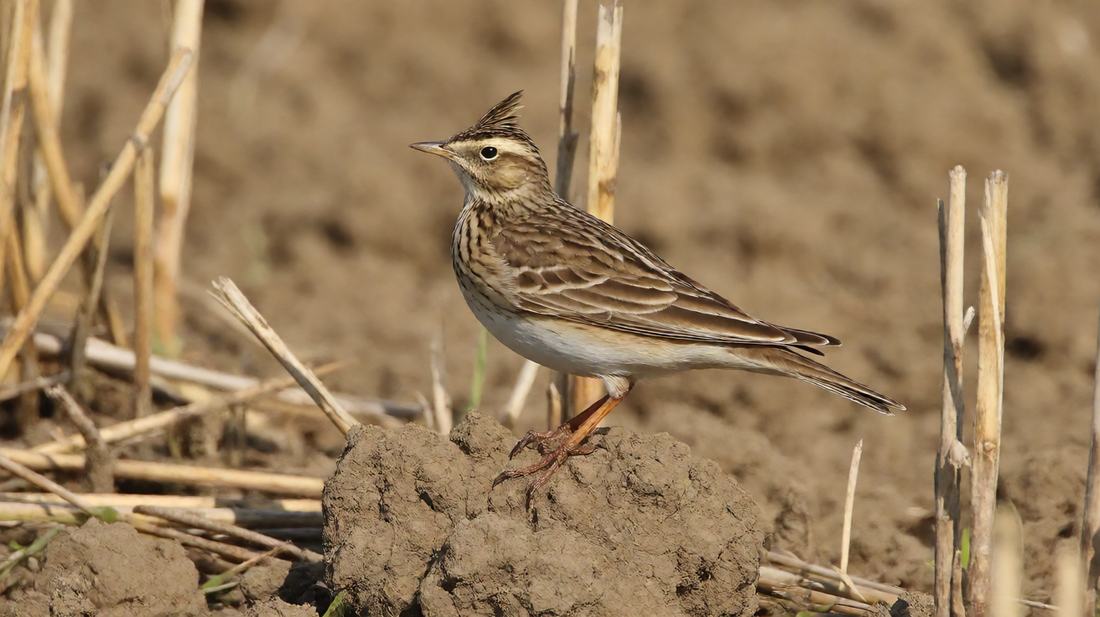
Alauda arvensis | Eurasian Skylark
Species Profile · Alaudidae
Eurasian Skylark
The bird that gave English the word skylarking — a small brown songbird that climbs a hundred metres into the air and sings all the way back down.
IUCN: Least Concern
Range
Length
Weight
Nest
Incubation
The song that named a word
A lark of the open field
The Eurasian Skylark gave the word skylarking to the English language. It is a small brown songbird of open country. It is famous above all for the song flight of the male. The bird rises almost straight up on quivering wings. All the while it pours out a continuous torrent of notes. It then hangs or circles at a height of 50 to 100 m for several minutes. It comes down in a long slanting glide or a slow spiral. It keeps singing on the way down. The bird is 16 to 18 cm long. Its wings span 30 to 36 cm. It weighs 30 to 45 g.
It is a plain, streaky, buff-brown bird with a short crest. It raises that crest when alert. It has a pale stripe over the eye and pale underparts. Its long hind claws give it a stable stance on the ground. It differs from the similar Woodlark in several ways. It has a longer tail and a more heavily streaked breast. It also lacks the white line over the eye that meets at the nape. The species lives in grassland, farmland, moorland, coastal dunes and airfields. It wants any open country with short vegetation. It feeds on the ground on seeds, leaves and insects. It nests on the ground in a shallow scrape lined with grass.
It hides that nest in the base of a tussock or a crop. It is found across Europe, North Africa and much of temperate Asia as far as Japan. Northern populations migrate south and western ones are largely resident. It has been introduced to Australia, New Zealand, Hawaii and Canada. It has also been introduced to parts of the United States. So the song praised by a nineteenth-century English poet is now heard in new places. It is assessed as Least Concern on the global Red List. Its range is very large and its population still numbers in the hundreds of millions. The species has fallen severely across western Europe since the middle of the twentieth century. In Britain and several other countries it has gone from commonest farmland bird to scarce one.
Family tree
Alauda, the true larks
The Skylark sits in the family Alaudidae, the larks. This is a big group of about 100 species. They are small to medium-sized songbirds with a robust body and a long hind claw. Their streaked brown feathers hide them well. Their song is often delivered in flight. Within that group the bird sits in the genus Alauda. That is a small group. It also includes the White-winged Lark of central Asia and a few island species. Its closest kin are the other larks of Europe and Asia. The most useful comparison is with the Yellowhammer. That is another songbird of open land with a streaky brown back.
It is told at a glance by its bright yellow head and body. It also sings from a bush or a wire rather than from the air. The Woodlark is a third comparison. It has a shorter tail and less streaking. Its fluty, falling song is quite unlike the skylark’s sustained torrent. The species was described by Linnaeus in 1758. Many forms are recognised across its vast range. They differ mainly in size and in the shade of the feathers. Northern and eastern birds are generally larger and paler. Southern ones are smaller and darker. The scientific name fits very well.
Alauda is the Latin name for a lark. Arvensis is Latin for of the field or of arable land. So the whole name means the lark of the fields. That describes a bird tied to farmland for thousands of years. The bird has been brought to many parts of the world for its song. In Australia and New Zealand the new birds are now well settled. They live in pastures and on roadsides. In Canada the small new group near Victoria is of no national concern. That is because it is not native there.
Streaked brown and crested
How to identify one
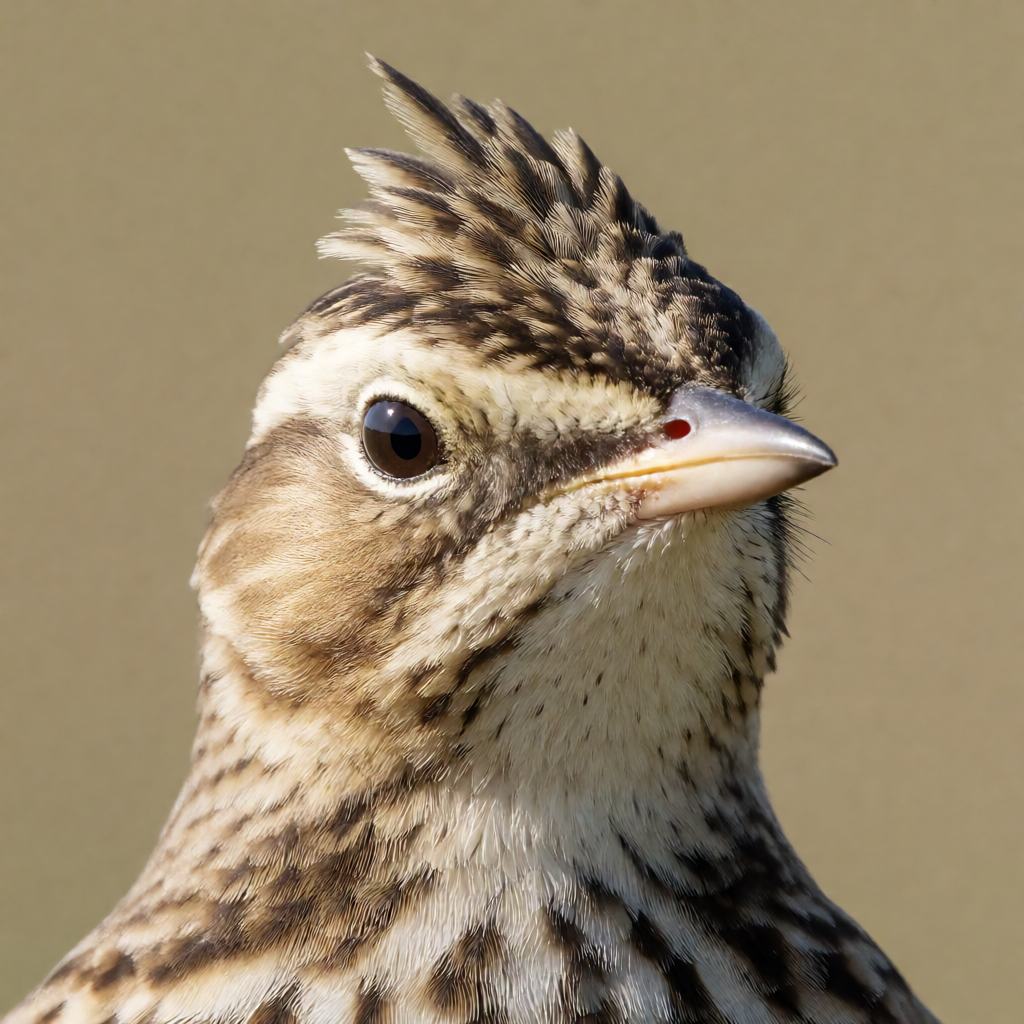
The Eurasian Skylark is a medium-sized songbird. Its body is robust and compact. Its tail is longer than that of most similar species. Its plumage is designed for concealment on the ground. The mix of buff, tan and dark brown carries dark streaks down the centre of every feather. So a bird crouched in short grass or stubble is very hard to see until it moves. The upperparts are a warm sandy brown with broad dark streaks. Pale fringes give a scaled or mottled look. The underparts are whitish or pale buff with dark streaks. Those streaks run down the breast and along the flanks.
The face carries a pale stripe above the eye and a dark line through it. The small crest on the crown is usually held flat. The bird raises it when alert or displaying. The wings are broad and rounded. The bird flies with a fluttering, undulating action. It alternately flaps and folds the wings. That flight style helps separate a distant skylark from a pipit or a bunting. Those birds fly with a steadier, more direct action. The tail is long and notched. The outer feathers are white.
That shows well in flight when the bird spreads the tail on landing. The legs are a pale brownish or flesh colour. They carry the very long, straight hind claw that is characteristic of the family. That claw is thought to give the bird extra stability on soft or uneven ground. Males and females look alike. The male is on average slightly larger. The plumage does not change with the seasons. It looks fresher and browner after the autumn moult. The species undergoes a complete moult on the breeding grounds once the nesting season has finished.
1
2
3
Farmland, dune and moor
Where it lives
The Skylark is a bird of open land with short, mixed plants. It needs a mix of things that is easy to list. That mix has become ever harder to find. It wants an open landscape with no tall trees or bushes close by. It wants a sward short enough for the bird to walk through and to see over. It needs patches of bare ground or thin cover for seeds and insects. It also needs a little taller or denser plants to hide the nest. In its natural state the species lived on steppe and dry grassland. It used sand dunes, saltmarsh, upland moorland and the edges of heath.
In much of Europe and Asia it has been most numerous on farmland for centuries. It breeds in cereal crops, pasture, fallow land, beet and potato fields. It uses grass margins too. It also uses golf courses, airfields and racecourses. It uses playing fields, industrial wasteland and the verges of roads and railways. Its taste for a short, mixed sward explains its success in mixed farmland. It also explains why it suffers so badly from the shift to large, uniform fields of winter-sown cereals. In those fields the plants grow too tall and dense by nesting time. The species nests on the ground.
Any work that disturbs the ground or the sward in the nesting season harms it. So the timing of mowing, rolling, spraying and harvesting matters a great deal. So the bird now stands for the clash between modern farms and wild life. Northern birds migrate and move south in autumn in loose flocks. Huge numbers winter in the lowlands of western and southern Europe. They gather in stubble and ploughed fields. In hard weather the flocks concentrate on the coast and in the warmest districts.
Seeds in winter, insects in summer
What it eats
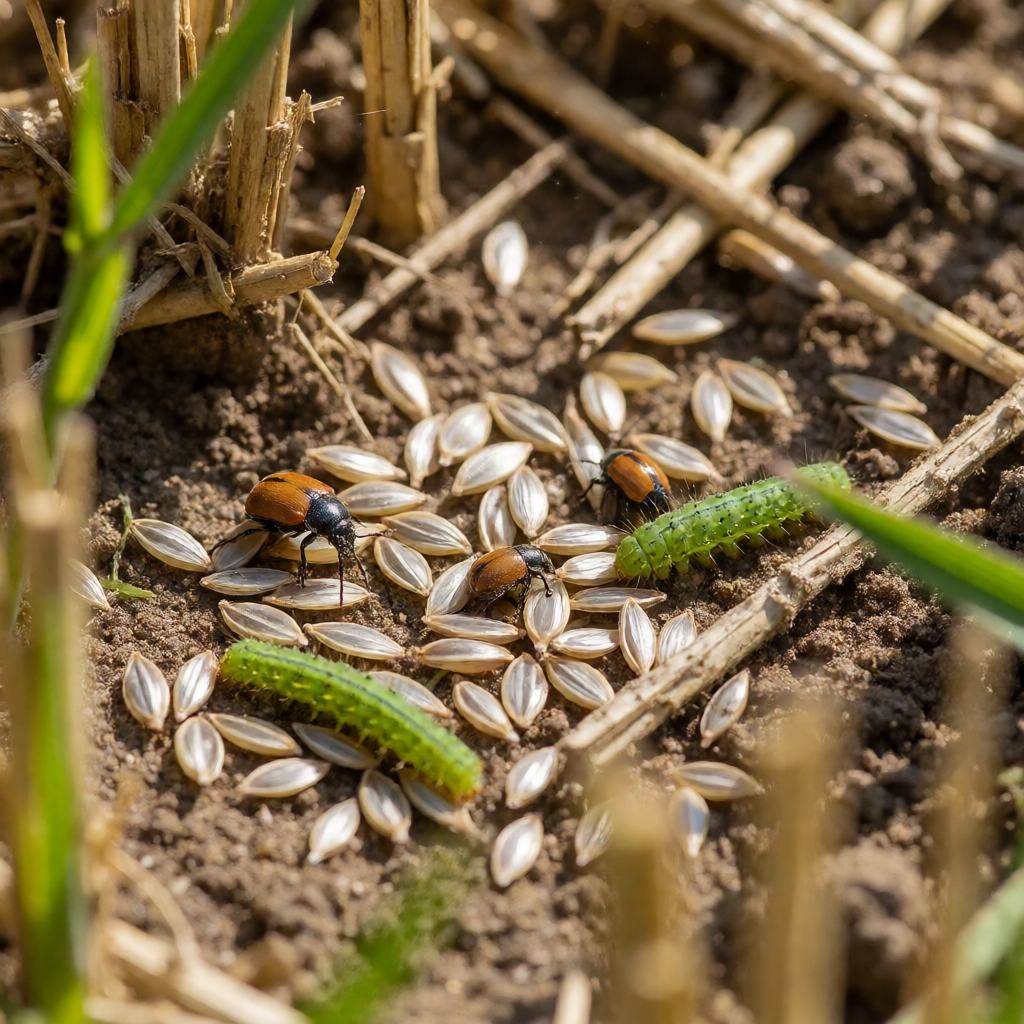
The Eurasian Skylark is an omnivore of the open field. Its diet changes markedly through the year. Over 12 months it takes a mixture of plant and animal food. The proportions shift with what is available and what the bird needs for growth and breeding. In spring and autumn the diet is dominated by cereal grains. It also takes the seeds of grasses, weeds and wild plants. In winter it lives mainly on seeds and the leaves of young plants and cereals. These are picked from the surface of the soil or from the seed heads. The bird will also use its bill to dig out newly sown grain. It takes the green tips of growing crops.
In summer the diet shifts towards animal food. The birds take beetles, weevils, ants, spiders, caterpillars and sawfly larvae. They take grasshoppers, flies and other small invertebrates. This animal food is essential for the growth of the chicks. The chicks are fed almost entirely on insects and other small soft-bodied prey for their first weeks. The adults also take these items in quantity while feeding young. In autumn the birds strip aphids and other small insects from the tips of cereal ears. They do this on ears that have not been harvested. In winter flocks gather on stubble and on fields where manure has been spread. The birds also take small stones and grit.
That helps grind the seeds in the gizzard. Feeding happens almost entirely on the ground. The bird walks or runs rather than hopping. It feeds in loose flocks outside the breeding season. Those flocks can be very large. Gatherings of several hundred or even a few thousand birds occur in favoured winter stubbles. The species drinks fresh water. It also takes dew and moisture from the surface of leaves. It will bathe in dust or in shallow water when the chance arises.
A scrape in the sward
The breeding cycle
The breeding season runs from late March in the south to July or August in the north. The season is long enough for the species to raise 2 or sometimes 3 broods. That is an unusually high rate of production for a small ground-nesting songbird. It is one of the ways the bird offsets its very high rate of nest loss. The nest is a shallow scrape in the ground, between 8 and 12 cm across. It is lined neatly with dried grass leaves and stems. It sits in a small depression in the sward. It is usually placed beside a tussock, a stone or a clump of vegetation. That gives some cover from above and from the side. The birds often nest in loose colonies in suitable fields.
Several nests may sit within a few dozen metres of each other. Between 3 and 5 eggs are laid, most often 4. They are greyish white, heavily marked with olive and brown speckles and blotches. The female alone incubates them for between 11 and 14 days. The male keeps singing and guarding the territory throughout. He will bring food to the sitting female. The chicks hatch covered in pale down. They leave the nest after 8 to 10 days, well before they can fly. They cannot fly until they are 16 to 20 days old. So they spend a long and dangerous period crouched in the vegetation on the ground.
Both parents feed them during this time. The young from a brood stay together as a family group for a further period after fledging. The male’s song flight is the most conspicuous feature of the breeding season. It is performed from late winter onwards, well before the females arrive. It appears to attract a mate and to advertise the territory. It can last for many minutes and be repeated dozens of times in a morning. Nest losses are very heavy. Studies show that predators take a large share of clutches and broods. The species also loses nests to mowing and cultivation. That is why the long breeding season and the ability to lay replacement clutches matter so much.
A farmland collapse
Conservation
The Eurasian Skylark is assessed as Least Concern on the global Red List. The bird has a very large range. Its numbers are vast, at more than 100 million birds. On a world scale it is not at risk of dying out. That global picture hides a very serious regional decline. In western Europe the species has fallen dramatically since the 1970s. In Britain its numbers have fallen by more than half in 25 years. The species has been added to national red lists in several countries. It is on the watch list in others. The fall comes almost wholly from changes in farm practice. The most important is the switch from spring-sown to winter-sown cereals.
That switch produces tall, dense crops by the time the birds need to nest. The loss of mixed farming matters too. It has taken out the spring fields, root crops, bare fallow and rough margins the birds need. The loss of stubble and weedy winter land is another cause. Heavy use of weed killers and autumn ploughing drive it. Harder use of grass fields adds to the harm. Earlier and more frequent mowing and heavier grazing destroy nests and chicks. The species nests on the ground in farmland. So its fate rests on farm wildlife schemes. A set of steps has been worked out to help it. Skylark plots are small bare patches inside winter corn fields.
They give the birds somewhere to nest with access to the ground. Retaining overwinter stubble helps. So does creating rough grass margins and delaying mowing on nesting grassland. These steps work where they are used on a big enough scale. The proof from many lands is that they must cover large areas and last many years. The bird needs a whole spread of good fields, not a few plots. Predation by cats, foxes and crows adds pressure in some areas. The bird is also caught for food in parts of southern Europe and the Mediterranean. Vast numbers of migrant skylarks are still taken there despite the law.
Quick hits
Five things to remember
- The English word skylarking comes from this bird’s habit of singing high in the air.
- The male may sing for several minutes while hovering 50 to 100 m above the ground.
- Its nest is a shallow scrape on the ground, lined with grass and hidden in a tussock.
- Chicks leave the nest at 8 to 10 days but cannot fly until about 20 days old.
- It was introduced to Australia, New Zealand and Canada for the sake of its song.