 By Iris
Babyrousa babyrussa | Babirusa
Species Profile · Suidae
Babirusa
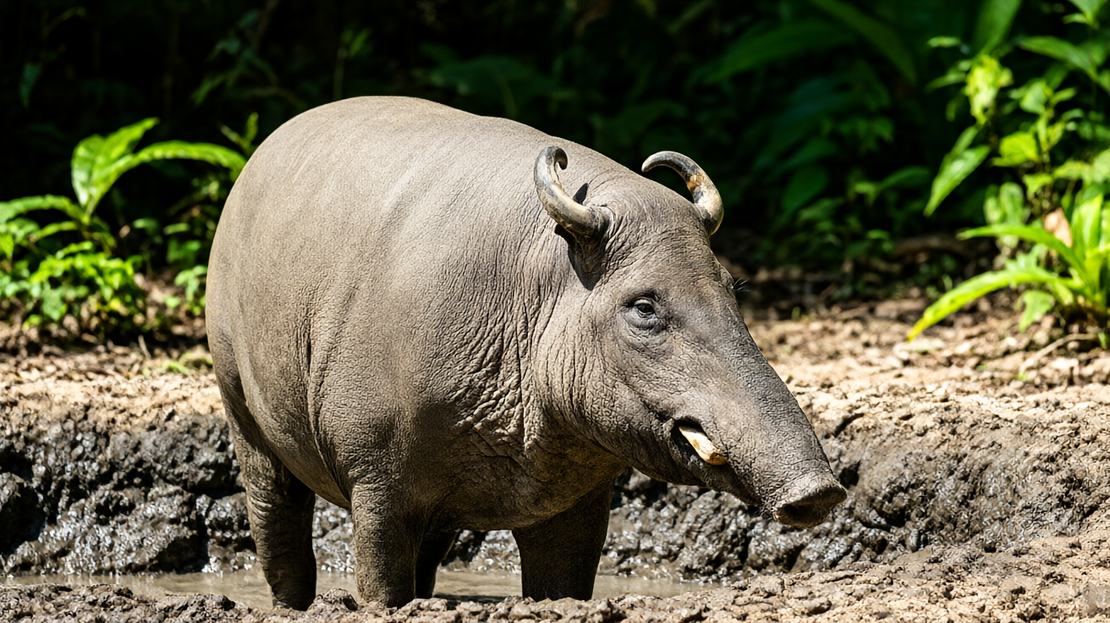
A wild pig with tusks that grow through its own snout stands in the forest.
Vulnerable
Length
Weight
Tusks
Gestation
Litter
Rating
The Babirusa
The pig with tusks through its face
A grey pig stands in shallow mud with two tusks curling above its eyes. The upper tusks grow upward through the skull and bend back toward the forehead. Nothing else on earth carries horns like these.
This pig lives only on Sulawesi and a few small islands nearby. The boar eats leaves and fallen fruit rather than roots. Its stomach has two chambers, which no other pig has.
Because the forest shrinks each year, the species now lives in scattered patches. Hunters still take animals for meat across much of the island.
Family tree
Suidae, the pig family
Its proper name is Babyrousa babyrussa, one of three named babirusas, and older books treated all of them as a single species. Skull studies later split the group by island and by tusk shape. Because the pigs never crossed deep water, each island evolved its own form.
This family includes every wild pig in the world. Babirusas split from other pigs long ago and changed in ways no relative shows. Its Malay name means deer pig, which refers to the antler like tusks.
Tusks and skin
How to tell one
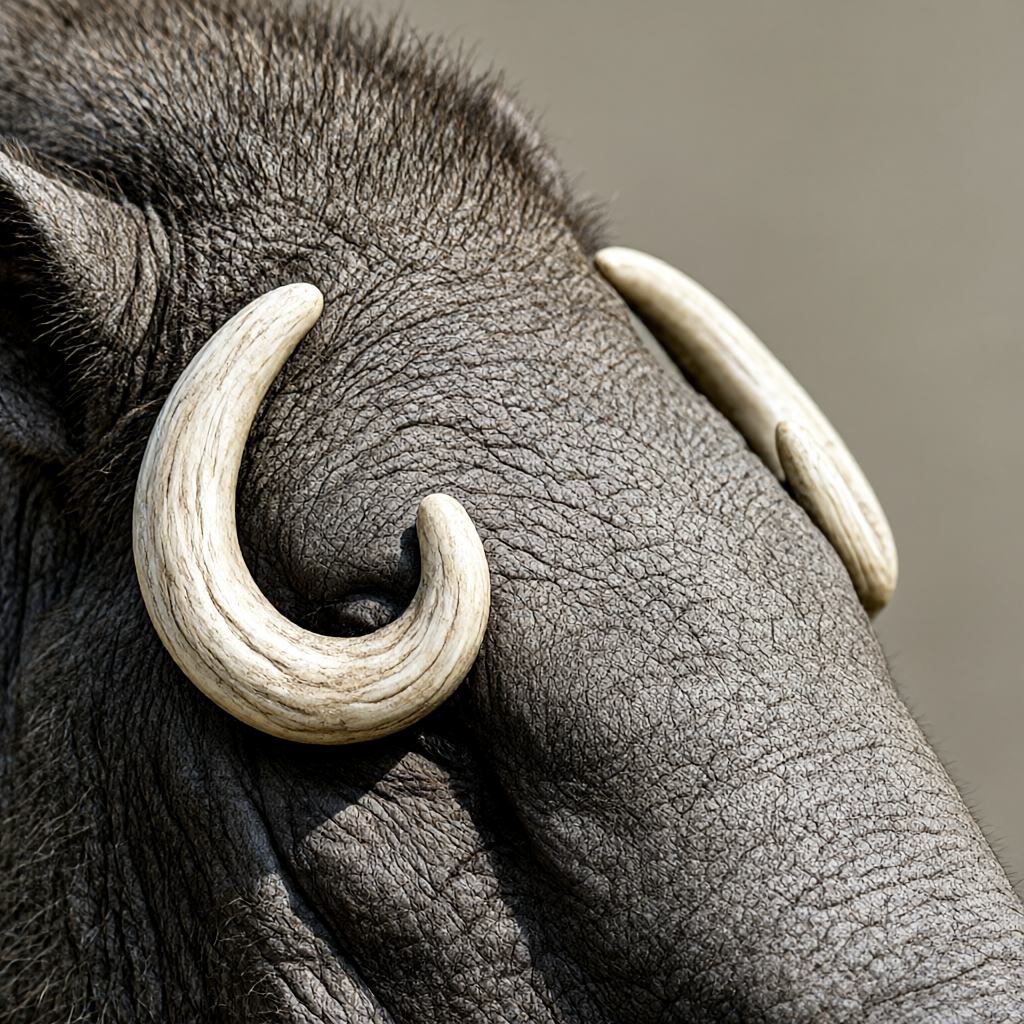
Adults run 85 to 110 cm from nose to tail base. Weight falls between 43 and 100 kg, and males run heavier than females, while skin looks grey and wrinkled under sparse hair. Upper tusks grow through the skin of the snout and curve backward.
Because the tusks keep growing, an old male may carry tips that nearly touch the skull. Lower tusks stand upright beside the mouth. A two chambered stomach lets the boar digest leaves, and legs run long and slender, which helps in thick forest.
A short tufted tail ends the body. Females carry two teats only, and litters seldom exceed two.
1
2
3
Forest, not grassland
Where it lives
Tropical forest is the main habitat, and so is forest edge. Bamboo thickets and river banks hold animals where cover stays. Because the pig cannot digest grass, it needs forest rather than open ground. Swampy ground suits it, since the boar wallows in mud to cool down.
Most records come from below 1,000 m. The boar avoids people where hunting is heavy. A rhinoceros also carries odd headgear, though its horn grows from the skull rather than through it.
Fruit, leaves and fungi
What it eats
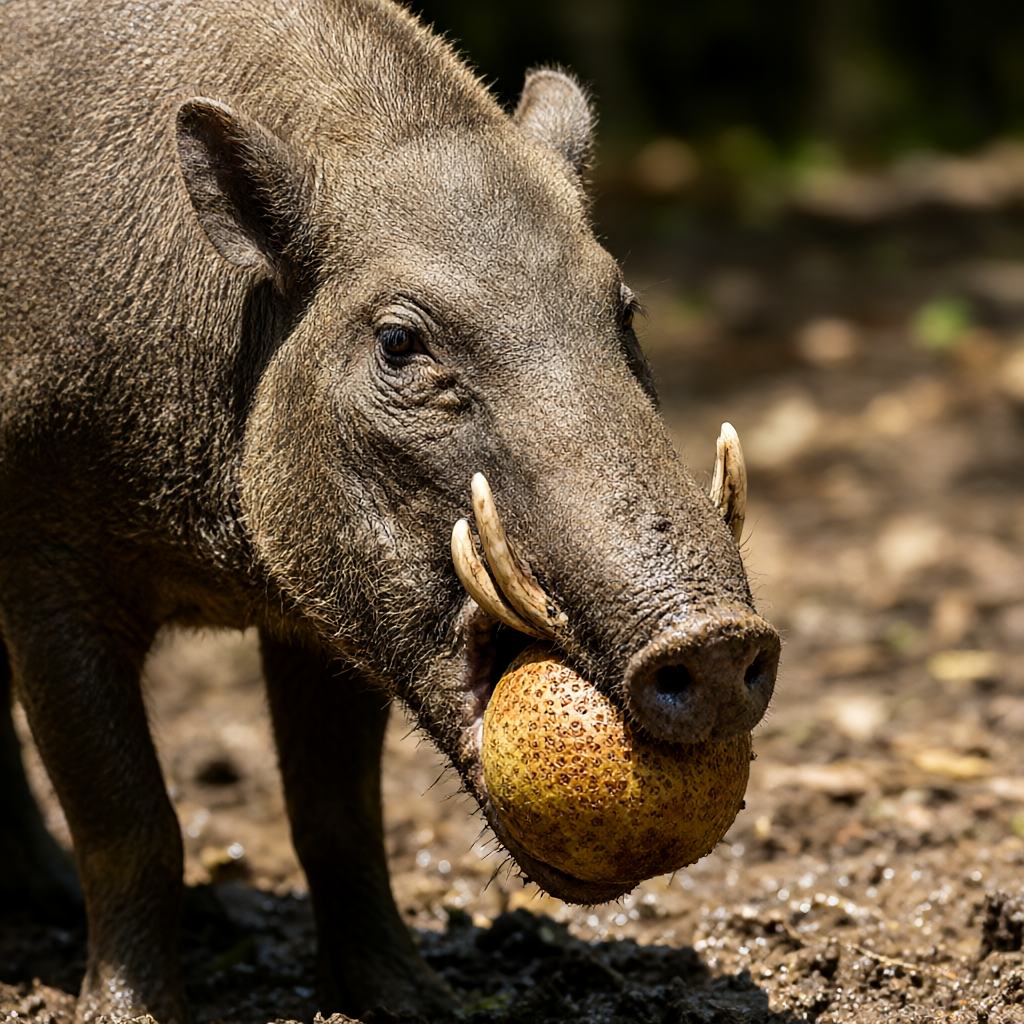
Leaves, fruit, nuts and fungi make up the diet. Because the stomach holds two chambers, plant material ferments before it passes on. Fallen figs matter most in the fruiting season.
Roots and tubers get taken seldom, which splits the pig from its kin. Mineral soil gets eaten at salt licks. The boar feeds in small groups, and the young stay close to the female.
One or two young
The breeding cycle
A female gives birth to one or two young. Gestation lasts about 155 days, which is long for a pig, and because the young stay with her for months she breeds slowly. A nest of leaves and twigs gets built before the birth.
Young stand within days and follow the mother soon after. Males take no part in raising them. Sexual maturity comes at one or two years in females.
Hunting and clearing
Conservation
The Red List calls the species Vulnerable. Forest loss takes both food and cover across Sulawesi. Because the boar breeds slowly, hunted groups recover poorly.
Tusks sell as ornaments, which keeps hunting profitable. Protected areas hold some animals, though enforcement is uneven. Breeding programmes in zoos now maintain a reserve population.
Side by side
How It Compares
| Trait | Babirusa | Wild Boar |
|---|---|---|
| Family | Suidae | Suidae |
| Length | 85-110 cm | 90-180 cm |
| Tusks | upper, through the snout | lower, curving outward |
| Food | leaves, fruit and fungi | roots, crops and carrion |
| Stomach | two chambered | single chamber |
| Rating | Vulnerable | Least Concern |
Common misreadings
What People Get Wrong
- Not a deer pig. That name describes the tusks, not the animal. Those tusks are upper canines that push through the skin of the snout and curve back toward the forehead as the boar ages.
- Not a grass eater. The stomach cannot handle grass at all. It takes leaves, fruit, nuts and fungi from the forest floor, which is why cleared ground leaves nothing for it to eat.
- Not a fast breeder. One or two young follow a pregnancy of five months. The female stays with them for months afterwards, so a pair produces few offspring and a hunted population recovers slowly.
Going further
Sources and Further Reading
Quick hits
Five things to remember
- Its tusks grow through the skull.
- Its stomach has two chambers.
- It eats leaves rather than roots.
- It lives only on Sulawesi.
- A female has just two teats.
[…] it sits low in the food web and shares its world with other small hunters such as the common shrew and the European water shrew, each occupying a slightly different slice of the same ground-dwelling […]
[…] Neomys, the water shrews. It belongs to the family Soricidae, the shrews, alongside the smaller Common Shrew and the tiny Pygmy Shrew. It is the largest European water shrew and is found across a broad band […]
[…] The name Erinaceus is Latin for hedgehog. The family sits in the order Eulipotyphla. That order holds hedgehogs, shrews, moles and solenodons. Genetic work has since pulled the old group apart. Hedgehogs are the spiny branch of it. Their fossils go back to the Eocene. The body plan has changed very little since then. The European hedgehog is a distant relative of the common shrew. […]
[…] animal shares the family with the Common Shrew. That animal grows a little larger. It lives across most of Europe. Our animal stays smaller and […]
[…] texts called the group elephant shrews, a name that caused confusion. The Common Shrew is a true shrew, while this animal sits in another order entirely. Both hunt bugs in litter, yet […]