 By st20113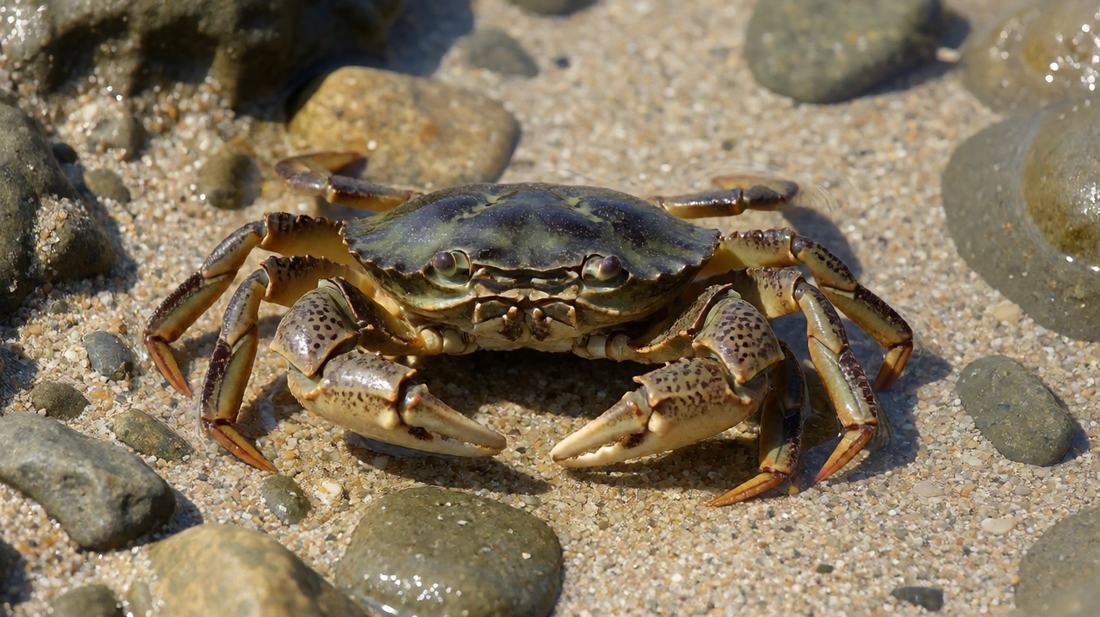
Carcinus maenas | Green Shore Crab
Species Profile · Carcinidae
Green Shore Crab
The small fierce crab under every European rock — and one of the world’s 100 worst invasive species, now at home on five continents.
IUCN: Not Evaluated
Range
Shell
Depth
Legs
Eggs
The crab under the rock
Europe’s commonest shore crab
The green shore crab is the small, fierce crab of European rocky shores, estuaries and harbours. It is one of the most successful marine invaders in the world. It is the crab most people in Europe find under a rock or in a rock pool. It has a broad, flat shell up to 10 cm across. The shell is mottled green to brown. The crab has 5 pairs of legs and a pair of strong claws of unequal size. It is tough and fast.
It will eat almost anything. That is why it rules the shore and the shallow water below it. It lives from the middle of the shore down to about 60 m. It lives on rock, sand, mud and gravel. It lives among seaweed and shellfish beds. It stands wide swings in temperature, salt and oxygen. It can live out of water for days if it stays damp.
Those same traits have made it a serious pest outside its home range. People have moved it to North America, Australia, South Africa, Argentina and Japan. There it eats shellfish, tears up eelgrass and beats native crabs. Experts list it among the world’s 100 worst invasive species. At home it is a familiar, common and central animal of the shore.
Family tree
Carcinidae, the shore crabs
The green shore crab is in the family Carcinidae and the genus Carcinus. It has also been placed in Portunidae, the swimming crabs. Older books still use that family. Linnaeus named the species in 1758 as Cancer maenas. It was later moved to Carcinus. The genus name comes from Greek and means crab. The species name maenas refers to a small sea fish of the classical world. Carcinidae is a small family of shore crabs.
The genus Carcinus holds this species and the closely related Mediterranean green crab. The animal is not a true swimming crab. It lacks the flat, paddle-shaped last pair of legs that mark Portunidae. It walks on the bottom rather than swimming in open water. It can swim when it needs to. The family sits in the infraorder Brachyura, the true crabs. That sits in the order Decapoda, the ten-footed crustaceans, and the class Malacostraca. The fossil record of the genus goes back to the Miocene.
The green shore crab shares the order Decapoda with the edible crab. That is a much larger and heavier animal of subtidal rock and sediment. The two look alike at a glance. Both have the black-tipped claws that anyone who has handled a European crab knows. But the edible crab has a broad oval pie-crust shell. This species is flatter, greener and far more active.
Flat green shell, dark claw tips
How to identify one
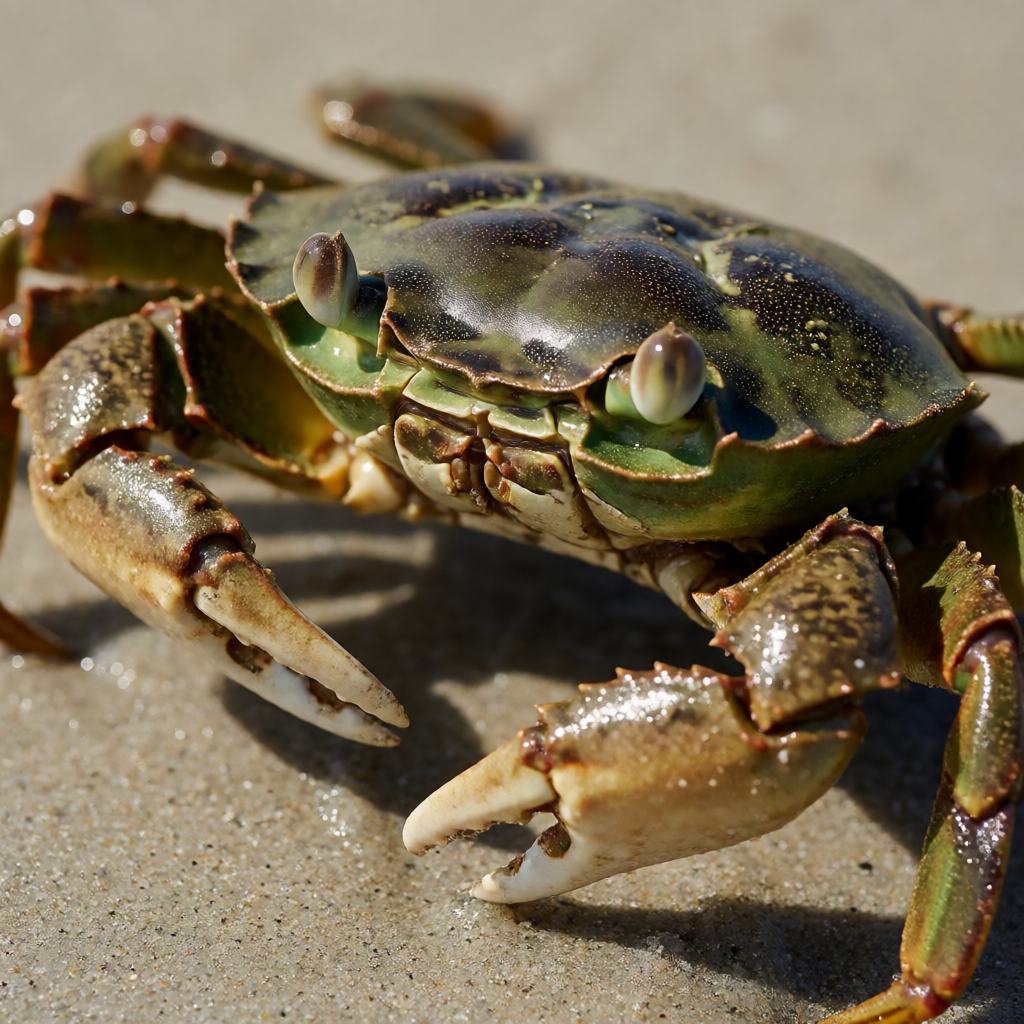
A green shore crab has a broad, flat carapace up to about 10 cm across. Most adults are 5 to 8 cm. The shell is wider than it is long. It is roughly hexagonal. There are 5 short teeth on each side behind the eye. There are 3 rounded lobes between the eyes. The upper surface is finely granular. It often has a faint pattern of lines. The colour is very variable.
The usual form is a mottled dark green to olive brown. Some animals are almost black. Others can be red, orange, yellow or grey. The underside is pale and can be bright yellow or orange. Young crabs are often patterned with white and dark marks. That helps them vanish against a mixed background. There are 5 pairs of legs. The first pair carries the chelae, the claws. The claws are unequal in size.
The crab uses them for fighting, for driving off rivals and for crushing shells. The claws have black or dark tips in many animals. The last 4 pairs are walking legs. They are flat and fringed with hair. The crab uses them to swim as well as to walk. The eyes sit on short stalks and can be folded into sockets. A large adult can weigh 200 g or more.
1
2
3
Shore, estuary and harbour
Where it lives
The green shore crab lives from the middle of the shore down to depths of about 60 m. It is one of the few crabs at home in all three of these places: a rocky shore, a muddy estuary and a harbour. It is found on rock, under stones and boulders, and in rock pools. It lives in crevices, among seaweed and kelp holdfasts, and on sand and mud. It lives in mussel and oyster beds and among eelgrass. By day it hides under cover. It comes out to feed mostly at night or when the tide covers it.
The animal is very tolerant. It lives at salt levels from nearly fresh to full seawater. It lives at temperatures from near freezing to above 25 degrees. It stands low oxygen. That is what lets it live in the upper reaches of estuaries and in dirty harbours where other crabs cannot. It is a strong osmoregulator. It can hold its internal salt balance in brackish water far better than most shore crabs.
Its native range covers the north-east Atlantic. It runs from Iceland and Norway south to Mauritania. It includes the Baltic, the Mediterranean and the Black Sea, and all coasts of Britain and Ireland. Outside that range it lives on both coasts of North America. It also lives in Australia, South Africa, Argentina and Japan.
Shellfish, worms and carrion
What it eats
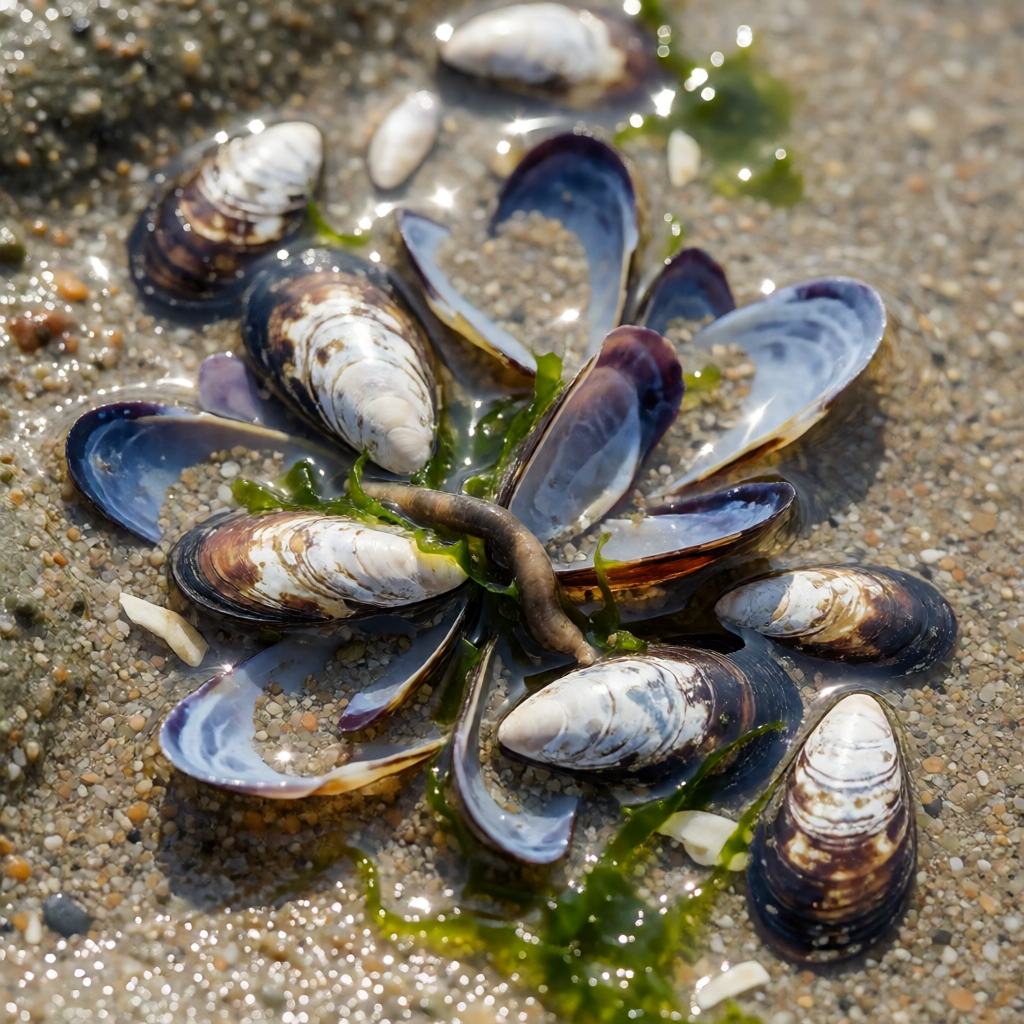
The green shore crab is an omnivore, a scavenger and a predator. It will take almost anything it can open, tear or pick up. Shellfish are the most important prey. It eats mussels, cockles, clams and oysters. It eats periwinkles and other small gastropods. The crab uses its stronger claw to crush the shell. Or it chips at the edge until it can get the shell open. It can handle prey much bigger than seems possible for its size.
It also eats worms and small crustaceans. It eats barnacles, sea squirts, small fish and fish eggs. It eats the eggs and young of other crabs. It grazes and sieves algae, diatoms and detritus from sediment. It takes carrion readily. It is one of the first scavengers to reach anything dead on the shore. Feeding is opportunistic. It varies with the habitat and the season.
Crabs in mussel beds eat mostly mussels. Crabs in estuaries eat mostly worms and detritus. The crab feeds mainly at night and on the flood tide. It eats the young of shellfish that people farm. It damages eelgrass beds while it forages. Those are the two reasons it does so much harm where it has been introduced.
Eggs carried under her body
The breeding cycle
Mating is tied to moulting. The female can mate only when her shell is soft. So a male finds a female that is about to moult. He carries and guards her for days. He mates with her right after she sheds. The male then guards her for a short while. He stops once the new shell begins to harden. The female can store sperm.
She can use it to fertilise more than one batch of eggs. She carries the eggs on the pleopods under her abdomen. They sit in a broad mass that looks like a sponge. The mass turns from bright orange to grey as the embryos grow. A large female can carry up to about 185000 eggs. She carries the eggs through the winter, or for several weeks if the water is warm. She fans them and keeps them clean. When they hatch, the larvae are released as zoeae into the plankton.
They pass through several zoeal stages and then a megalopa stage. They drift and feed in open water for weeks to a couple of months. Then they settle to the bottom and change into a tiny crab. Most settlement happens in shell, gravel and seaweed. Growth is rapid. Maturity comes at 1 to 3 years. The animals live 3 to 7 years. They go on moulting through life.
Not Evaluated, a global pest
Conservation
The green shore crab is not assessed on the global Red List. There is no conservation concern for it. Within its native range it is abundant and rising in places. Outside that range the problem is that there is too much of it. It sits on the list of the world’s 100 worst invasive species. Where it has been introduced it preys heavily on native shellfish.
It competes with and preys on native crabs and lobsters. It damages eelgrass and saltmarsh by its burrowing and foraging. That loosens the sediment and cuts the habitat for other species. On the Pacific and Atlantic coasts of North America it has caused serious losses to clam, oyster and soft-shell shellfish fisheries. A lot of effort goes into trapping and controlling it. It spreads in ballast water and on ships’ hulls.
It spreads with shellfish moved for farming, and with bait and packing material. Within its native range the pressures are minor and local. Heavy bait collection, oil spills and severe pollution in harbours all cut local numbers. But the animal comes back fast. Its larvae drift in the plankton and its tolerance is so broad. Monitoring and rapid response remain the main tools where it is new.
Quick hits
Five things to remember
- The species is listed among the world’s 100 worst invasive species, and it now lives in North America, Australia, South Africa, Argentina and Japan.
- A large female can carry up to about 185000 eggs under her abdomen, and the egg mass turns from bright orange to grey as the young grow.
- The crab can live out of water for days as long as its gills stay damp, which is why it is often found under dry stones well above the tideline.
- Crabs range from dark mottled green through brown to bright red and orange, and the colour varies with the background the animal grew up against.
- It can hold its internal salt far better than most shore crabs, which is what lets it live in estuaries where the water is nearly fresh.
[…] crab shares the family group with the Green Shore Crab. That crab has a smooth green shell. It lives on sand and mud below the tide line. Our crab has a […]