 By st20113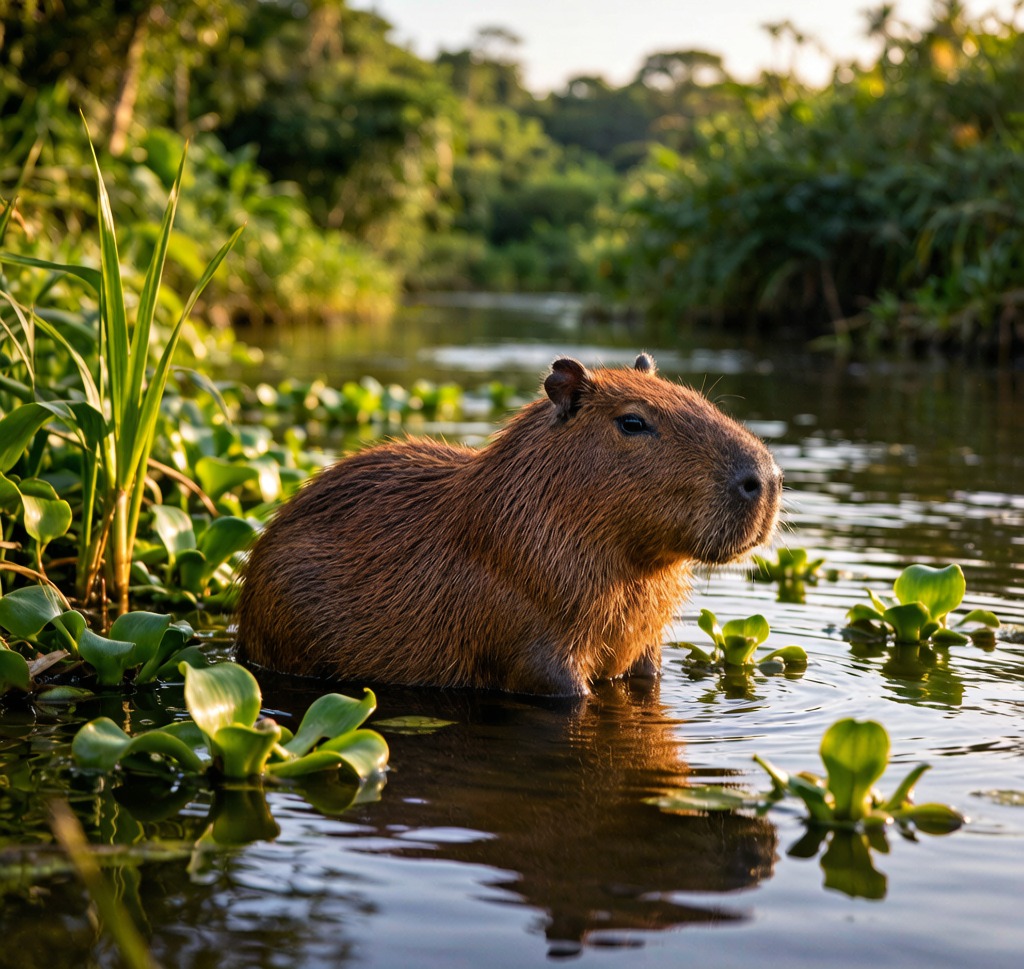
A Capybara (Hydrochoerus hydrochaeris) resting in a tropical wetland in Venezuela
Overview
The Capybara (Hydrochoerus hydrochaeris) is the world’s largest living rodent, native to South America. Often described as a “giant guinea pig,” capybaras are highly social, semi-aquatic mammals that thrive in a variety of wetland habitats. With their barrel-shaped bodies, blunt snouts, and tranquil demeanor, capybaras have become internet-famous for their seemingly zen-like temperament, often seen allowing birds to perch on their backs.
An adult capybara stands approximately 50-60 centimeters at the shoulder and measures 100-135 centimeters in length, weighing between 35 and 66 kilograms. Their coarse, reddish-brown fur is dense and water-resistant. Capybaras have partially webbed feet, making them excellent swimmers. Their eyes, ears, and nostrils are positioned high on the head, allowing them to see, hear, and breathe while mostly submerged.
Habitat and Distribution
Capybaras are found throughout most of South America east of the Andes, from Colombia and Venezuela south to Uruguay and northern Argentina. Their range encompasses a wide variety of tropical and subtropical wetland habitats, including lakes, rivers, swamps, marshes, flooded grasslands, and the dense vegetation along riverbanks. They require permanent water sources for wallowing, swimming, and foraging, and they are never found far from water.
Their habitat flexibility is remarkable – capybaras can thrive in cattle ranching landscapes where they graze alongside livestock, and they are also found in pristine rainforest environments. However, they prefer open savanna-like areas near water where grass is abundant. Seasonal flooding drives capybaras to higher ground during the wet season, and they may travel considerable distances to find suitable habitat during periods of drought.
Diet and Foraging
Capybaras are strict herbivores with a diet centered on grasses and aquatic vegetation, supplemented by bark, leaves, fruits, and seeds. They are grazers that feed primarily at dawn and dusk, spending several hours each day consuming large quantities of coarse grasses. An adult capybara can eat 2.5 to 3.5 kilograms of vegetation per day. Their teeth are continuously growing and are worn down by the abrasive plant material they consume.
Water plays a crucial role in their foraging behavior. Capybaras often feed on submerged and semi-submerged plants while in the water, and they use water to help digest tough plant fibers through a process of fermentation in their enlarged cecum. Like other rodents, capybaras practice coprophagy, consuming special nutrient-rich fecal pellets called cecotropes to maximize nutrient absorption from their fibrous diet.
Social Structure
Capybaras are highly social animals that live in groups typically numbering between 10 and 20 individuals, though groups of up to 100 have been observed in particularly favorable habitats. Each group is led by a dominant male who maintains his position through aggressive displays and physical confrontations with rival males. Females, their offspring,, and subordinate males make up the rest of the group.
Social bonding is reinforced through mutual grooming and vocal communication. Capybaras produce a range of sounds including barks, clicks, whistles, and purrs to communicate with group members. One of the most distinctive aspects of capybara social behavior is their remarkable tolerance of other species – they have been observed allowing birds such as cattle egrets and jacanas to feed on insects disturbed by their movement, and even allowing young caimans and turtles to rest near them.
Reproduction and Predation
Capybaras breed year-round, though in seasonal environments, births are concentrated during the rainy season when food is most abundant. The dominant male in a group has priority access to mating with females. After a gestation period of about 150 days, the female gives birth to a litter of 1 to 8 precocial young (average 4-5), which are born fully furred, able to see, and capable of walking within hours of birth.
All group members take part in caring for the young, a behavior known as alloparenting. The young begin grazing within days and are weaned at around 16 weeks. Natural predators of capybaras include jaguars, pumas, anacondas, caimans, and large eagles. Capybaras respond to predator threats by diving into water, where they can remain submerged for up to 5 minutes, or by fleeing to dense vegetation at high speed.
Relationship with Humans
In some South American countries, capybaras are hunted for their meat and leather. In Venezuela, a dried, smoked capybara ham called “chiguire” is a traditional delicacy, and the animals are also ranched for this purpose in some regions. However, capybaras are protected in national parks and reserves throughout much of their range, and their role as a key species in wetland ecosystems is increasingly recognized.
In recent years, capybaras have become a global internet sensation, with videos of them relaxing in hot springs going viral worldwide. Their calm, unruffled nature has made them one of the most beloved animals in the Americas, and they serve as a flagship species for the conservation of South American wetlands and riparian habitats.
[…] seen, yet it plays an outsized ecological role in maintaining forest diversity, much like the capybara that shares its […]