 By st20113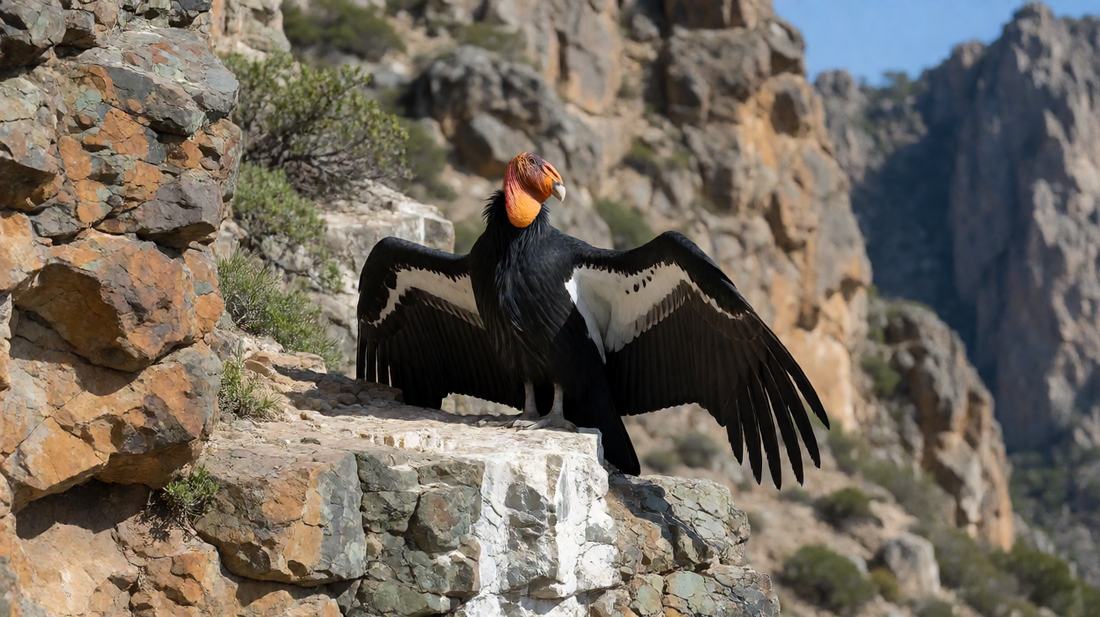
Gymnogyps californianus | California Condor
Species Profile · Cathartidae
California Condor
The largest flying bird of North America, brought back from twenty-seven individuals — and still dependent on people to keep it alive.
IUCN: Critically Endangered
Range
Length
Weight
Nest
Incubation
The bird that came back
From 27 birds to a wild flock
The California condor is the largest flying bird of North America. It is also one of the rarest birds of the world. It is a gigantic and a very dark scavenger. It lives in the mountains of the south-west of the continent. It also uses the coastal cliffs of that region. Its wingspan is nearly 3 metres. That makes it one of the largest of all the birds that can fly. The bird is a soaring glider of the most extreme kind. Its body weighs as much as 14 kilograms. Its wing is built for the long and the slow ride on the rising air. The flight looks almost effortless. It is not built for the flapping of the ordinary bird.
The species is one of the most celebrated stories of the conservation of the wildlife. It was reduced in the 1980s to a total of 27 individuals. It was then brought back from the edge of the extinction. The captive breeding and the reintroduction were the most intensive ever attempted for a bird. The programme was also the most expensive. The whole of the surviving population of the world is descended from those 27 birds. The recovery has continued to this day. The total number of the condors of the world passed 600. That mark was reached at the end of the year 2025. The number of the free-flying birds is now close to 400. The bird is nevertheless still in a very serious condition. It is assessed as Critically Endangered.
The whole of the wild population depends on the continued intervention of the people. The birds are killed by the lead of the ammunition. That lead remains in the carcasses on which they feed. The species cannot yet maintain itself without the help of the programme. It needs the supplementary feeding and the medical treatment. It needs the constant monitoring that the recovery programme provides. The California condor is therefore a bird that has been saved from the extinction. It has not yet been restored to the state of a self-supporting species. It is the clearest of all the examples of a hard truth. The recovery of a very rare animal can become a permanent commitment. It does not always become a completed project.
Family tree
Gymnogyps, a genus of one
The California condor was described by George Shaw in 1797. The modern treatment places it in the genus Gymnogyps. That genus contains no other living species. The genus sits within the family Cathartidae. Those are the vultures of the New World. The family contains 7 species and is confined to the Americas. Its members are the condors and the vultures of the Americas. They are the only large scavenging birds of the western hemisphere. The family has one of the most interesting histories of classification. The vultures of the New World have been moved about by turns. They have been placed with the vultures of the Old World. They have also been placed with the storks and with the birds of prey.
The modern molecular work has shown the truth. They are in fact the close relatives of the storks. The resemblance to the vultures of Africa and of Asia is therefore misleading. It is a consequence of the similar way of life. It is not a consequence of the common descent. The likeness of the 2 groups is a standard example of convergent evolution. The California condor is therefore the close relative of the Andean Condor (Vultur gryphus). That bird is the giant scavenger of the Andes of South America. The 2 birds share the family and the bare head and neck. They share the hooked bill and the enormous wing. They are the 2 largest of the family by a considerable margin. They differ in the details of the head and of the plumage.
The Andean condor has a white ruff at the base of the neck. The male of that species has a fleshy comb on the head. The California condor has a black ruff and no comb. The 2 are separated by the whole of the length of the Americas. They have no contact at any point. The fossil record of the genus Gymnogyps is a rich one. The genus was widespread over the whole of North America in the Pleistocene. The remains of the other species have been found from Florida to Peru. The California condor is therefore the last surviving member of a group. That group was once numerous and widely distributed. The group has contracted to a single species and a single small area. That is one of the most dramatic of the known histories of a lineage of birds.
Black wing, white flash
How to identify one
An adult California condor is between 117 and 134 centimetres in length. Its wingspan is between about 249 and 300 centimetres. Its mass is between about 7 and 14 kilograms. So the bird is the largest of the flying birds of North America. It is one of the heaviest of all the birds capable of sustained flight. The plumage of the adult is a matte dark brown-black. It covers the whole of the body and the upper surface of the wings. The underwing carries a great triangle of the white. The triangle extends from the leading edge towards the tip of the wing. The contrast between the white of the underwing and the black of the rest is striking. That contrast is the single most useful field character of the species. It shows at an immense distance against the sky.
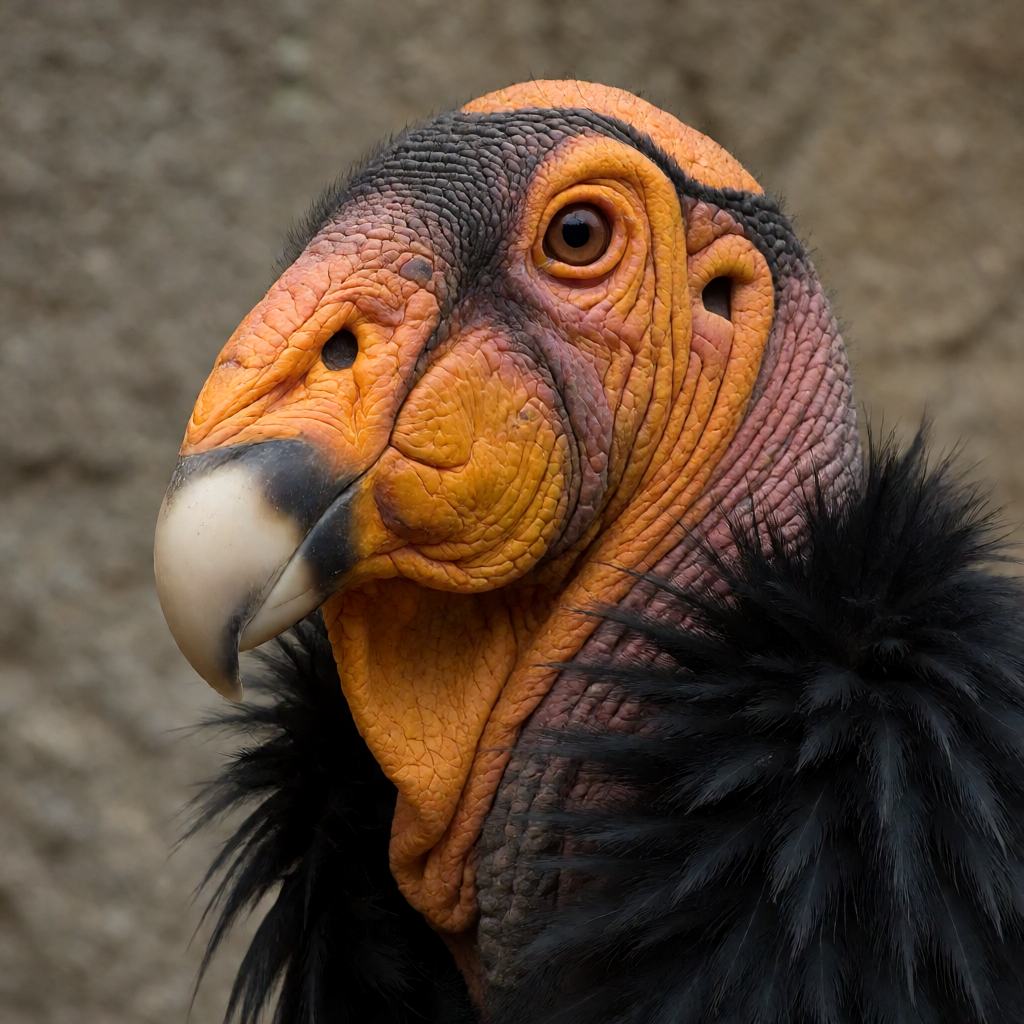
The head and the neck are entirely bare of the feathers. The skin is a dull and a greyish colour in the ordinary state. It turns to a bright and a vivid orange-red when the bird is excited. It does the same when the bird is feeding. That change of colour is one of the most remarkable signals of the bird world. The birds use the colour of the head to assess one another. They do so at a carcass. The bill is heavy and is hooked at the tip. It is a pale cream in the adult. The bill of the young bird is a dark grey-black. The colour of the bill is one of the easiest ways to judge the age. The eye is dark and is surrounded by a ring of the bare skin.
The bird has very acute vision. It locates the carrion by sight rather than by smell. The sense of smell is well developed in some of the other members of the family. The condor is a bird of the open and the very large landscape. It finds its food with the eye. The legs and the feet are grey and are strong. The bird walks and hops on the ground with an awkward gait. The foot is not built for the grasping of a prey. The whole of the feeding of the species is done from carrion. That carrion is already dead.
1
2
3
Mountain and coastal cliff
Where it lives
The California condor is a bird of the mountains and of the coastal cliffs. It is a bird of the open and the very large landscape. The species needs 2 things above all others. The first is the wind and the rising air. A bird of nearly 3 metres across the wings must have them. That lift keeps the bird in the air. The second is the great open country. It must hold a supply of the carrion of the large mammals. So the bird lives in the rugged and the mountainous terrain. The thermal and the ridge lift are reliable there. The herds of the deer and the cattle graze over a wide area there too.
The historic range of the species covered the whole of the south-west of North America. The bird occurred from the coast of California and of Baja California. It reached the mountains of Arizona and of Utah and of New Mexico and Texas. It was also recorded on the coast of the Pacific north-west. The carcasses of the whales and of the sea lions provided the food there. The species exploited that supply. The range of the bird has contracted very greatly over the last 2 centuries. The modern birds live in a small number of the designated areas. Those areas lie in California and Arizona and Utah and Baja California. They also lie in the north-west. The bird nests and roosts on the ledges and the caves of the cliffs.
It also uses the great cavities of the tall trees. The site is chosen for its inaccessibility as much as for the shelter. The condor is a bird of the very great home range. The individual can travel more than 200 kilometres in a single day. It travels in the search of the food. It can cross the whole of the mountain range of a state in a few days. The enormous scale of the movement is one of the reasons for the difficulty. The conservation of the bird requires the cooperation of many authorities. It also requires the cooperation of the different landowners.
A finder of the dead
What it eats
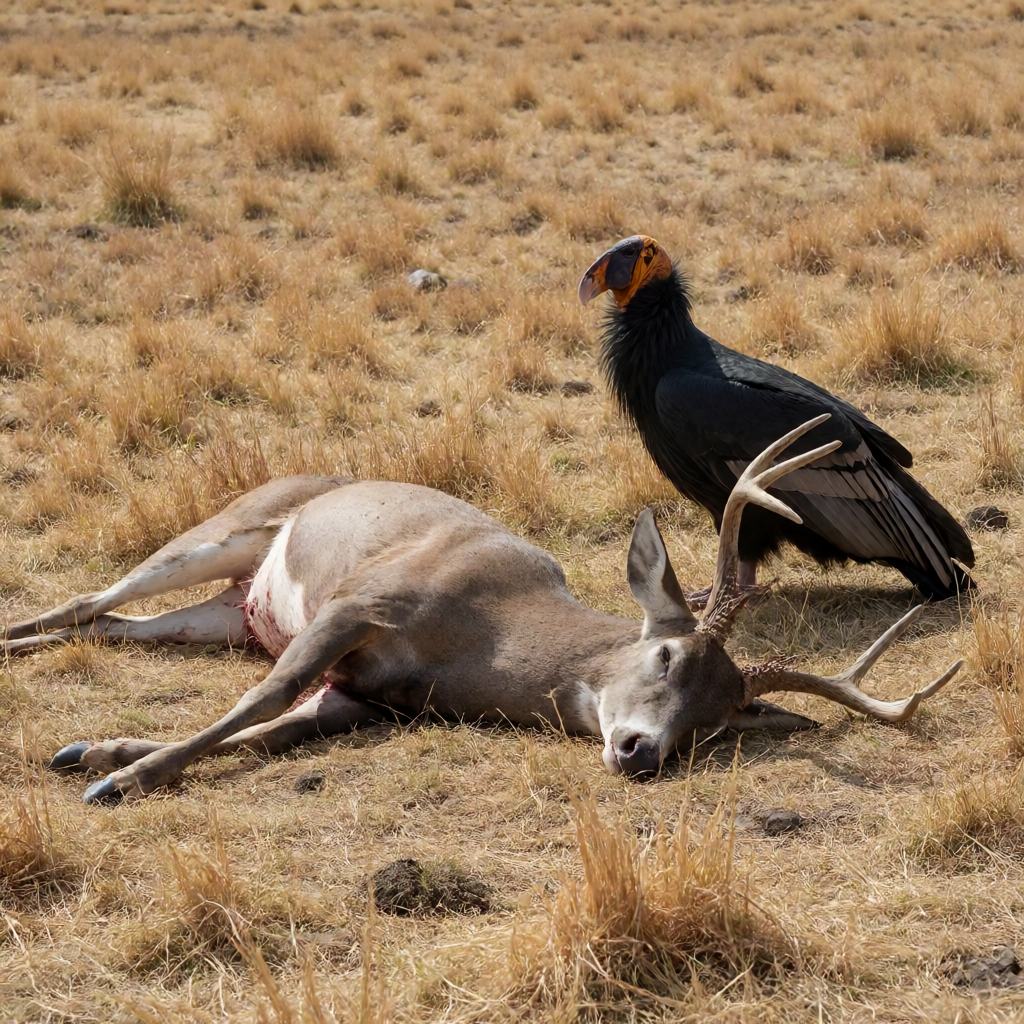
The California condor is a specialised scavenger of the large carrion. The greater part of the diet is made up of the bodies of the large mammals. The species takes the deer and the cattle and the sheep. It takes the horse and the ground squirrel and the rabbit. It also takes the carcass of the sea lion and of the whale on the coast. The bird is not able to kill its prey. It does not attempt to. The whole of its feeding depends on the death of other animals. The bird locates the food by sight and not by smell. The species covers a very great area in the search. The individual condor can travel more than 200 kilometres in a day. The bird uses the thermal and the ridge lift to gain height.
It then glides over the country in long and slow sweeps. The record altitude of the species is more than 4,600 metres above the sea. The bird is a social feeder. A number of the condors will gather at a single carcass. The group establishes a strict order of the size and of the age. The older and the larger birds feed first. The younger birds wait at the edge. The whole of the group is a very conspicuous sight on the ground. The birds will remain at a carcass for several days. They will eat a very great quantity of the meat at a single sitting. The species is not able to digest the bone. It feeds on the soft tissue.
The quantity of the food that a single bird can take is remarkable. It manages that at a single meal. The bird can store a very large amount of the meat in the crop. It can then go without the food for several days. The greatest danger to the species arises from this way of the feeding. The carcasses of the animals that are killed by the hunters contain the lead ammunition. The fragments of the lead are the problem. The lead is dissolved in the acid of the stomach of the bird. It is absorbed into the blood. It poisons the whole of the nervous system. The lead poisoning is the greatest single cause of the death. It kills the wild condors today.
One egg every two years
The breeding cycle
The California condor is one of the slowest of all the birds to reproduce. The species does not begin to breed until it is between 6 and 8 years old. The pair produces a single egg at an interval of 2 years in the usual case. So a pair raises about 1 young in 2 years. The rate of the reproduction of the species is the slowest of any. No other bird of North America breeds so slowly. The pair bond is a lasting one. The 2 birds maintain the contact by the display of the head and of the neck. They also exchange the low and the hissing calls. The nest site is a cave or a ledge or a cavity in a cliff. It can also be a great hole in a tall tree. The same site is used by the pair year after year. The absence of the suitable nesting sites is one of the limits on the recovery.
The single egg is laid in the winter and the early spring. It is a large egg of a pale blue-green colour. The incubation lasts for between 53 and 60 days. It is shared by both parents. The chick is covered in a grey down. It is fed by the regurgitation of the food by the parents. The young bird does not leave the nest until it is between 5 and 6 months old. It continues to follow the parents and to be fed by them. That period lasts for several months more. So the whole of the rearing of 1 young bird occupies more than a year. The young bird depends on the parents for a very long time. That dependence is one of the longest of any bird of the size. The whole of the breeding biology is arranged on one assumption.
The assumption is that the adult birds will live for decades. The recorded life span of the wild bird is more than 50 years. One of the known birds was more than 60 years old at its death. It was one of the oldest of the species on record. The length of the life of the species is one of the assets of the recovery. A bird that lives for half a century can take its time. It can afford to raise a very small number of the young. The recovery programme has exploited that biology directly. The removal of the first egg from the nest induces the bird to lay again. The nest belongs to a wild pair. The technique has doubled the productivity of the wild population. It is known as the double clutching.
Critically Endangered still
Conservation
The California condor is assessed as Critically Endangered on the global Red List. It is one of the rarest of all the large birds of the world. The history of the species in the last century is a bleak one. It is a history of a very rapid decline. The bird was still widespread over the south-west of the continent in the 19th century. The number had fallen to a few dozen by the middle of the 20th century. In 1987 the total of the known birds was 27 individuals. The whole of that remnant was taken into captivity. That was a last and an unprecedented attempt to save the species. The first of the condors were returned to the wild in the early 1990s. The population has increased steadily since then. The total of the world was 607 birds at the end of the year 2025. The number of the free-flying birds was 392. The rest of the population is held in the breeding centres. Those centres are in the zoos of California and of Oregon and of Mexico City. The species was for a period classified as Extinct in the Wild. That period covered the years in the cages.
The whole of the population was held there at the time. The wild population is now nearly 400 birds. The recovery from that state is one of the great achievements. The modern conservation of the wildlife has few better examples. The work has been financed and carried out by a partnership. The federal and the state agencies of the United States are part of it. The private organisations of the United States and of Mexico are part of it too. The bird is nevertheless not yet safe. The lead poisoning remains the greatest of the threats. The fragments of the lead ammunition remain in the gut piles. They also remain in the unrecovered carcasses of the hunted deer. The shot coyote leaves the same danger. The condors eat the fragments. The lead is absorbed and the bird dies of the poisoning. The lead killed at least 9 of the 22 wild birds that died in 2025. The state of California has banned the lead ammunition. The hunters elsewhere use the non-lead ammunition on a voluntary basis.
Those 2 things are the most important of the measures of the conservation. The bird also swallows small fragments of the glass and of the metal. The chicks pick them up in the nest. The fragments kill the bird. The collision with the power line is a further cause of death. The young birds are the usual victims. The outbreak of the avian influenza came in the region of Arizona and of Utah. It killed 21 of the birds in a single year. That showed how quickly the disease can damage a population. The population is concentrated into a small number of the sites. It also has a very low rate of the reproduction. The species is protected by the law in the United States and in Mexico. It is listed in the first appendix of the convention on the international trade. The whole of the wild population carries radio transmitters. It is monitored every day. The birds that are sick or injured are captured and treated. The species will require that level of the attention for the foreseeable future.
Quick hits
Five things to remember
- In 1987 the total number of the California condors in the world was 27. The whole of that remnant was brought into captivity. For a period of several years the species was classified as extinct in the wild.
- The bird can travel more than 200 kilometres in a single day. It does so in the search of the food. The recorded altitude of the species is more than 4,600 metres above the sea.
- The bare skin of the head changes from a dull grey to a vivid orange-red. The members of the group use the colour to assess one another at a carcass.
- The removal of the first egg from the nest of a wild pair induces the bird to lay a replacement. The technique of the double clutching has doubled the productivity of the wild population.
- The whole of the population of the world today is descended from those 27 birds of the year 1987. The species raises about 1 young in 2 years. The wild bird can live for more than 50 years.