 By Iris
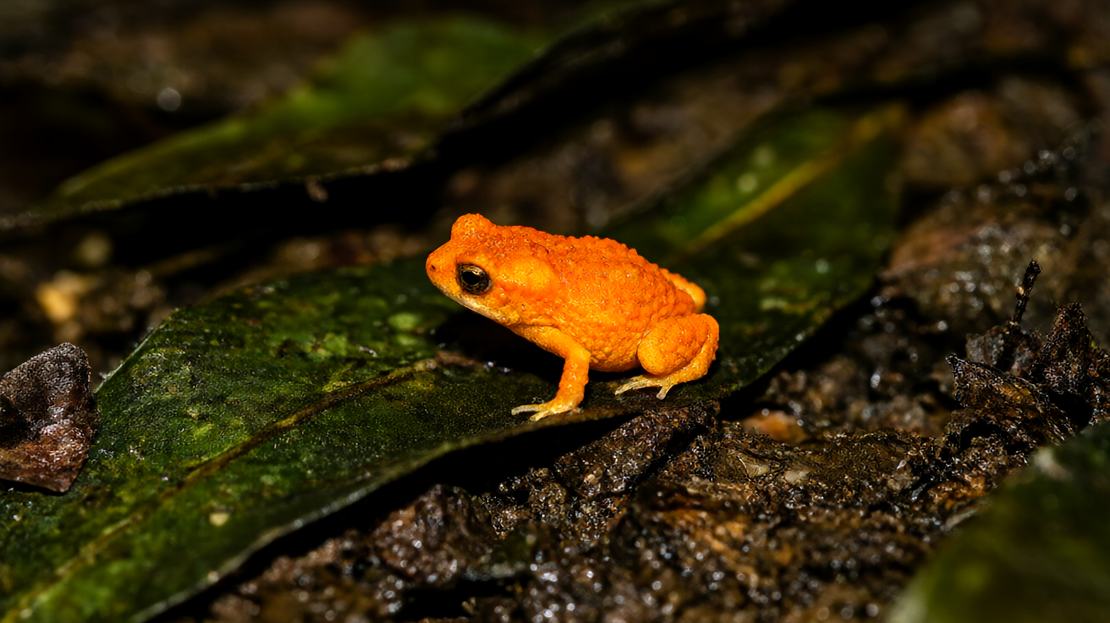
Brachycephalus ephippium | Pumpkin Toadlet
Species Profile · Brachycephalidae
Pumpkin Toadlet
A fleck of orange sits on a wet leaf and does not move.
Least Concern
Length
Weight
Toes
Clutch
Skin
Rating
The Pumpkin Toadlet
A fleck of orange on a leaf
A fleck of orange sits on a wet leaf and does not move. It is a frog, and a small one. The whole body runs under 2 cm, which puts it among the smallest frogs alive.
Pumpkin toadlets live in the leaf litter of the Brazilian Atlantic Forest. They walk rather than hop, and they never swim. Because the skin carries a powerful toxin, the bright colour is a warning rather than decoration.
Family tree
Brachycephalidae, small and armoured
Its proper name is Brachycephalus ephippium, one of many pumpkin toadlets. Brachycephalidae is the family, a group found only in eastern Brazil. A Golden Poison Frog makes the same bargain, since it also trades speed for poison and bright colour.
Both rely on being seen, and both can afford to sit still. A Common Midwife Toad carries its eggs instead, though it stays dull brown and hides by day.
Orange, and toxic
How to tell one
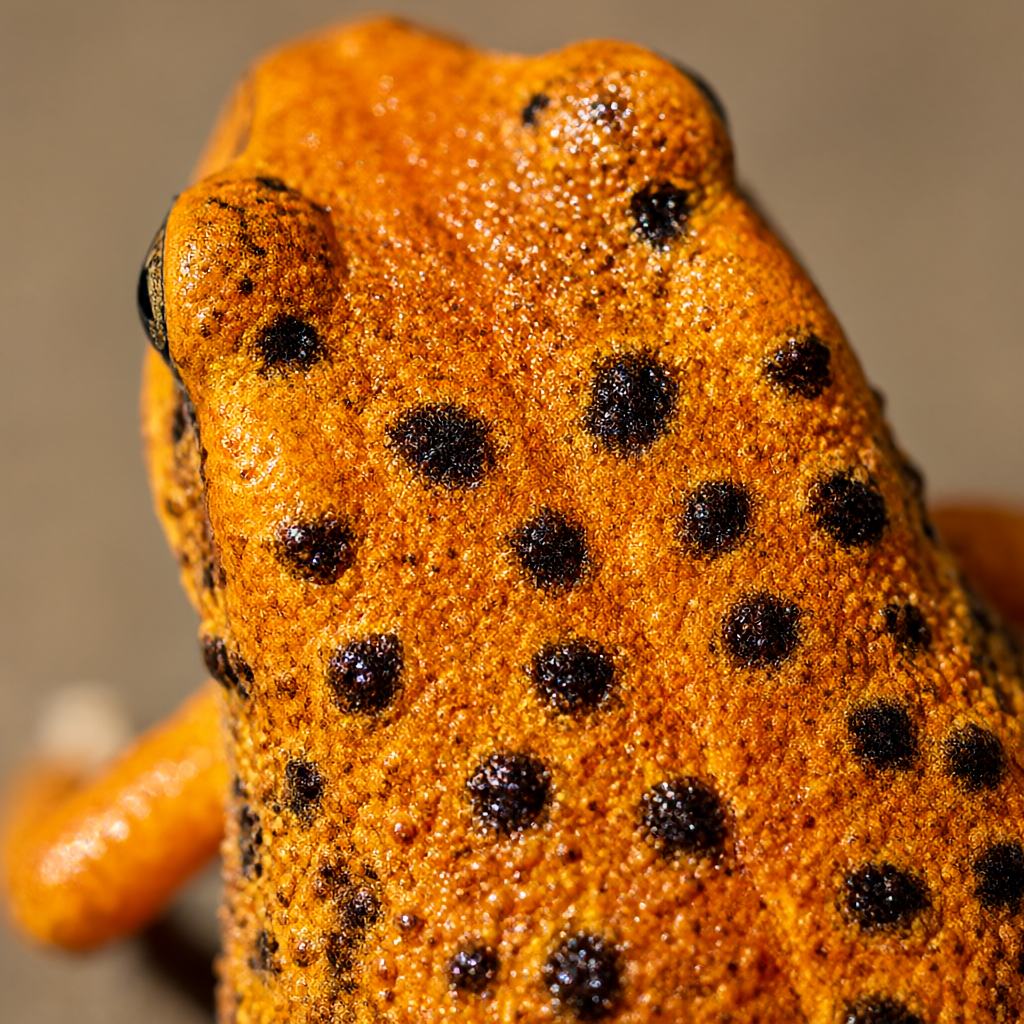
Body length runs 15 to 20 mm. Weight stays below 2 g. The skin is bright orange, and it looks almost varnished.
Its frame is heavily ossified, with many bones fused as one. Because the skull and back plates fuse early, it moves stiffly and cannot hop more than a few centimetres. The toes number three or four on each foot, fewer than most frogs carry.
Females grow slightly larger than males. It sits tight.
1
2
3
Deep leaf litter
Where it lives
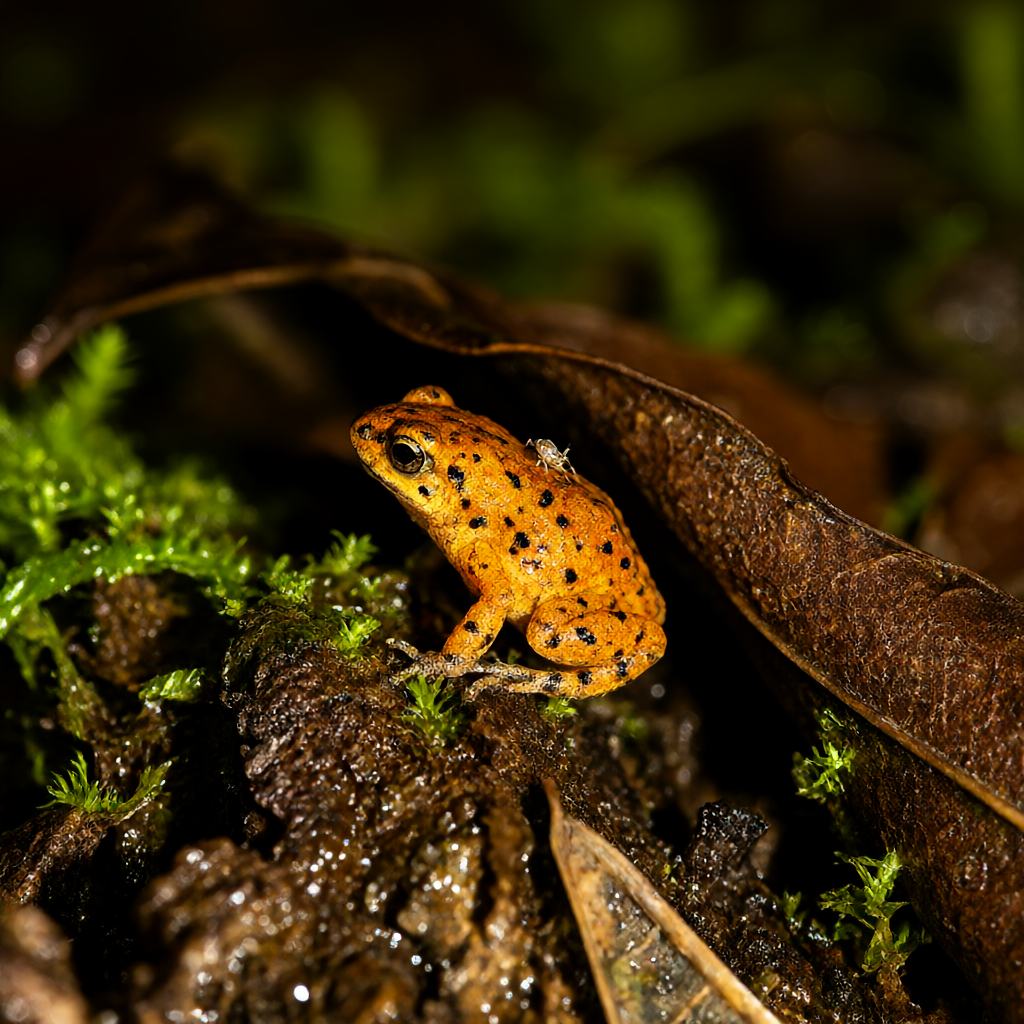
Forest floor in the mountains behind Rio de Janeiro and São Paulo holds the species. Deep leaf litter suits it, and it needs shade and moisture at once. Because the litter dries fast on an open slope, the frog cannot cross a cleared gap without losing its moisture.
Cloud and mist keep the layer damp through the dry months. The species also survives in secondary growth, as long as the canopy closes. Nothing moves fast.
Mites and springtails
What it eats
Small insects make up the food. Mites, springtails and tiny beetles come first. Because it cannot jump, it takes prey that walks within reach. Feeding happens by day, mostly in the litter.
Its range of movement stays small, and an individual may live out its life on one slope. Nothing large ever gets eaten, since the mouth opens only a few millimetres. Cover is all.
No tadpole stage
The breeding cycle
Eggs go into damp soil rather than water. A clutch holds a few large eggs, and each one develops straight into a small frog. Because there is no tadpole stage, it never needs a pool.
The male stays near the clutch, though he offers no care beyond that. Froglets emerge at about 5 mm and look like tiny adults. Growth takes months, and the orange colour deepens with age.
Forest fragments
Conservation
Red List status is Least Concern. Its range sits inside a region that has lost most of its original forest. Because the species tolerates regrowth, it holds on in small fragments.
Clearance for pasture and housing removes the litter layer entirely. Pollution and dry seasons may matter, though no survey has measured the effect.
Side by side
How It Compares
| Trait | Pumpkin Toadlet | Golden Poison Frog |
|---|---|---|
| Family | Brachycephalidae | Dendrobatidae |
| Length | 15-20 mm | 35-55 mm |
| Colour | bright orange | bright yellow |
| Toxin | tetrodotoxin | batrachotoxin |
| Hearing | no ear drum | ear drum present |
| Rating | Least Concern | Least Concern |
Common misreadings
What People Get Wrong
- Not a toad in the family sense. The name misleads. Brachycephalidae sits far from the true toads, and it shares almost nothing with the warty species in a garden.
- Not a jumper, despite the legs. The skeleton limits it. Fused plates stiffen the body, and it walks across wet leaves rather than launching itself between them.
- Not a frog that ever swims. Water is avoided. The whole life cycle runs on damp ground, and no tadpole stage appears anywhere between egg and adult.
Going further
Sources and Further Reading
Quick hits
Five things to remember
- The frog cannot hear its own call, since it has no ear drum and no middle ear.
- Its skin carries a toxin strong enough to deter most predators.
- It walks instead of hopping, and it never enters water.
- Bright orange covers the whole body, and the colour fades a little as the frog ages in the litter.
- A pumpkin toadlet is short enough to sit on a thumbnail with room to spare.
[…] total length and is used for balance during climbs and rapid direction changes. Unlike the Jaguar that overlaps its range in Central and South America, the cougar has a uniformly colored coat […]
[…] wetlands, shaping vegetation and serving as a critical prey base for predators ranging from jaguars to spectacled […]
[…] It became the sign of the king himself. Kings sat on jaguar-skin thrones and wore jaguar pelts. The jaguar appears again and again in the carvings of every great […]