 By st20113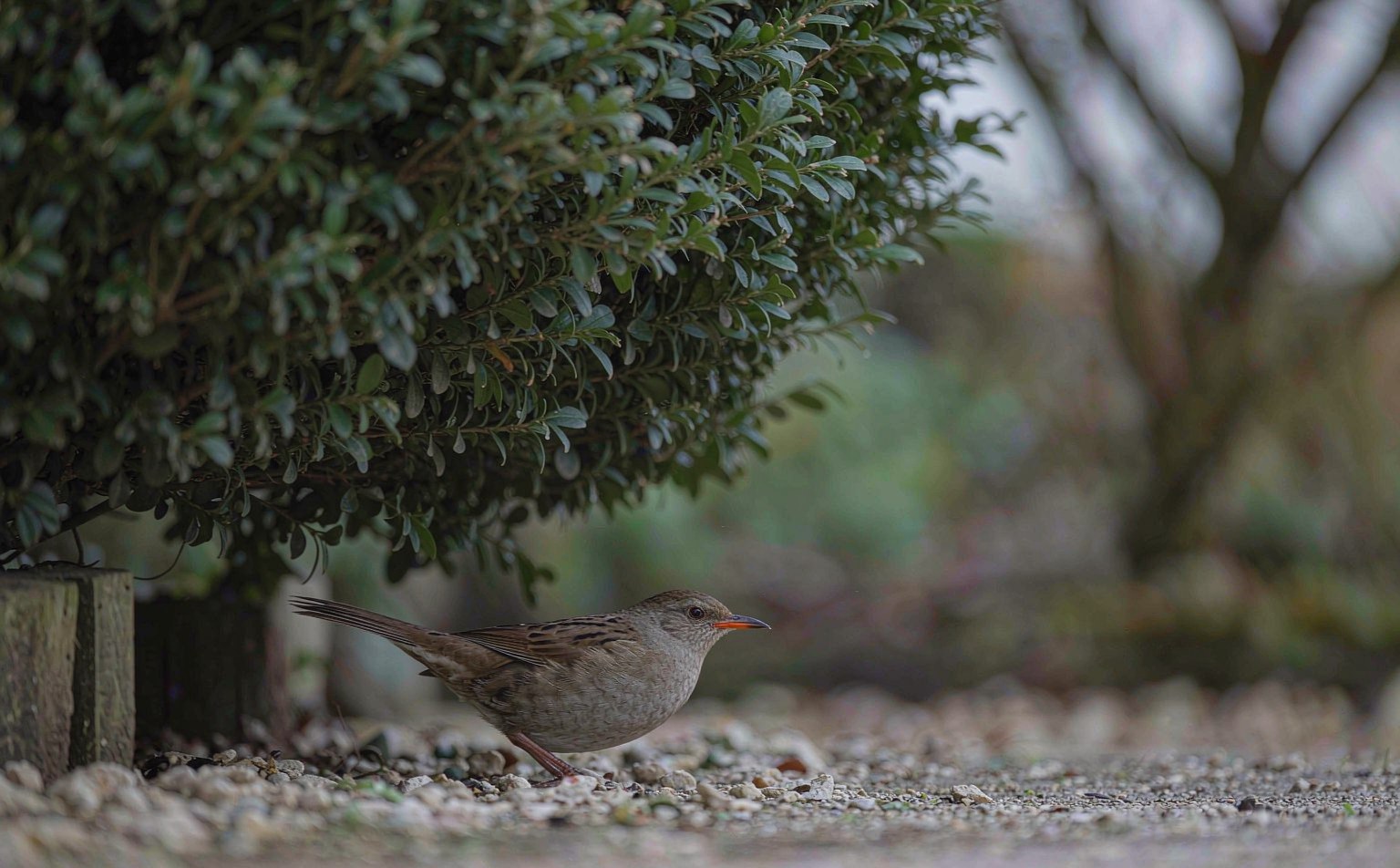
Prunella modularis | Dunnock
Introduction
The Dunnock (Prunella modularis), often called the hedge sparrow though it is not a true sparrow, is a modest, mouse-brown bird of European gardens, hedgerows and woodland edges. Skulking and unassuming in plumage, it compensates with one of the most remarkable breeding systems of any European passerine. Its quiet, squeaky song and nervous, tail-twitching manner make it a familiar yet easily overlooked garden resident.
Sometimes described as drab, the Dunnock is in fact finely patterned, with soft grey on the head and breast and streaked brown flanks. It forages on the ground beneath shrubs, and its subtle presence belies a complex social life that has made it a favourite subject of behavioural ecologists studying avian mating systems.
Taxonomy
The Dunnock was described by Carl Linnaeus in 1758 and placed in the genus Prunella, the only genus of the family Prunellidae, the accentors. Despite its sparrow-like look, it is not closely related to the true sparrows but is instead a distant relative of the thrushes. Its scientific name modularis refers to its melodious, warbling song.
Within the garden avifauna it shares habitat with the Eurasian Robin, and the two are often seen in the same shrubbery, though the Dunnock is far shyer. It also overlaps with the Song Thrush and the Common Blackbird in damp, leafy places where it searches for invertebrates among fallen leaves.
Physical Characteristics
The Dunnock is a compact bird of 13.5 to 15 centimetres in length, with a wingspan of 19 to 21 centimetres and a mass of 17 to 24 grams. Its plumage is predominantly earthy brown, finely streaked with darker markings on the back and flanks. The crown, nape and cheeks are soft blue-grey, and the eye is dark with a faint pale surround. The slender bill is ideal for picking small prey from the ground.
The legs are pinkish-brown and the tail is frequently flicked or partly cocked as the bird moves. Males and females are similar, though the male may show slightly greyer tones on the head. Juveniles are browner and more heavily streaked, lacking the adult’s grey suffusion. Overall the Dunnock’s camouflage is superb among bark, leaf litter and bare soil.
Habitat
Dunnocks favour low, dense cover: hedgerows, bramble thickets, garden shrubs, churchyards, urban parks and woodland margins. They avoid open ground away from shelter, preferring to dart from one bush to the next. In Britain and across temperate Europe they are among the most widespread garden birds, thriving wherever there is a tangle of vegetation at ground level.
They are largely resident, though some continental populations move short distances in winter. The species has adapted well to human habitats, and suburban gardens with shrub borders can support higher densities than some farmland, provided chemical-free leaf litter remains for foraging.
Diet
The Dunnock is principally insectivorous in spring and summer, taking small invertebrates such as beetles, ants, caterpillars, aphids and spiders from the soil surface and low foliage. It is a diligent turner of leaf litter, probing with its fine bill for hidden prey. This diet shifts in autumn and winter toward seeds and other plant material when insects become scarce.
At garden feeding stations Dunnocks are ground feeders, sweeping up spilled seed beneath hanging feeders rather than perching on them. They prefer quiet corners and will retreat if dominant species such as blackbirds or larger finches approach, reflecting their subordinate position in the garden pecking order.
Reproduction
The Dunnock’s breeding biology is notable for its flexible mating system. A female may mate with one male, or with two or more males that share parentage of her brood; conversely a male may attend a single female or several. Males assess paternity by closely following females and performing frequent courtship displays, including wing-quivering.
The female builds a neat cup of twigs, moss and grass, often low in a hedge, shrub or climber, and lays four to five unmarked blue eggs. She incubates alone for about twelve to thirteen days, but both attending males may feed the chicks, which fledge after roughly eleven to thirteen days. Two or three broods may be raised in a good season.
Conservation
The Dunnock is classified as Least Concern, with a large European population. However, intensive farmland management, the removal of hedgerows and the tidying of gardens have caused local declines by reducing the dense low cover and invertebrate food the species requires. In some areas numbers have fallen noticeably over recent decades.
Conservation measures that benefit the Dunnock include retaining and replanting native hedgerows, leaving untidy shrubby corners, and avoiding pesticide use that strips the leaf-litter invertebrate community. Because the species breeds close to the ground, cats can be a significant local predator, and sheltered planting helps reduce losses.
Fun Facts
- Dunnocks practise cooperative and even polyandrous breeding, with two males sometimes helping to rear one female’s chicks.
- The male’s paternity guards by tracking the female’s movements, a behaviour studied in detail by evolutionary biologists.
- Although called the hedge sparrow, the Dunnock is not a sparrow at all but an accentor, kin to the thrushes.
- Its eggs are a striking unspotted sky-blue, unusual among the small brown garden birds.
- A Dunnock sings a thin, rapid warble from deep within a bush, often hidden from view.