 By st20113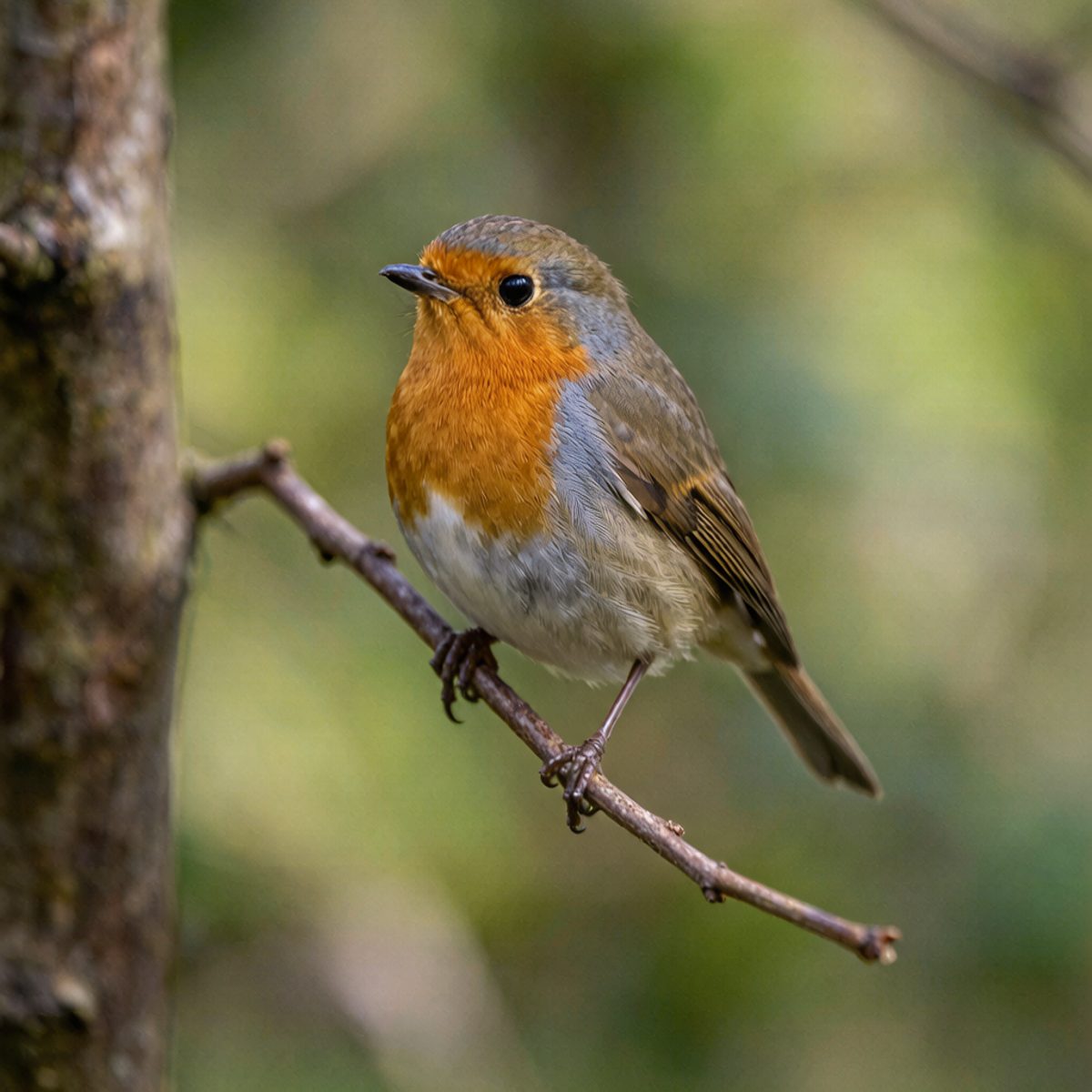
Introduction
The European robin, scientifically Erithacus rubecula, is one of the most beloved and recognizable garden birds of Europe. The adult’s bright orange-red face and breast, set against olive-brown upperparts, make it unmistakable. A confident and curious bird, it often follows gardeners to snatch disturbed worms and may even perch nearby to watch. Across the continent it is woven into folklore as a gentle companion of the changing seasons. In Britain it is the emblem of Christmas cards, said to cover the bodies of the dead with leaves, while in other lands it marks the return of spring with its bright song. Gardeners welcome it as a helper that follows the spade for worms, and its tame boldness has made it one of the first birds children learn to name. Despite this closeness to people, it remains a wild creature that sings its own territory from hedge to hedge.
Taxonomy
The European robin belongs to the family Muscicapidae, the Old World flycatchers and chats, within the genus Erithacus. Despite its friendly image, it is a fiercely territorial songbird. It shares hedgerows and woodlands with many other small birds, and its nests are sometimes raided by predators such as the red fox, which occasionally takes young birds, though the robin itself is a nimble insect hunter rather than prey.
Physical Characteristics
Robins measure 12 to 14 centimeters in length with a wingspan of 18 to 22 centimeters, weighing just 14 to 21 grams. The orange-red forehead, face, and breast contrast with grey-brown flanks and olive-brown back and wings. Young birds lack the red and are spotted brown before their first molt. The slender black bill, dark eyes, and upright posture give the robin a bright, alert appearance that endears it to people across its range.
Habitat
Robins thrive in woodlands, parks, gardens, hedgerows, and churchyards, anywhere with low cover and open ground for foraging. They are among the few birds that sing through the winter, defending territories even in snow. In northern Europe many migrate south, while others stay year-round near feeding stations. The species favors damp, leafy places where invertebrates are abundant, and it readily exploits human activity to find food.
Diet
The robin feeds mainly on insects, spiders, and other invertebrates, which it picks from the ground, leaves, and bark. In autumn and winter it switches to berries, seeds, and fallen fruit when insects are scarce. It is famous for hopping close to digging gardeners to seize worms turned up by the spade. It also visits bird tables for mealworms and scraps. As a largely ground-foraging insectivore, it helps control garden pests throughout the warmer months.
Reproduction
Robins breed from spring into summer. The female builds a neat cup nest of moss, grass, and leaves, often in a remarkable variety of nooks such as flowerpots, shed ledges, or tree hollows. She lays five to six pale blue eggs speckled with red, incubating them for about thirteen days. Both parents feed the chicks, which fledge after roughly fourteen days. Robins commonly raise two or three broods in a single season.
Conservation
The European robin is abundant and classified as Least Concern, with a population numbered in the hundreds of millions. It benefits from gardens, parks, and varied farmland, though intensive agriculture and cat predation can affect local numbers. Its familiarity and cheerful song have made it a favorite in many cultures. Ongoing habitat richness rather than urgent protection is what keeps this little bird so widespread.
Fun Facts
The robin’s red breast is a territorial flag, flashed to warn rivals away from a claimed patch. It will fearlessly investigate a person digging, hoping for an easy meal of worms. In British folklore the robin is linked to Christmas and kindness to the dead. Males and females look alike, both sporting the famous orange face. A robin may sing softly at night under streetlights, a habit unusual among small songbirds.
[…] Adult common cuckoos measure 32 to 34 centimeters in length with a wingspan of 55 to 60 centimeters. The species exhibits sexual dimorphism: males have gray upperparts and a gray breast, while females may be gray or rufous morph. Both sexes have barred underparts and a distinctive yellow eye-ring. The slender body and long tail give the cuckoo a hawk-like silhouette in flight. This resemblance to raptors may help females approach host nests without raising alarm among smaller birds such as the European robin. […]
[…] to challenging environments, from high-altitude foraging to seasonal hibernation or migration. the European robin, the common blackbird, and the common chaffinch frequently coexist with the sturnus vulgaris across […]
[…] observers for centuries, featuring in folklore, art, and scientific illustration across Europe.the European robin, the common blackbird, and the goldcrest frequently coexist with the common redstart across shared […]
[…] observers for centuries, featuring in folklore, art, and scientific illustration across Europe.the European robin, the common blackbird, and the goldcrest frequently coexist with the bluethroat across shared […]
[…] naturalist Christian Ludwig Brehm in 1831. It sits within the genus Turdus, which includes the European Robin (though the robin is placed in a different genus, Erithacus) and the familiar blackbird. The […]
[…] the British countryside it forages alongside the Eurasian Robin in gardens and with the Song Thrush and the Common Blackbird on lawns, though the wagtail’s […]
[…] the garden avifauna it shares habitat with the Eurasian Robin, and the two are often seen in the same shrubbery, though the Dunnock is far shyer. It also […]