 By st20113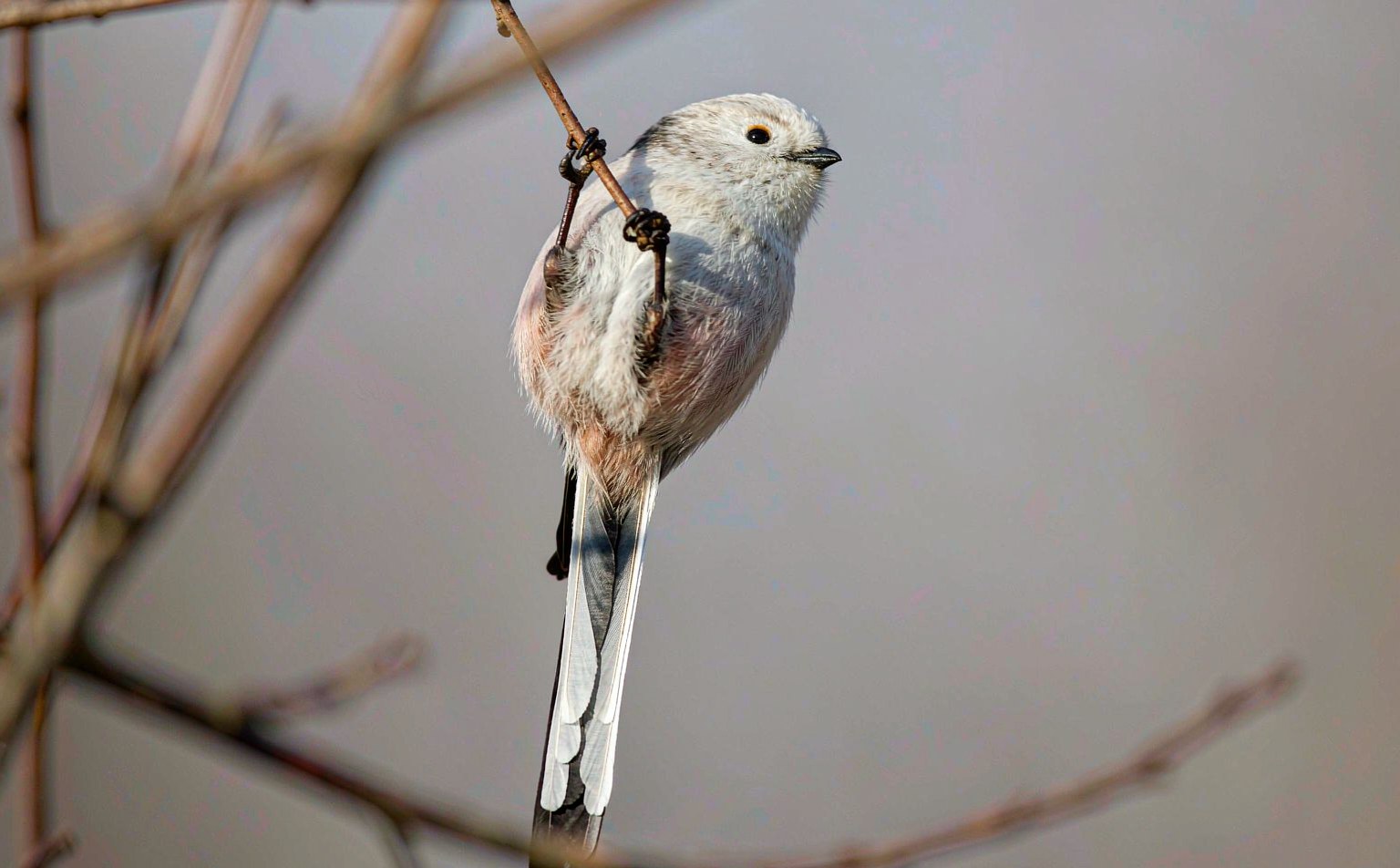
Aegithalos caudatus | Long-tailed Tit
Introduction
The Long-tailed Tit (Aegithalos caudatus) is a tiny, irresistibly sociable bird whose elongated tail makes up more than half its total length. A resident of woodlands, scrub and gardens across Europe and temperate Asia, it is usually encountered in chattering family parties that ripple through the branches in search of spiders and insects. Its rounded, pinkish-white body and black-and-white tail give it a distinctive, almost pom-pom appearance in flight.
Highly gregarious for most of the year, the species forms the core of mixed foraging flocks in autumn and winter, and its soft, wheezing contact calls betray the passage of the group through a hedge. Despite a delicate look, it is a hardy bird that builds one of the most elaborate nests of any European passerine.
Taxonomy
The Long-tailed Tit was described by Carl Linnaeus in 1758 and is now placed in the genus Aegithalos within the family Aegithalidae, separate from the true tits. Its affinities lie with the bushtits of Asia and North America rather than with Parus species, a fact reflected in its very different nesting and social behaviour.
In gardens it often forages near the Great Tit and the Eurasian Wren, and mixed flocks may also include the Eurasian Jay in woodland edges, though the Long-tailed Tit keeps to the outer twigs where its aerial skills shine.
Physical Characteristics
The Long-tailed Tit is about 13 to 15 centimetres long but weighs only 7 to 9 grams, because roughly two-thirds of that length is the long, narrow, black-and-white tail. The body is compact and rounded, with black, white and pinkish-buff plumage; the head is white with a broad black stripe through the eye, and the underparts are clean pale pink. The tiny bill is short and stubby, suited to gleaning minute prey.
Juveniles resemble adults but have shorter tails and darker, greyer crowns until they moult. The combination of the oversized tail and the soft pink-and-white coloration is unmistakable. In flight the bird appears as a bouncing, elongated shape, quite unlike the heavier tits it sometimes accompanies.
Habitat
Long-tailed Tits inhabit deciduous and mixed woodland, coppice, hedgerows, orchards and well-vegetated gardens. They prefer areas with a dense shrub layer where spiders are abundant, and they require thorny or concealed sites for their bulky nests. In winter they range more widely, joining other species in loosely knit flocks that work through scrub and tree canopies.
The species is largely resident in mild regions, though harsh weather can drive irruptions southward. The expansion of suburban planting and garden shrubs has allowed it to colonise towns, and it is now a regular, if localized, garden visitor across much of its range.
Diet
The Long-tailed Tit feeds almost entirely on small arthropods, especially spiders, aphids, scale insects and the eggs and larvae of moths and beetles. It gleans these from the underside of leaves and along the finest twigs, often hanging acrobatically to reach prey that larger birds ignore. In winter, when insects are scarce, it may take a little plant matter but remains heavily dependent on invertebrate prey.
Because a flock can strip an area of its tiny prey rapidly, the birds move almost continuously, which explains the restless, travelling nature of the groups. Their high metabolic rate demands almost constant feeding, particularly in cold weather when energy needs peak.
Reproduction
Breeding begins in early spring. The Long-tailed Tit constructs a remarkable domed nest of moss, lichen, spiders’ webs and feathers, lined with up to a thousand soft feathers and hidden in a thorny shrub or conifer. The female lays a large clutch of typically eight to twelve eggs, occasionally more, and incubates them for about thirteen to eighteen days.
Both parents feed the chicks, and in many populations older offspring from the first brood remain to help rear subsequent siblings, a cooperative behaviour that improves nest success. The young fledge after roughly fourteen to eighteen days but stay with the family group, which coalesces into the winter flocks. Harsh springs can devastate broods, as the tiny chicks are vulnerable to cold and food shortage.
Conservation
The Long-tailed Tit is rated Least Concern, with a widespread and generally stable population. It has benefited from increased tree and shrub planting in gardens and along roads, but it remains sensitive to severe winter weather, which can cause marked annual fluctuations in numbers.
The availability of spider-rich scrub and safe nesting cover is the main determinant of local abundance. Leaving thorny native shrubs, avoiding autumn trimming of hedges used for nesting, and reducing pesticide use all help support the species. Because the species often nests low and late, disturbed hedgerows are a key threat during the breeding season.
Fun Facts
- A Long-tailed Tit’s nest can contain more than 1,500 feathers, making it remarkably soft and insulating.
- The species’ tail is longer than its entire body, yet the bird weighs less than a teaspoon of sugar.
- Young from earlier broods often stay to help their parents raise later siblings.
- Family parties keep contact with a faint, wheezy call as they move through the branches.
- In cold nights the whole flock may roost tightly together, looking like a furry ball to conserve warmth.