 By st20113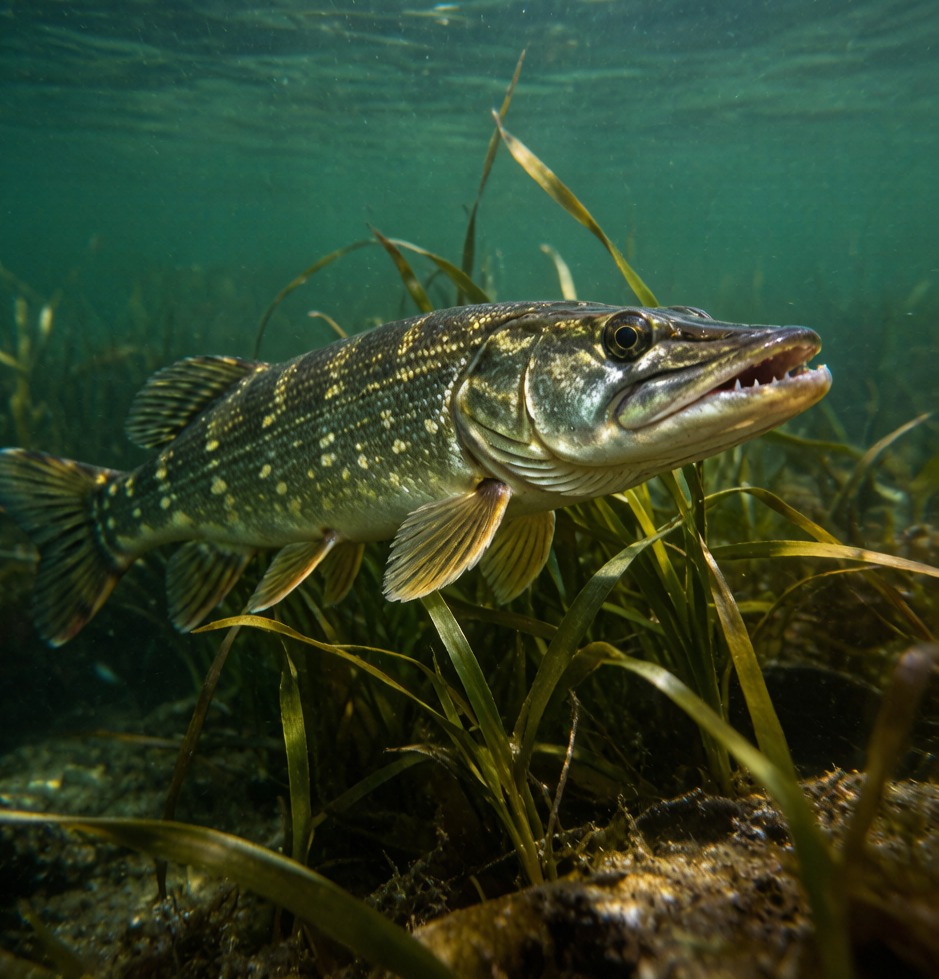
Introduction
The Northern Pike (Esox lucius) is one of the most formidable freshwater predators in the Northern Hemisphere and one of the most widely distributed freshwater fish in the world. With its long, torpedo-shaped body, razor-sharp teeth and explosive acceleration, the Pike is often called the freshwater equivalent of a marine predator, and it has fascinated anglers, naturalists and scientists for centuries with its savage feeding behaviour and prehistoric appearance. A solitary ambush predator, the Pike waits motionless in vegetation before launching a
Taxonomy
Scientifically classified as Esox lucius within the family Esocidae, the pike family, the Northern Pike belongs to an ancient lineage of predatory fish that has changed little over tens of millions of years. The genus Esox contains five extant species: the Northern Pike found across Europe, Asia and North America, the American Muskellunge (Esox masquinongy) of the Great Lakes region, the Southern Pickerel (Esox americanus) of eastern North America, the Chain Pickerel (Esox niger), and the recently described Alaska Pike (Esox lucioides). Pike fossils dating back over 65 million years have been found, making the Esocidae one of the oldest continuously surviving fish lineages.
Physical Characteristics
The Northern Pike has one of the most distinctive body plans of any freshwater fish, perfectly adapted for its ambush predatory lifestyle. Its long, streamlined, torpedo-shaped body is built for explosive acceleration over short distances, with a large head representing up to one-quarter of its total length, a flattened broad snout, and a mouth filled with up to 700 sharp, needle-like teeth arranged in multiple rows. The dorsal and anal fins are positioned far back near the tail, allowing for powerful propulsion. Colouration is typically olive to greenish-brown above with lighter yellowish sides and a whitish belly, with darker horizontal barrings that provide effective camouflage among submerged vegetation.
Habitat
Northern Pike are found in a wide variety of freshwater habitats across their enormous range, including lakes, ponds, reservoirs, slow rivers, canals, ditches and the vegetated margins of larger rivers. They show a strong preference for areas with abundant submerged vegetation, submerged wood, undercut banks or other structure that provides ambush hunting opportunities and shelter during the day. They are somewhat tolerant of low oxygen levels in winter and can survive under ice-covered waters by reducing their metabolic rate. Pike spawn in
Diet
The Great White Shark (great-white-shark-carcharodon-carcharias) is the iconic apex marine predator that the Northern Pike is most often compared to, sharing a sit-and-wait ambush hunting strategy despite inhabiting completely different environments. The Northern Pike is a voracious generalist predator that consumes almost any animal it can capture and swallow, from insects and crayfish to fish, frogs, ducklings, small mammals and occasionally carrion. Fish make up the majority of the diet in most populations, including cyprinids, perch, roach, rudd and even other Pike
Reproduction
Northern Pike spawn in early spring as water temperatures rise above approximately 6 to 8 degrees Celsius, typically before many other fish species spawn, giving their young a head start on available prey. Spawning typically occurs in flooded vegetation, marshes or shallow lake margins where males and females release eggs and milt simultaneously in a chaotic spawning event often involving multiple males. A single large female may lay between 15,000 and 250,000 eggs depending on her size, scattering them over submerged vegetation
Conservation
The Northern Pike is classified as Least Concern globally, reflecting its large population and extensive range across the Northern Hemisphere, and it is considered one of the most abundant and sustainably managed freshwater fish species in the world. However, local population declines have occurred in regions where drainage, pollution or barriers have degraded spawning habitat. The species is highly valued by recreational anglers, and well-managed Pike fisheries generate significant economic benefits for rural communities, providing an incentive for habitat protection and sustainable
Fun Facts
The Northern Pike has been called the freshwater shark, and like the Great White Shark, it uses a sit-and-wait ambush hunting strategy combined with explosive acceleration rather than sustained pursuit, and it is an apex predator in most freshwater environments it inhabits. The species has been documented making spectacular lateral leaps out of the water during catch-and-release fishing, a behaviour thought to be an attempt to dislodge a hook. Northern Pike teeth are arranged not only on the jaws but also on
[…] to challenging environments, from high-altitude foraging to seasonal hibernation or migration. the northern pike and the tench frequently coexist with the european perch across shared landscapes, creating complex […]
[…] observers for centuries, featuring in folklore, art, and scientific illustration across Europe.the northern pike, the European eel, and the common roach frequently coexist with the ruffe across shared landscapes, […]