 By st20113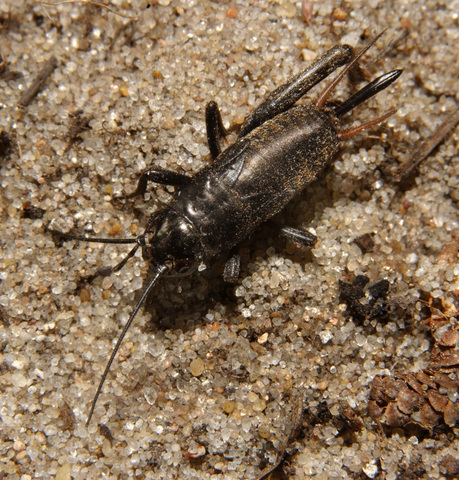
Introduction
The European Field Cricket (Gryllus campestris) is one of the most beloved insects of the European countryside. With its jet-black body and distinctive, melodious song that fills summer meadows, this species has become a symbol of warm summer evenings across the continent. Found from the British Isles to the Caucasus and from Scandinavia to the Mediterranean, it inhabits dry, sunny grasslands where its song has inspired poets, composers, and naturalists for centuries.
Taxonomy
Gryllus campestris was formally described by Carl Linnaeus in 1758, placing it within the family Gryllidae (true crickets) and the order Orthoptera, which also includes grasshoppers and katydids. The genus name Gryllus is Latin for “cricket.” It is distinguished from related species by its robust, fully winged form and preference for self-dug burrows in sun-exposed soil. Twelve subspecies have been described across its range, reflecting adaptations to varied regional climates.
Physical Characteristics
The European Field Cricket measures between 20 and 26 millimeters in body length, with males typically slightly larger than females. Its coloration is a deep, glossy black — a trait that helps it absorb solar heat in its cool temperate habitat. The wings are well-developed and used for producing sound. The most striking features are the powerful hind legs adapted for jumping and the long antennae that can exceed the length of the entire body. Like the honey bee, the cricket uses sensory perception to navigate its environment with remarkable precision.
Habitat
This species inhabits short, dry grasslands, sunlit embankments, heaths, and meadows with sparse vegetation and bare patches of soil. It requires warm, well-drained soils where it excavates a burrow — a short tunnel ending in a small chamber — which serves as a refuge and a stage from which to sing. In recent decades, the species has experienced significant range contraction in northern Europe, largely due to agricultural intensification, loss of traditional grazing pastures, and pesticide use. Conservation areas that maintain short-grazed grasslands have become vital refuges for remaining populations.
Diet
The European Field Cricket is omnivorous, feeding primarily on plant material including leaves, stems, seeds, and flower petals. It also consumes small invertebrates such as aphids, caterpillars, and other insects, making it both a herbivore and a modest predator. Similar to the hunting behavior of the green darner dragonfly, the cricket is an opportunistic forager that takes advantage of whatever prey is available in its immediate surroundings. This diet is particularly important for juveniles, which require high-protein food to fuel their rapid growth through multiple nymphal stages.
Reproduction
Mating occurs from late spring through summer. The male courts the female by producing his characteristic song — a continuous, chirping trill — from the entrance of his burrow. The song is produced by rubbing the base of one forewing against a file-like structure on the other. After mating, the female deposits up to 200 eggs individually into the soil using her ovipositor. Eggs hatch after two to three weeks, and nymphs undergo eight to ten molts over approximately a year before reaching adulthood.
Conservation
The European Field Cricket is listed as a species of conservation concern in several northern European countries, including Britain, where it has declined by more than 75 percent since the mid-20th century. Conservation measures include maintaining sunlit, grazed grasslands with patches of bare soil, reducing pesticide use, and reintroducing the species to suitable former habitats. Captive breeding and release programs have shown promise in re-establishing populations in protected areas.
Fun Facts
The song of the male European Field Cricket is directly influenced by temperature — the rate of chirping increases predictably as the air warms. This relationship is so reliable that cricket chirping has been used as a rough natural thermometer. The insect’s song can be heard from distances exceeding 100 meters on a still summer evening.
In medieval Europe, crickets were sometimes kept as pets in small cages, and their songs were considered good omens, reflecting the deep cultural connection humans have long felt with this singing insect.
[…] dwelling bush-crickets of the northern temperate zone, and it is a close relative of the true Gryllus campestris in the broader sense of “cricket”, though the two sit in different families and differ […]
[…] species is a near relative of the crickets and grasshoppers of the same ground layer, including the Gryllus campestris of dry, sunny turf, though the two occupy rather different […]