 By st20113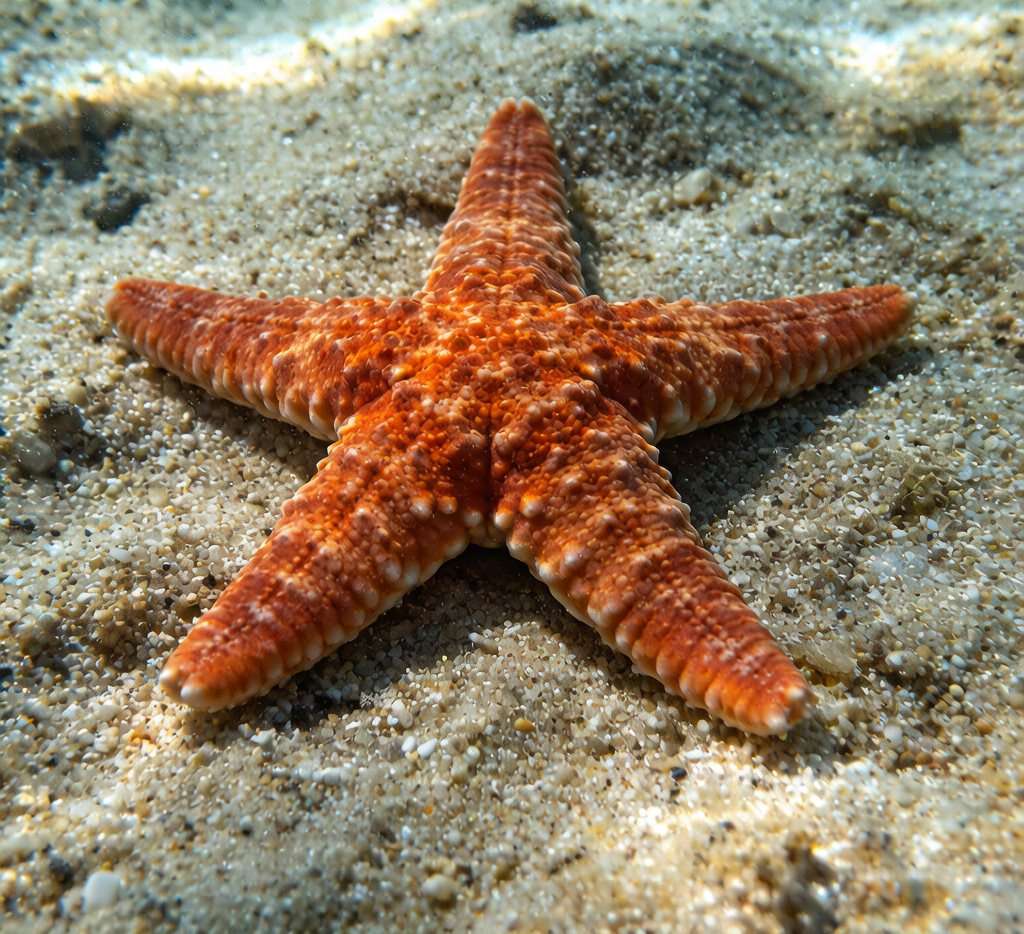
Introduction
The Common Starfish, Asterias rubens, is one of the most familiar invertebrates of the North Atlantic and one of the most ecologically important predators in coastal marine ecosystems. Found from Scandinavia and the British Isles to West Africa and across the Atlantic coast of North America, this five-armed echinoderm is a keystone predator of tide pools and shallow rocky reefs. Despite its common name—increasingly replaced by “sea star”—it is not a fish but an invertebrate of the phylum Echinodermata, closely related to sea urchins and sea cucumbers. Its bright orange to reddish-brown coloration and five-pointed symmetry make it instantly recognizable to beachcombers. As both predator and scavenger, it plays a pivotal role in maintaining the diversity and structure of intertidal communities.
Taxonomy
Asterias rubens belongs to the family Asteriidae, class Asteroidea, phylum Echinodermata. The genus name Asterias comes from the Greek asterias, meaning “star,” and rubens is Latin for “reddish.” Described by Carl Linnaeus in 1758, it ranks among the earliest named marine animals. Echinoderms are deuterostomes, sharing a major branch of the animal tree with vertebrates. Their larvae are bilateral and free-swimming, quite unlike the radially symmetric adults. The Common Starfish shares its phylum with sea urchins and feather stars, both familiar inhabitants of North Atlantic rocky shores.
Physical Characteristics
Typically having five arms radiating from a central disc, individuals with four, six, or seven arms occur occasionally. Each arm is lined with hundreds of tube feet operated by a hydraulic water vascular system, allowing the starfish to grip surfaces, move, and pry open the shells of prey. The upper surface is covered with tiny pincer-like pedicellariae that keep the skin clean of parasites. Primitive eyespots at the tips of each arm detect light and movement, and chemical sensors across the body help locate food. Individuals range from bright orange to deep reddish-brown and typically measure 10 to 30 centimeters in diameter.
Habitat
Asterias rubens inhabits the intertidal zone and shallow subtidal waters of the eastern North Atlantic, from Norway and the British Isles to Morocco, and across the western Atlantic from the Arctic to North Carolina. It prefers rocky coasts and gravel bottoms, typically from the low tide line to about 200 meters depth. It is most abundant on wave-exposed rocky shores where wave action brings a constant supply of oxygen and food. By day it clings to vertical rock faces or hides in crevices, becoming more active at night when many of its prey—mussels, oysters, and barnacles—are less active.
Diet
The Common Starfish feeds primarily on mollusks, especially mussels, oysters, and barnacles, as well as the invasive European Shore Crab. To capture prey, it grips the shell with its tube feet and applies sustained pulling force until the bivalve’s adductor muscles fatigue and the valves open slightly. It then everts its stomach into the shell, digests the soft tissue externally, and retracts its stomach to absorb the nutrients. A single starfish can consume half its own body weight in food per week. It also scavenges on dead fish and invertebrates, playing a key role in recycling nutrients on rocky reefs.
Reproduction
Common Starfish reproduce by broadcast spawning in spring and summer, with males and females releasing sperm and eggs directly into the water column. A single female can release millions of eggs per spawning event. Fertilized eggs develop into free-swimming bilaterally symmetrical larvae that drift in the plankton for several weeks before settling and metamorphosing into juvenile starfish with five arms. Sexual maturity is reached in approximately two to three years. The starfish can also reproduce asexually by shedding arms—a process called autotomy—and regenerating the missing portions over one to several months.
Conservation
Not globally threatened, but populations in polluted coastal areas face local decline due to habitat degradation and reduced water quality. Ocean acidification poses a longer-term risk to echinoderms, whose calcareous ossicles are vulnerable to dissolution in more acidic seawater. As a keystone predator, Asterias rubens maintains intertidal biodiversity by preventing mussels from monopolizing space and outcompeting other species. Like the Sea Otter, which controls sea urchin populations and preserves kelp forests along the Pacific coast, the Common Starfish regulates community structure through its predation pressure.
Fun Facts
The Common Starfish can regrow an entire arm and central disc from a small fragment—a regenerative feat that has made it a model organism in developmental biology. Each arm tip carries a primitive eyespot capable of detecting light and movement, though the images formed are blurry at best. Asterias rubens tolerates salinities as low as 15 parts per thousand, persisting in estuarine environments where few other starfish survive. Individuals can live for over 10 years in the wild. The starfish has no brain or blood—instead it pumps seawater through its body using its water vascular system, using hydraulic pressure to move its tube feet, open shells, and navigate the seafloor.
[…] three-dimensional reef structures providing habitat for dozens of associated species including starfish, marine worms, and small […]
[…] Ophiura. That genus holds a number of similar, less known species. Its closest famous kin is the Common Starfish. The starfish shares the same five-part radial […]