 By st20113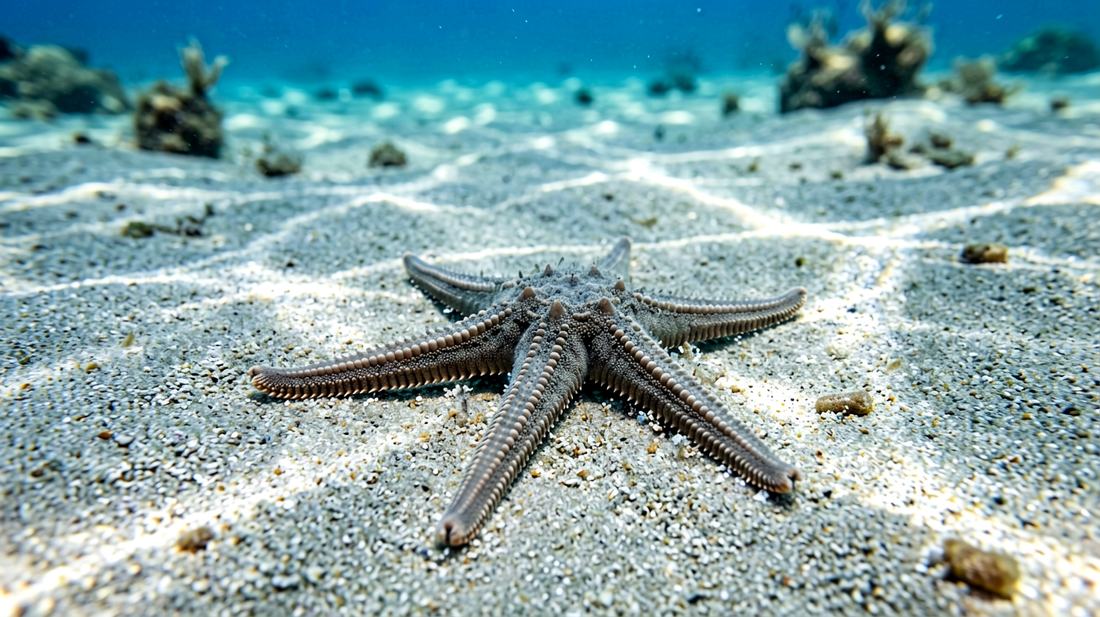
Ophiura ophiura | Common Brittlestar
Species Profile · Ophiuridae
Common Brittlestar
A five-armed echinoderm that rows itself across the seabed, sheds an arm to escape and can live hundreds to the square metre.
Not assessed by IUCN
Range
Disc
Arms
Depth
Assessed
A star that runs
The common brittlestar
The common brittlestar is a flat, five-armed echinoderm. It hides in sand and mud on the seabed. Only the tips of its long arms poke out above the sediment. From above it looks like a small grey starfish. Its limbs are very slender. It is a different kind of animal altogether.
It is built for speed rather than grip. A brittlestar moves by rowing itself along with its arms. It moves in a jerky, snake-like way. That way gives the group its name. It travels far faster than a starfish ever could. When a hunter grabs an arm, the brittlestar sheds it.
It crawls away and grows a replacement over the following months. In parts of the north-east Atlantic it is very common. Several hundred animals crowd into a single square metre. That density makes it a key food for flatfish and crabs. It is a scavenger as much as a hunter. Much of what it eats has already died.
Family tree
Cousin of the starfish
The common brittlestar belongs to the phylum Echinodermata. Its class is Ophiuroidea. Its order is Ophiurida. Its family is Ophiuridae. It sits in the genus Ophiura. That genus holds a number of similar, less known species. Its closest famous kin is the Common Starfish. The starfish shares the same five-part radial symmetry.
It also shares the same water-vascular system. Yet it differs in almost every detail of how it lives. A starfish has thick, muscular arms. These grip shells and prise them open. A brittlestar has thin, jointed arms. They work like oars and cannot prise anything apart. Brittlestars lack the tube feet that let a starfish walk. Their arms attach to the central disc at a joint.
They do not merge into it. The class Ophiuroidea is the largest group within the echinoderms. It has more than 2,000 known species. Its members live from shallow shores to the deepest trenches. The name Ophiura comes from Greek words for snake and tail. It refers to the writhing arms. The family has a fossil record stretching back some 480 million years. It reaches the Ordovician period.
Disc, arms and joints
Built for rowing, not gripping
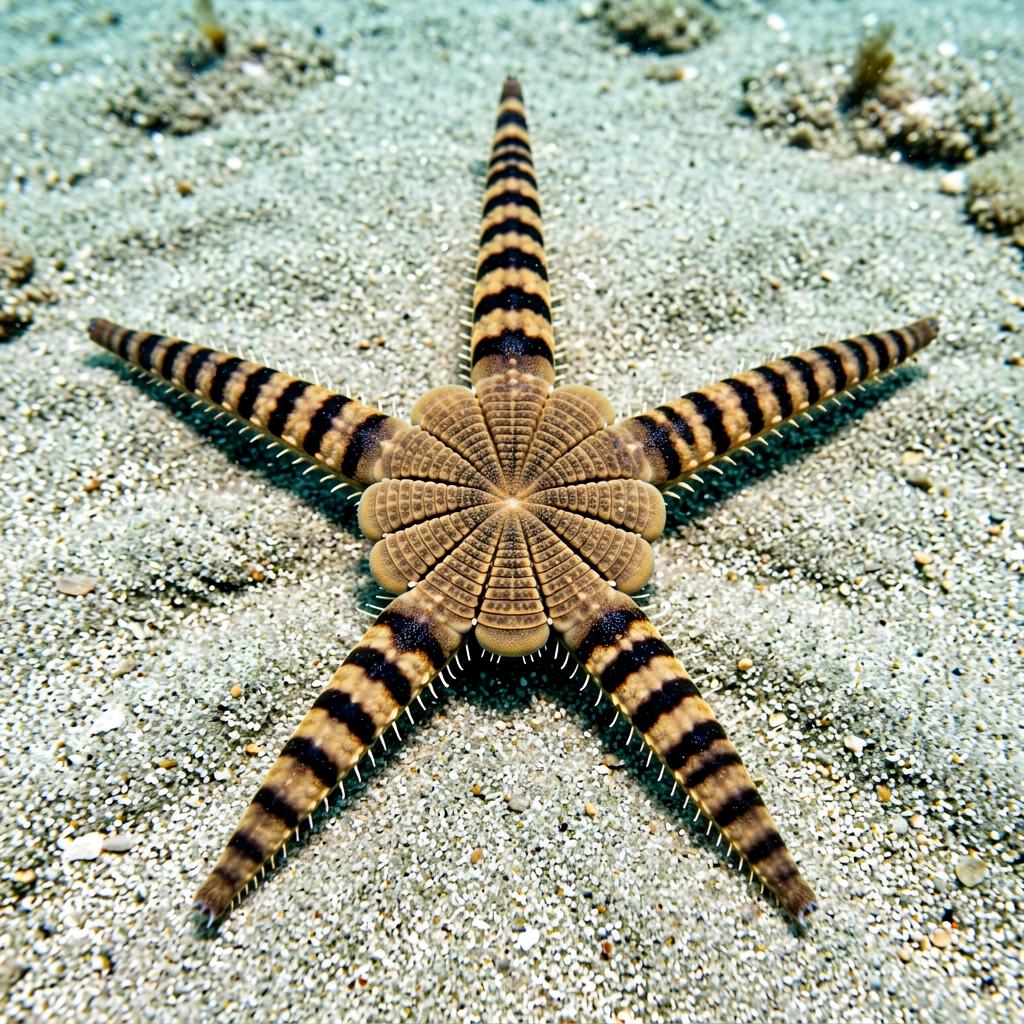
The central disc of an adult measures 20 to 30 mm across. Each of the five arms is about three or four times as long as the disc is wide. The disc is circular and slightly domed. It is covered in small layered plates. These give it a rough feel. The arms taper towards fine, pointed tips. Colours range from pale grey and cream to brown and olive. Most show darker bands across the arms. Most also show paler plates on the upper side of the disc.
The mouth lies in the centre of the underside. It is surrounded by five jaws. A ring of small tentacle scales sits around it. Brittlestar arms are built from internal plates. These are called vertebrae. They connect with ball-and-socket joints. Muscles along each joint let the arm bend in almost any way. They also let it coil tightly around an object. Tube feet are reduced to small papillae.
They sense and move food towards the mouth. They are not used for walking. The whole frame is made of calcite. A dead brittlestar leaves a scatter of tiny plates in the sediment. Growth is slow. The animal is thought to live for several years. Ageing it is hard. The plates record no clear yearly rings.
1
2
3
Buried in the sediment
Where it lives
The common brittlestar is common in the cool, shallow seas of the north-east Atlantic. It ranges from Norway and Iceland south. It runs along the coasts of the British Isles, France and the Iberian Peninsula to Morocco. It lives mainly on soft ground. This includes sand, muddy sand and gravel. It is found from about low water mark down to about 200 m. It is one of the most often caught animals in dredge samples. It is also common in grab samples from the shelf.
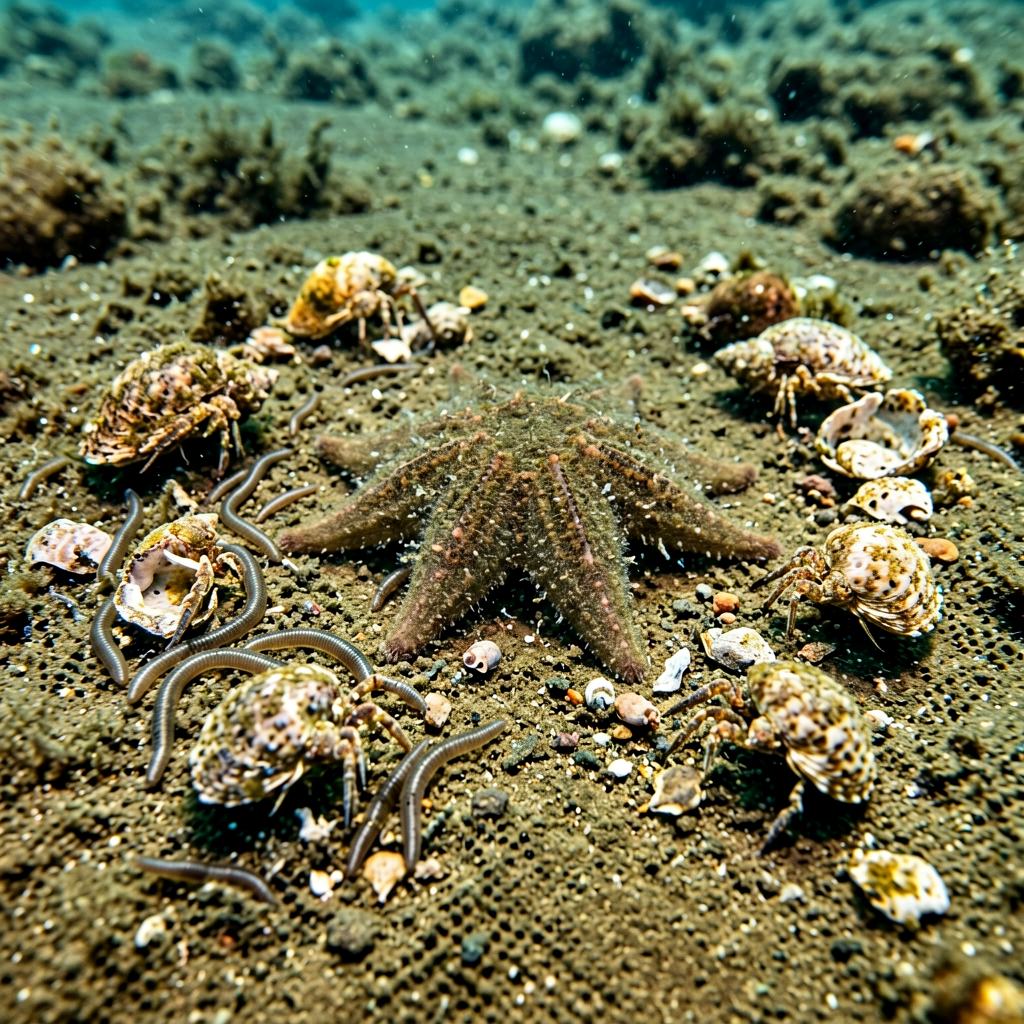
The species buries itself just below the surface. It leaves the arm tips exposed. In this spot it can sense food and danger. It does so without leaving cover. Densities vary with sediment type. Mud-rich sites with plenty of dead matter hold the largest numbers. There the seabed can be a moving carpet of arms. Brittlestars are not found in estuaries with low salt.
They avoid coarse, shifting gravel where burying is hard. Adults cannot swim or travel far. Numbers are largely cut off from one another. They depend on larvae drifting in the plankton to settle new ground. The species reaches the Mediterranean at its southern edge. There it is replaced by closely related forms.
What it eats
Detritus and dead animals
The common brittlestar is a flexible feeder. It takes detritus, small worms, tiny crustaceans, mollusc spat and carrion. Detritus is the fine rain of dead matter. It settles from the water above. It forms the bulk of the diet. The animal gathers it by waving its arms. The small tube feet pass the bits to the mouth. Larger items are seized by the arm tips.
They are carried to the jaws. The jaws crush and shred the food before it is swallowed. Brittlestars also gather around a dead fish or crab. They come in large numbers. Anglers sometimes find them swarming over thrown-away bait. They feed mostly at night. Then the risk of being seen by a hunting flatfish is lower. They retreat deeper into the sediment during daylight.
They process so much sediment and detritus. In doing so they recycle nutrients into the water. They also keep the seabed aired. In turn they are eaten by plaice, dab, cod and haddock. Crabs and herring gulls eat them too. A shed arm is often the only proof that a hunter failed.
Larvae in the plankton
Slow to grow up
Male and female common brittlestars look alike. They release eggs and sperm straight into the water. This happens in spring and early summer. That is when plankton growth begins to rise. A large female can shed hundreds of thousands of eggs in one spawning season. Fertilisation takes place in the open water. The larva is called an ophiopluteus. It is a small, clear, free-swimming creature.
It has bands of cilia and long skeletal rods. These give it a glassy, almost special look. It drifts in the plankton for several weeks. It feeds on tiny algae. Currents may carry it tens or hundreds of km from its parents. The larva eventually settles on suitable sediment. It changes into a young brittlestar. The young has a small disc and five short arms.
It takes several years to reach full size. Breeding is closely tied to water heat. In warm years spawning begins earlier. The species can also regrow lost arms. A broken arm tip cannot form a new animal in this species. That differs from some kin that breed by splitting in two.
Trawling the seabed
Pressure on soft ground
The common brittlestar has no formal status. It is widespread and very common in suitable habitats. No fishery targets it. Its main risks are indirect. Bottom trawling and dredging disturb the sediment it lives in. They kill large numbers of animals. Repeated harm over the same ground can cut numbers for years.
The species grows slowly. It breeds only once a year. Nutrient build-up and waste from sewage and fish farms change the seabed. It favours a few tough species over others. Brittlestars are used by scientists as signs of such change. Oil spills and heavy metal waste also build up in echinoderm tissues. Brittlestars are so numerous and easy to sample.
They have become a standard tool in watch schemes. These run around the British Isles. Long-term studies of their numbers reveal the health of whole seabed groups. No specific protection exists for the species. Conservation effort instead focuses on limiting harm to soft-bottom habitats.
Quick hits
Five things to remember
- The common brittlestar rows itself along with its arms. It does not walk on tube feet, so it is far faster than a starfish.
- When a hunter grabs it, it sheds an arm at a special breakage joint. It grows a new one within months.
- Up to several hundred brittlestars can live in a single square metre of muddy seabed.
- Its free-swimming larva is a glassy creature with long skeletal rods. It looks quite unlike the adult in shape.
- Brittlestars gather in crowds to feed on a dead fish. They turn the seabed into a tangle of moving arms.