 By st20113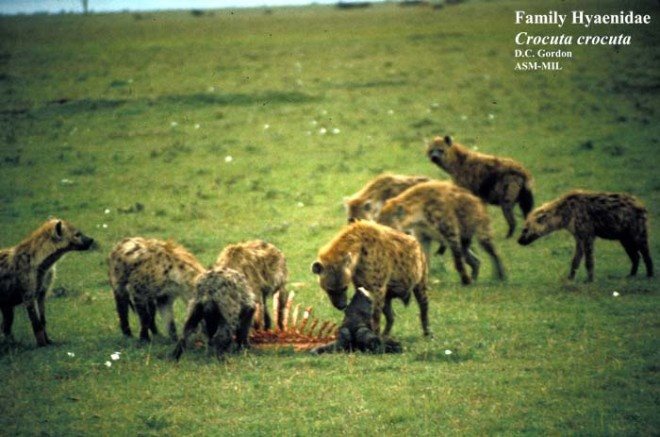
Introduction
The spotted hyena (Crocuta crocuta) is the largest and most common of the three hyena species, famous for its spotted coat and far-carrying whooping call. Far from the simple scavenger of folklore, it is a skilled hunter and one of Africa’s most successful large predators. Highly social and remarkably intelligent, the spotted hyena lives in complex clans ruled by females. It ranges across much of sub-Saharan Africa, from open savanna to semi-desert.
Taxonomy
Spotted hyenas belong to the family Hyaenidae, which also includes the striped hyena, brown hyena, and aardwolf. Genetic work places them closer to cats and mongooses than to dogs, despite their dog-like appearance. The species is the only member of its genus, Crocuta. Their lineage diverged early from other carnivores, giving them a distinctive anatomy and social system unlike that of any true canine.
Physical Characteristics
Adults weigh between 40 and 86 kilograms, with females noticeably larger and more muscular than males. The coat is short and sandy, marked with irregular dark spots that fade with age. A massively built neck and shoulders, along with bone-crushing jaws, allow them to process carcasses other predators cannot. Their front legs are longer than the hind legs, giving a sloping back and a distinctive loping gait. Acute hearing and a keen sense of smell guide them to food across long distances.
Habitat
Spotted hyenas thrive in a wide variety of habitats, including grasslands, woodlands, savannas, montane forests, and arid scrub. They need access to water but tolerate dry country better than many large carnivores. Clans defend large territories centered on dens, where cubs are raised in underground burrows. They are largely nocturnal near human settlement but hunt and socialize at any hour where undisturbed, ranging widely in search of prey.
Diet
Although they readily scavenge, spotted hyenas kill the majority of their own food, targeting wildebeest, zebra, gazelles, and other medium-sized herbivores. Working in coordinated groups, they can run down prey over long distances and overpower animals much larger than themselves. Their powerful digestion extracts nutrition from bone, skin, and hooves, leaving almost nothing wasted. This efficiency lets them flourish where other predators struggle.
Reproduction
Spotted hyenas do not have a fixed breeding season. After a gestation of about 110 days, females give birth to one to three cubs in a secluded den. Newborns are unusually well developed and already show the aggression typical of the species, sometimes fighting siblings for dominance. Cubs are nursed for months on exceptionally rich milk. Young females inherit their mother’s rank, so clan society is strongly matrilineal from the start.
Conservation
The spotted hyena is currently listed as Least Concern, but local populations face persecution, poisoning, and loss of wild prey. Negative myths have long fueled conflict with herders, even though hyenas can reduce disease by clearing carrion. Protected reserves sustain healthy numbers, and education programs are slowly shifting attitudes. The African wild dog and the cheetah share the same savanna but are far more threatened.
Fun Facts
Female spotted hyenas dominate every part of clan life, and their social rank passes to their daughters. Their famous “laughter” is actually a signal of anxiety or submission, not amusement. A clan’s whooping call can travel several kilometers at night to rally members or warn rivals. Their jaws exert one of the strongest bites relative to size of any mammal. Clans can contain more than eighty animals, organized like a strict hierarchy headed by a senior female. Cubs are born with their eyes open and teeth already showing, ready to compete from the first hour. Spotted hyenas can digest bone almost completely, producing the pale droppings that mark their territory. They cooperate to defend kills against lions many times their weight, often succeeding through sheer numbers. The shyer striped hyena avoids competition by foraging alone after dark, while the lion remains its chief rival for kills across the plains. Despite their fearsome reputation, spotted hyenas are highly social and curious, often investigating new objects in their territory with cautious interest.