 By st20113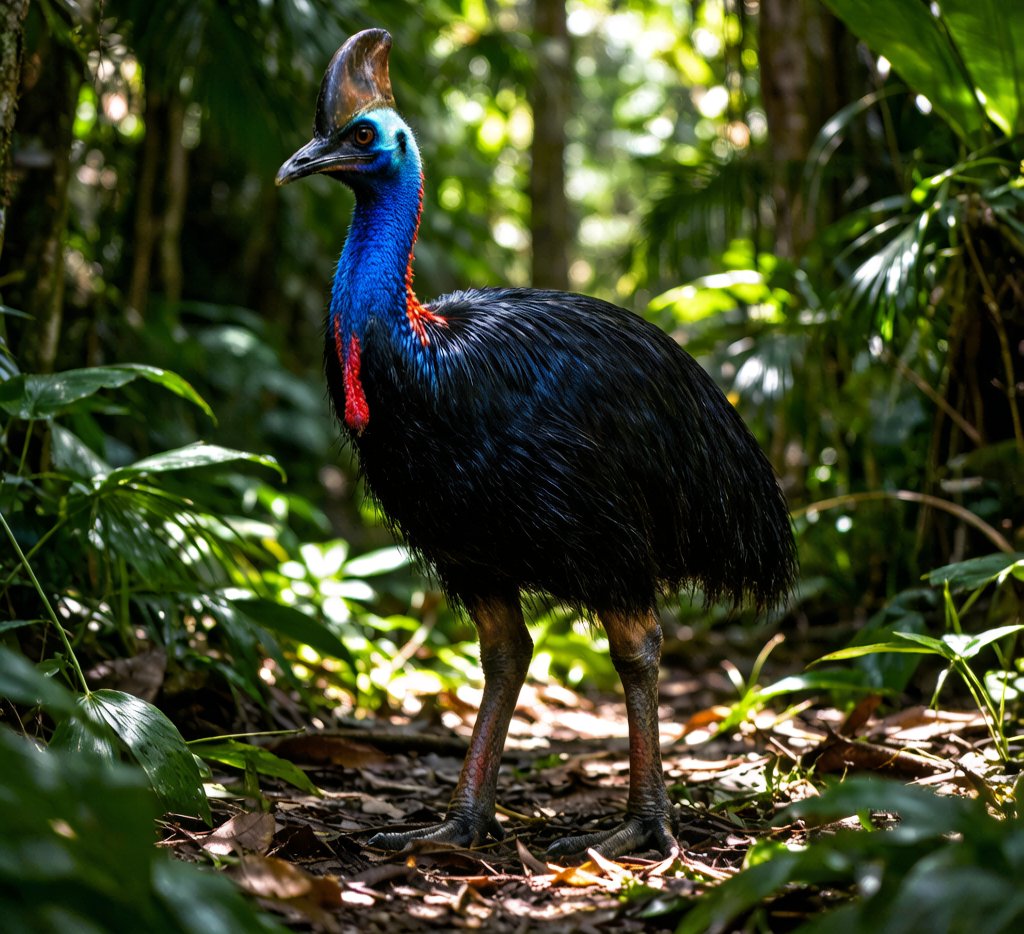
Introduction
The Southern Cassowary (Casuarius casuarius) is one of the most remarkable birds on Earth. Standing up to 1.9 metres tall and weighing as much as 60 kilograms, it is the second-heaviest bird after the ostrich. Native to the tropical forests of northeastern Australia, New Guinea, and surrounding islands, this striking bird is instantly recognisable by its jet-black plumage, vivid blue facial skin, and the helmet-like structure called a casque that tops its head. Often called the “gardener of the forest,” the Southern Cassowary plays a crucial role in maintaining the health and diversity of the rainforest ecosystems it inhabits.
Taxonomy
The Southern Cassowary belongs to the family Casuariidae, which contains three cassowary species. Its genus, Casuarius, includes the most widespread member of the group. The species name casuarius derives from the Malay word kasu, meaning “horned,” a reference to the prominent casque. Its closest relatives are the emu of Australia and the ostrich of Africa, together forming an ancient lineage of large, flightless birds. These species diverged from a shared ancestor more than 50 million years ago, long before the continents reached their current configuration.
Physical Characteristics
The Southern Cassowary’s body is covered in dense, coarse black feathers that more closely resemble hair than typical avian plumage, lacking the barbules that give most feathers their smooth texture. Its most vivid features are the bright blue facial skin and the brilliant red neck wattle. The hollow keratin-covered casque atop its head grows throughout its life and develops unique wear patterns that may serve as individual identification marks. The legs are thick and powerful, and each foot bears a dagger-like claw reaching 10 centimetres in length—the cassowary’s primary weapon against predators.
Habitat
Southern Cassowaries inhabit tropical rainforests of northeastern Australia—primarily the Cape York Peninsula—and the lowland forests of New Guinea. They favour the complex terrain of lowland swamp and floodplain forests, though they range occasionally to higher elevations. The cassowary requires areas rich in fruit-bearing trees such as myrtles, palms, and laurels, as well as access to freshwater streams. It is an ecological keystone species: by consuming fruit and depositing seeds intact across the forest floor, it ensures the regeneration of the very forest that shelters it.
Diet
The Southern Cassowary is primarily frugivorous, with over 75 percent of its diet consisting of fallen fruit and berries from more than 150 plant species. When fruit is scarce, it supplements with leaves, shoots, flowers, and fungi, and occasionally eats invertebrates and small vertebrates. It may follow gatherings of saltwater crocodile to feed on scraps. Remarkably, it can survive without drinking free water, meeting all its moisture needs from food alone.
Reproduction
Breeding season varies by region: April to June in Australia, December to March in New Guinea. The male builds a ground nest from fallen leaves, where the female lays two to five pale green eggs. He incubates them alone for approximately 50 days while the female seeks additional mates. This polyandrous strategy means a single female may mate with multiple males in one season. Chicks are precocial and can run within hours of hatching. The male guards them for approximately nine months until they are independent, and sexual maturity is reached at roughly three years of age.
Conservation
While not globally threatened, the Southern Cassowary is considered endangered in Australia and vulnerable throughout New Guinea. Its primary challenges are habitat fragmentation, vehicle strikes, and predation by introduced dogs. Despite its formidable appearance, the cassowary cannot adapt to the pace of human landscape change. Its essential role as a seed disperser makes its decline particularly concerning: without the cassowary, many tropical rainforest trees may struggle to regenerate, triggering a cascade of ecological consequences.
Fun Facts
The Southern Cassowary is widely regarded as the world’s most dangerous bird, responsible for the majority of bird-related human fatalities globally. Its powerful legs can deliver kicks capable of breaking bones, and its dagger claw has been known to pierce internal organs. Despite this fearsome reputation, it is reclusive and prefers to avoid humans. The cassowary can run at speeds up to 50 kilometres per hour through dense forest and leap obstacles up to 1.5 metres high. The purpose of its vivid blue facial skin and red wattle is thought to be social signalling and species recognition, and the hollow casque may act as a resonating chamber for deep, booming calls that travel through the dense rainforest canopy.