 By st20113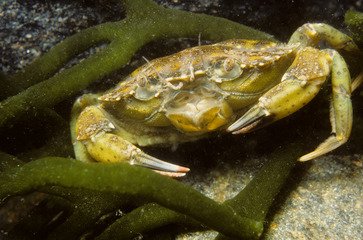
Introduction
The European crab (Carcinus maenas), commonly called the shore crab or green crab, is a small but influential crustacean of the north Atlantic and Mediterranean coasts. It is one of the most successful invasive species on the planet, having colonized coastlines on several continents. In its home waters it lives among rocks and weeds, often near the colorful coral and algae that shelter countless small animals. Its reputation as a hitchhiker comes from larvae and adults traveling in ship ballast and on moved shellfish.
Taxonomy
Carcinus maenas was described by Linnaeus in 1758. It belongs to the family Portunidae, the swimming crabs, recognized by their flattened hind legs adapted for paddling. The genus Carcinus contains just a few species, but they are among the most ecologically important crabs in temperate seas. Crustaceans such as this are distant relatives of insects, sharing a common arthropod ancestor with spiders and centipedes. Genetic studies show that invasive populations overseas descend from a small number of founders.
Physical Characteristics
The European crab has a broad, slightly oval shell usually measuring up to six centimeters across, though larger specimens occur. Its color ranges from green to brown or red depending on age and habitat. The front claws are strong and toothed, used for crushing prey and for defense. On the seafloor it may encounter the fragile seahorse, which relies on camouflage rather than speed to survive. A row of sharp teeth inside the mouth helps it process tough shellfish with little wasted effort.
Habitat
This crab thrives in estuaries, mudflats, rocky shores, and harbors from the intertidal zone down to about sixty meters. It tolerates a wide range of salinity and temperature, which explains its invasive success. It hides under stones and in crevices during the day and forages at night. Its coastal realm connects to open waters visited by the famed great white shark, though the crab stays near the bottom. It readily colonizes artificial structures such as piers, breakwaters, and oyster farms along the coast.
Diet
European crabs are opportunistic omnivores and active predators. They eat mussels, oysters, worms, small fish, and a wide variety of plant and animal detritus. Their powerful claws allow them to crack open bivalve shells that few competitors can handle. By controlling mussel populations they shape entire shore communities. Their world also overlaps with the migratory paths of the singing humpback whale, which feeds on tiny krill far above. Invasive crabs can strip a mussel bed rapidly, leaving little for native predators that depend on them.
Reproduction
Mating takes place after the female molts, when her shell is still soft. Males guard freshly molted females until fertilization occurs, then carry the fertilized eggs beneath their abdomen for weeks. Tiny larvae are released into the plankton, where they drift and develop through several stages before settling as miniature crabs. Massive numbers of larvae support the diets of many filter-feeding animals in the sea. Warm waters speed up development, allowing several generations to build up in a single season.
Conservation
The European crab is not threatened and is in fact expanding its range through ballast-water transport and aquaculture. Its invasive populations can devastate native shellfish industries and outcompete local crabs. Managing its spread requires monitoring ports and restricting the movement of live seafood. Even the deep ocean is not untouched, as discarded crab pots may drift and entangle creatures such as the elusive giant squid in the abyss. Early detection programs now use traps to monitor and sometimes remove newly arrived populations.
Fun Facts
The European crab can walk in any direction but prefers moving sideways, a trait that gives crabs their comical reputation. It can regenerate a lost claw over successive molts. Its shell color often signals its mood and surroundings through hidden pigments. Fishermen have used it as bait for centuries across Europe. A single female may release up to two hundred thousand larvae in one breeding season. Some cultures regard a sudden abundance of crabs as a traditional signal of changing seasons.
[…] in Latin, referring to the speckled orange spots on the carapace. It is closely related to the European Shore Crab of the eastern Atlantic. Like all decapod crustaceans, it possesses a hard chitin exoskeleton that […]