 By st20113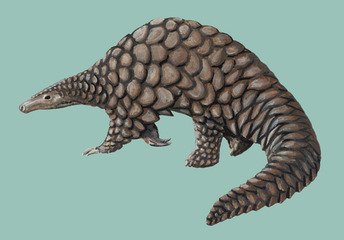
Introduction
The Giant Pangolin (Smutsia gigantea) is the largest of the world’s eight pangolin species, instantly recognizable by its extraordinary armor of overlapping keratin scales. Native to equatorial Africa, it can reach lengths of 1.8 meters and weigh over 30 kilograms. Despite its size, it is one of Africa’s least studied large mammals, spending most of its life hidden in dense vegetation and underground burrows, emerging only at night. Its wide geographic range across West and Central Africa has made it a flagship species for rainforest conservation, but illegal wildlife trade targeting its scales now threatens its survival.
Taxonomy
The Giant Pangolin belongs to the order Pholidota, a small group of pangolins that diverged from the carnivore lineage approximately 70 million years ago. Its scientific name, Smutsia gigantea, honors the South African zoologist Johannes Smuts. The family Manidae encompasses all eight pangolin species, with the genus Smutsia containing the Giant Pangolin and the smaller Tree Pangolin (Smutsia temminckii). Despite similarities to anteaters and armadillos, pangolins share no close taxonomic relationship with them — a striking case of convergent evolution.
Physical Characteristics
The Giant Pangolin’s entire dorsal surface is covered by 11 to 13 rows of large, overlapping keratin scales — the same protein in human fingernails — constituting approximately 20 percent of its body weight. These sharp-edged scales provide effective protection and are replaced continuously throughout life. The underside and face are covered in coarse dark hair. Its elongated head has a toothless tubular snout, and powerful forelimbs bear three large curved claws for digging. Its tongue, when fully extended, can exceed 40 centimeters.
Habitat
The Giant Pangolin inhabits the lowland tropical rainforests and swampy forest margins of West and Central Africa, from Senegal through the Congo Basin to northern Angola and western Uganda. It prefers areas with high termite density, soft soil for burrow excavation, and access to water below 1,200 meters elevation. Giant Pangolins construct elaborate underground burrow systems with multiple chambers, often reused for many years. They are strongly associated with old-growth forest but can survive in selectively logged areas where sufficient ground cover remains.
Diet
As an obligate myrmecophagous feeder, the Giant Pangolin subsists almost entirely on social insects, primarily termites and ants, much like the Aardvark. It uses its sense of smell to locate colonies, then tears open mounds with its curved foreclaws and extends its extraordinarily long, sticky tongue to collect thousands of insects in a single bout. Its stomach, equipped with keratinous spines and muscular walls, grinds prey without teeth. A single adult may consume up to 200,000 insects per night, providing a critical ecosystem service by controlling termite populations.
Reproduction
Gestation lasts approximately 150 days, after which the female gives birth to a single pup born with soft scales that harden within days. The mother carries her young on her back during foraging expeditions. Weaning occurs over three to four months, though the juvenile may remain with its mother for up to two years before reaching sexual maturity. The species produces at most one pup per year — a low reproductive rate that makes populations particularly vulnerable to sustained exploitation.
Conservation
The Giant Pangolin is classified as Endangered on the IUCN Red List, with population declines estimated at 30 to 50 percent over three generations. The primary driver is large-scale illegal wildlife trafficking for its scales, used in traditional Asian medicine despite having no proven therapeutic value. Its meat is also consumed as bushmeat. All eight pangolin species, including the Tree Pangolin, received CITES Appendix I protection in 2016, but enforcement remains inconsistent. Conservation organizations are strengthening anti-poaching patrols, disrupting trafficking networks, and establishing community-based programs that provide economic incentives for habitat protection.
Fun Facts
The Giant Pangolin is the only mammal on Earth covered entirely in keratin scales, and it lacks teeth entirely, relying on its muscular stomach to grind up insects. Its tongue is anchored at the rear of its thoracic cavity near the pelvis, a unique anatomical arrangement allowing extraordinary extension. Despite being almost entirely ground-dwelling, Giant Pangolins are accomplished swimmers. They curl into a tight ball when threatened, using their scales as flexible armor, and can emit a pungent acid spray from glands near their tail.