 By st20113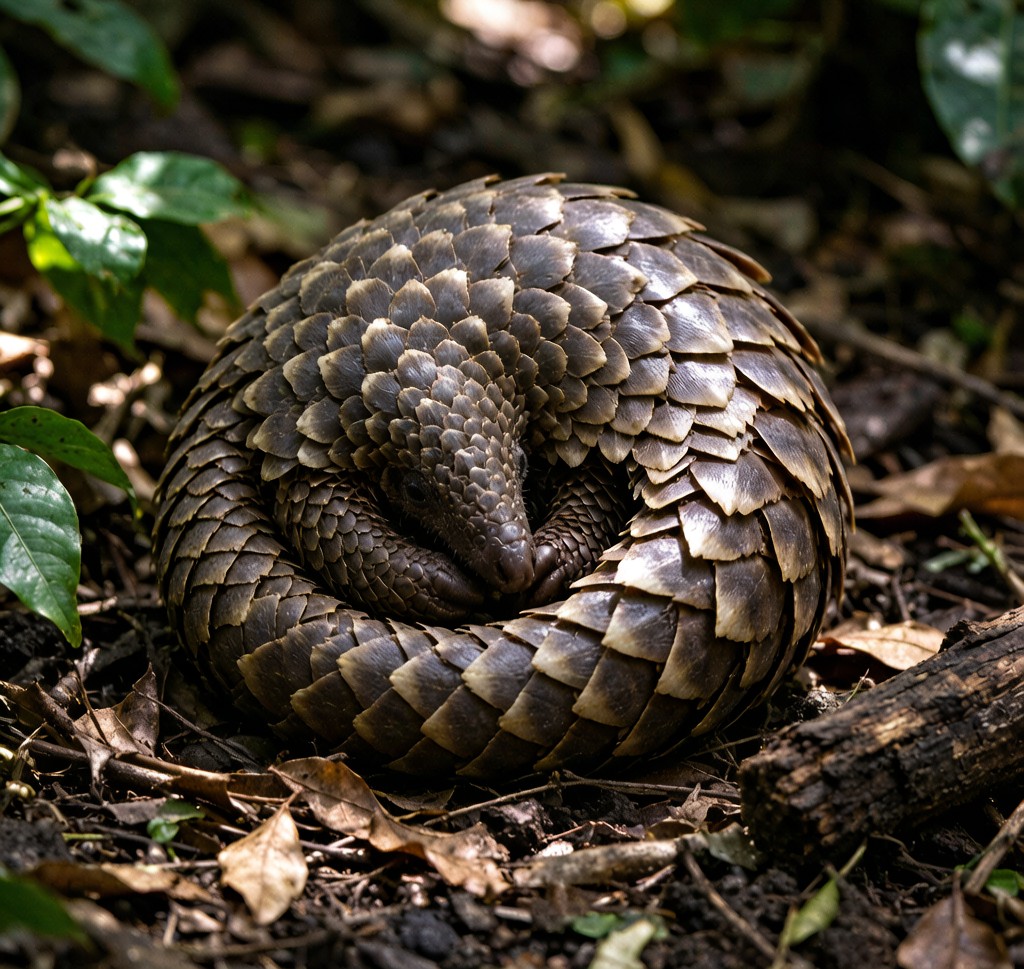
A Pangolin (Phataginus tricuspis) curled in its characteristic defensive ball on the African forest floor, showing its overlapping keratin scales
Overview
The Pangolin (Phataginus tricuspis), also known as the White-bellied Pangolin or Three-cusped Pangolin, is one of the most remarkable and most threatened mammals on Earth. Found across the forests of Central and West Africa, the pangolin is the only mammal in the world entirely covered in overlapping keratin scales – the same material that makes up human fingernails and rhino horns. These scales, which can number 100 to 1,000 depending on the species’ size, provide extraordinary protection against predators, making the pangolin one of the most heavily armored mammals alive. When threatened, the pangolin curls into an impenetrable ball, with its scales acting as sharp, overlapping layers that can shred the mouth of any predator foolish enough to attempt to bite through.
Pangolins are also among the most illegally trafficked animals in the world – a tragic irony that has driven all eight species of pangolin (four in Africa, four in Asia) to the brink of extinction. They are hunted for their scales (used in traditional medicine despite having no proven therapeutic value) and for their meat (considered a delicacy in China and Vietnam), with estimates suggesting that over one million pangolins have been taken from the wild in the past decade alone. All eight species are now protected under international law, listed in CITES Appendix I.
Habitat and Distribution
The White-bellied Pangolin is the most widely distributed of Africa’s four pangolin species, occurring from Senegal in the west across to Kenya in the east, and south to Angola and Tanzania. It inhabits tropical lowland rainforest, swamp forest, and dense bushland, where it is almost entirely arboreal – climbing trees and vines with remarkable agility using its prehensile tail and sharp claws to grip bark. It is also found in secondary forest and agricultural landscapes adjacent to natural forest.
During the day, pangolins rest in hollow trees, underground burrows, or dense vegetation, emerging at night to forage. They are highly dependent on forest ecosystems and are among the first species to disappear from degraded or fragmented habitats. The species’ habitat requirements – large tracts of continuous tropical forest – are under severe pressure from deforestation for timber, agricultural expansion, and mining across its range. The ivory trade crisis has also paradoxically affected pangolins, as law enforcement attention focused on elephants has freed up illegal wildlife trade networks to shift to other high-value species including pangolins.
Unique Biology and Behavior
The pangolin’s most remarkable feature is its tongue, which is longer than its entire body. When fully extended, the pangolin’s tongue – which is anchored at the base of the ribcage and coated in sticky saliva – can extend up to 40 centimeters beyond the tip of the snout. This extraordinary organ allows the pangolin to probe deep into insect nests, particularly those of ants and termites, which constitute its entire diet. A single adult pangolin can consume 70 to 200 grams of insects per night – up to 20,000 individual insects. Pangolins have no teeth, so insects are ground up in their muscular stomach, aided by small pebbles and grit ingested incidentally while feeding.
When threatened, the pangolin employs its famous defensive behavior: it curls into a tight ball, using its scaled tail to cover its vulnerable face and underparts. This posture is so effective that even lions have been documented abandoning attempts to eat pangolins. As an additional defense, pangolins can also spray a noxious acid-like secretion from glands near their anus, similar to the defense mechanism of skunks. This combination of physical armor and chemical defense makes the pangolin almost impossible to prey upon in the wild.
Reproduction and Conservation
Pangolins are solitary except during mating, and little is known about their mating systems in the wild. Females give birth to a single offspring after a gestation of approximately 120 to 150 days, in a burrow or hollow tree. The newborn pangolin – called a pangopup – weighs approximately 100 to 500 grams and is already covered in soft, translucent scales that harden within a few days. The mother carries the pup on her back or at the base of her tail for the first few weeks of life, and the pup begins foraging independently at approximately three months of age. Females typically give birth to one pup per year, making reproductive rates extremely low.
The White-bellied Pangolin is listed as Endangered on the IUCN Red List, reflecting catastrophic population declines driven by poaching and habitat loss. Conservation efforts focus on strengthening law enforcement against pangolin trafficking, particularly at international ports and airports; raising awareness in consumer countries about the biological and ecological value of pangolins; supporting community-based forest monitoring programs in range countries; and developing pangolin breeding programs in captivity to support potential future reintroduction and supplementation of wild populations. The discovery of significant pangolin populations in previously unknown areas offers some hope for the species’ long-term survival.