 By st20113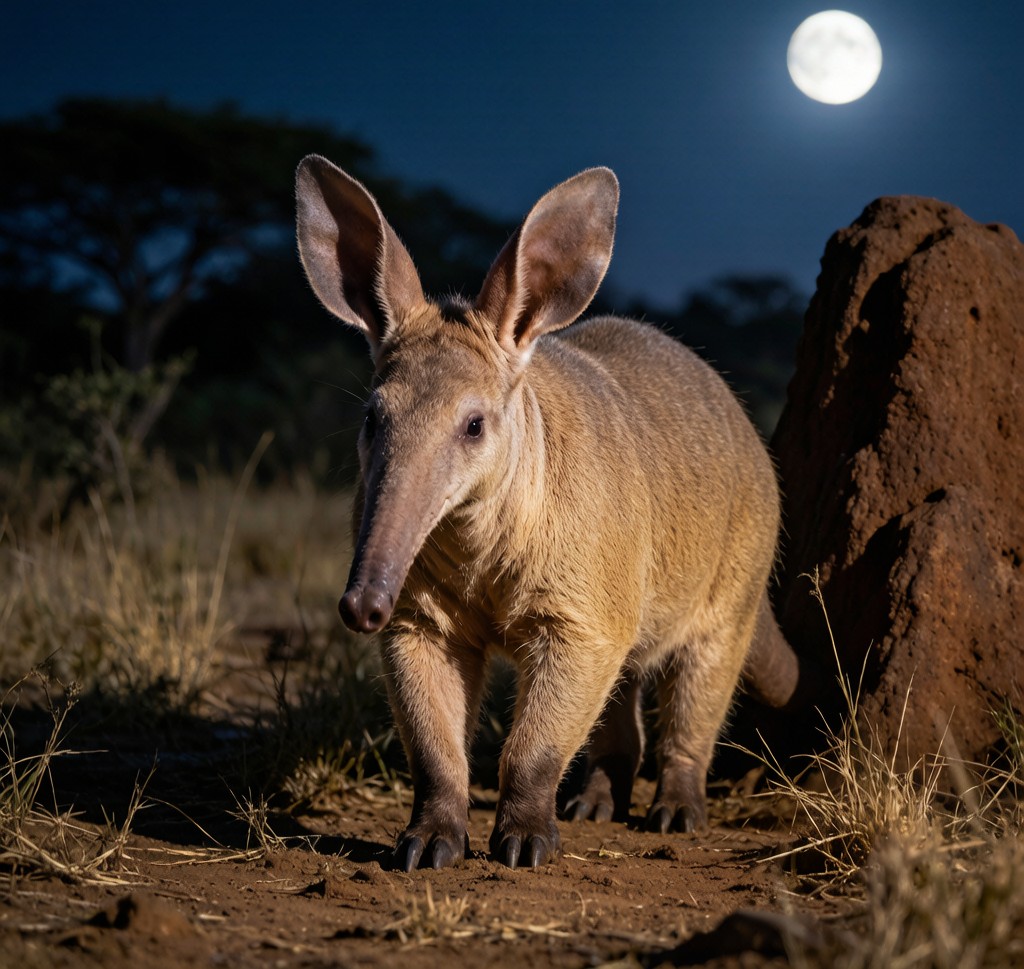
An Aardvark (Orycteropus afer) emerging from its burrow at dusk in the African savanna, showing its distinctive long snout and large ears
Overview
The Aardvark (Orycteropus afer) is one of the most peculiar and least-known mammals in Africa – a nocturnal, burrowing insectivore whose combination of features defies easy classification. With its pig-like body, kangaroo-like tail, rabbit-like ears, and anteater-like long sticky tongue, the Aardvark looks like an animal assembled from spare parts of other creatures. It is the only living species in the order Tubulidentata, representing an ancient and solitary branch of the mammalian family tree that diverged from all other living mammals approximately 80 million years ago. The name “aardvark” comes from Afrikaans and Dutch, meaning “earth pig” – an apt description of its tubular snout and pig-like body shape.
Aardvarks weigh 40 to 80 kilograms and measure 1 to 1.3 meters in body length, plus a 50 to 70-centimeter tail. They are powerfully built for digging, with short, muscular legs, heavy clawed feet adapted for excavating, and a dense, tough skin that protects against ant and termite bites. Their most remarkable feature is their tongue – which can extend up to 30 centimeters beyond the tip of the snout and is covered in sticky saliva that coats termite prey. The Aardvark is almost entirely solitary, coming together only to mate, and spends virtually all of its daylight hours underground in self-excavated burrows.
Habitat and Distribution
The Aardvark occurs throughout sub-Saharan Africa, from Senegal in the west to Ethiopia in the east, and south to South Africa. Within this vast range, it occupies a remarkable diversity of habitats including savanna, woodland, grassland, and semi-desert – anywhere that its primary prey, termites, are sufficiently abundant. The species is absent from true rainforest and true desert, and is most common in areas with sandy or loamy soils that are easy to dig but firm enough to support stable burrow walls.
The Aardvark’s burrow is one of its most important ecological adaptations. Using its powerful front claws, a single Aardvark can excavate a burrow system several meters deep and up to 10 meters long in a single night. Burrows serve multiple functions: shelter from daytime heat, refuge from predators including lions, leopards, and hyenas, and a base for foraging. Aardvarks use different burrows for sleeping and for temporary refuge, and their abandoned burrows are critical resources for many other species – including African wild dogs, bat-eared foxes, African Civets, and even Nile crocodiles in some areas.
Ecology and Behavior
The Aardvark is a specialized termite specialist. It locates termite mounds using its keen sense of smell – its olfactory bulbs are among the largest of any mammal relative to brain size – and digs into the mound using its powerful front claws. Once inside, it extends its extraordinary 30-centimeter tongue to collect termites, which adhere to the sticky saliva coating. An adult Aardvark can consume up to 50,000 termites in a single night, using its thick skin and muscular body to protect itself from soldier termite bites. The Aardvark’s stomach has a muscular pyloric region that functions like a gizzard, grinding up the chitinous exoskeletons of the termites.
Aardvarks are almost entirely nocturnal, emerging from their burrows approximately 30 minutes after sunset and returning before dawn. They are highly solitary – individuals maintain large home ranges of 2 to 5 square kilometers that overlap extensively with those of other Aardvarks, and there is little social interaction outside of the brief mating season. Individuals communicate using scent marks from anal glands and may use a grunting vocalization to signal their presence. Their excellent hearing allows them to detect the approach of predators or the movement of prey in complete darkness.
Conservation
The Aardvark is listed as Least Concern on the IUCN Red List, reflecting its large range and relatively stable populations. However, there is considerable uncertainty about population trends, and anecdotal evidence from researchers working in Africa suggests that Aardvark numbers may be declining in some areas. The species faces multiple threats, including habitat loss through agricultural expansion and urbanization, direct hunting for meat (aardvark meat is reported to be prized by some rural communities), and persecution by farmers who mistakenly believe Aardvarks damage crops or compete with poultry for food.
Perhaps the most significant emerging threat is climate change. Termites are highly sensitive to changes in temperature and rainfall, and the Iridomyrmex species that are the Aardvark’s primary prey may be declining in parts of its range as rainfall patterns shift. Aardvarks are also vulnerable to drought, as they obtain most of their water from their prey and from moist soil, and prolonged dry periods may force them to range further from their burrows in search of food. Research into Aardvark populations using camera traps and burrow surveys is providing new insights into their distribution and ecology, and protecting areas of intact savanna habitat with abundant termite populations remains the primary conservation priority for this remarkable and elusive animal.
and the slow-moving two-toed sloth. Another specialist digger with a taste for ants is the aardvark of Africa, though these animals are not close relatives despite their similar
[…] habitat to several per square kilometer in prime areas. The Aardwolf often shares habitat with the Aardvark, another specialized insectivore, though the two species exploit different food […]