 By st20113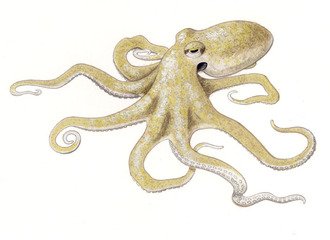
Introduction
The common octopus (Octopus vulgaris) is one of the most studied cephalopod species, found in tropical and subtropical waters across the globe, from the Mediterranean and Atlantic to the Indo-Pacific. With eight flexible arms lined with hundreds of suckers containing thousands of chemical and tactile receptors, the octopus possesses a sensory toolkit of extraordinary sophistication. Recent research has revealed capacities for learning, memory, play, and individual personality once thought to be exclusive to vertebrates.
Taxonomy
Octopus vulgaris belongs to the family Octopodidae within the order Octopoda and the class Cephalopoda. The species was first described by Jean-Baptiste Lamarck in 1799. The genus Octopus contains approximately 100 species, ranging from tiny species at 2.5 centimeters to the giant Pacific octopus exceeding 9 meters in arm span. Molecular studies suggest that what was classified as O. vulgaris may represent multiple cryptic species that are morphologically similar but genetically distinct. Cephalopods diverged from other mollusks over 500 million years ago, with octopuses representing a highly derived branch. The blue-ringed octopus is among the most venomous of all marine animals and belongs to the same broader octopod lineage.
Physical Characteristics
Adult common octopuses have a mantle length of 12 to 25 centimeters and a total arm span of 50 to 100 centimeters, with the largest individuals exceeding 1.5 meters and weighing up to 10 kilograms. The body is soft-bodied and highly flexible, with no internal skeleton, allowing the octopus to squeeze through any opening larger than its beak, the only hard part of its anatomy. The skin contains millions of chromatophore cells that allow color changes in a fraction of a second, while muscular papillae can be raised or lowered to mimic surrounding surfaces. Each of the eight arms contains a distributed nervous system, allowing independent sensory processing and motor control.
Habitat
Octopus vulgaris inhabits shallow coastal waters to approximately 200 meters depth, with the highest densities on rocky reefs, seagrass meadows, and sandy bottoms. The species thrives in waters between 15 degC and 25 degC. Octopuses are primarily benthic, spending most of their time on or near the seafloor, though they can swim powerfully by expelling water through their funnel. They establish home ranges in crevices, empty shells, or self-constructed burrows, emerging to hunt primarily at night. The availability of suitable den sites is a critical limiting factor. Like the giant Pacific octopus, Octopus vulgaris is sensitive to pollution and ocean acidification.
Diet
The common octopus is a generalist carnivore with a diet dominated by crustaceans, bivalves, gastropods, and small fish. For shelled prey, it uses its beak to drill a hole through the shell using chemical secretions and mechanical scraping before injecting digestive enzymes and consuming the soft tissues. The octopus’s arms are not only locomotive tools but also highly sensitive tactile organs capable of independent decision-making due to the distributed nervous system. Each arm can process sensory information independently, enabling remarkable feats of manipulation while the central brain attends to other tasks. Like the seahorse, the octopus uses camouflage as a primary hunting strategy.
Reproduction
Octopuses are semelparous, reproducing only once before dying. Males use a specialized arm called the hectocotylus to transfer spermatophores into the female’s mantle cavity during a complex courtship display. After mating, the male typically dies within weeks, while the female stores sperm internally until she is ready to fertilize her eggs. She lays between 100,000 and 500,000 eggs, attaching them in clusters to her den walls and tending them continuously for 1 to 4 months, aerating them with water currents and protecting them from predators. During this period, the female does not feed. Upon hatching, planktonic paralarvae drift for several weeks before settling to the seafloor, with fewer than 1 percent surviving to become juveniles. Like the coral, octopus populations rely on high reproductive output to offset massive early-life mortality.
Conservation
Octopus vulgaris is listed as a species of Least Concern, but this masks significant local concerns about overfishing and habitat degradation. Global demand for octopus as food has increased substantially, and in many traditional fishing areas populations have declined noticeably. Fisheries managers have responded with size limits, seasonal closures, and quotas. Climate change poses additional challenges, as rising temperatures alter spawning timing and prey distribution, while ocean acidification may affect embryo development.
Fun Facts
The common octopus has three hearts: two pump blood to the gills, and the third pumps blood to the rest of the body. Its blood is blue because it contains hemocyanin rather than hemoglobin, a copper-based molecule more efficient under cold, low-oxygen conditions typical of the deep sea. Octopuses can learn by observation, a capacity previously thought to require complex social cognition found only in mammals and birds. Like the mantis shrimp, the octopus has independently evolved remarkable visual and sensory capabilities that rival those of vertebrate animals.
[…] to fish, birds, and mammals. Mobile and schooling, it shows the success of cephalopods such as the common octopus […]
[…] system of tubes connected to the cloaca — through which it draws oxygenated water. Like the common octopus, this species relies on specialized respiratory adaptations to meet its oxygen demands in […]
[…] pink, or purple depending on the symbiotic algae it hosts. Like other reef organisms such as the common octopus, it depends on healthy reef habitat for shelter and […]
[…] across, marked with brown bands over a creamy background. Along with relatives such as the common octopus, it belongs to the phylum Mollusca, though snails live on land rather than in the […]