 By st20113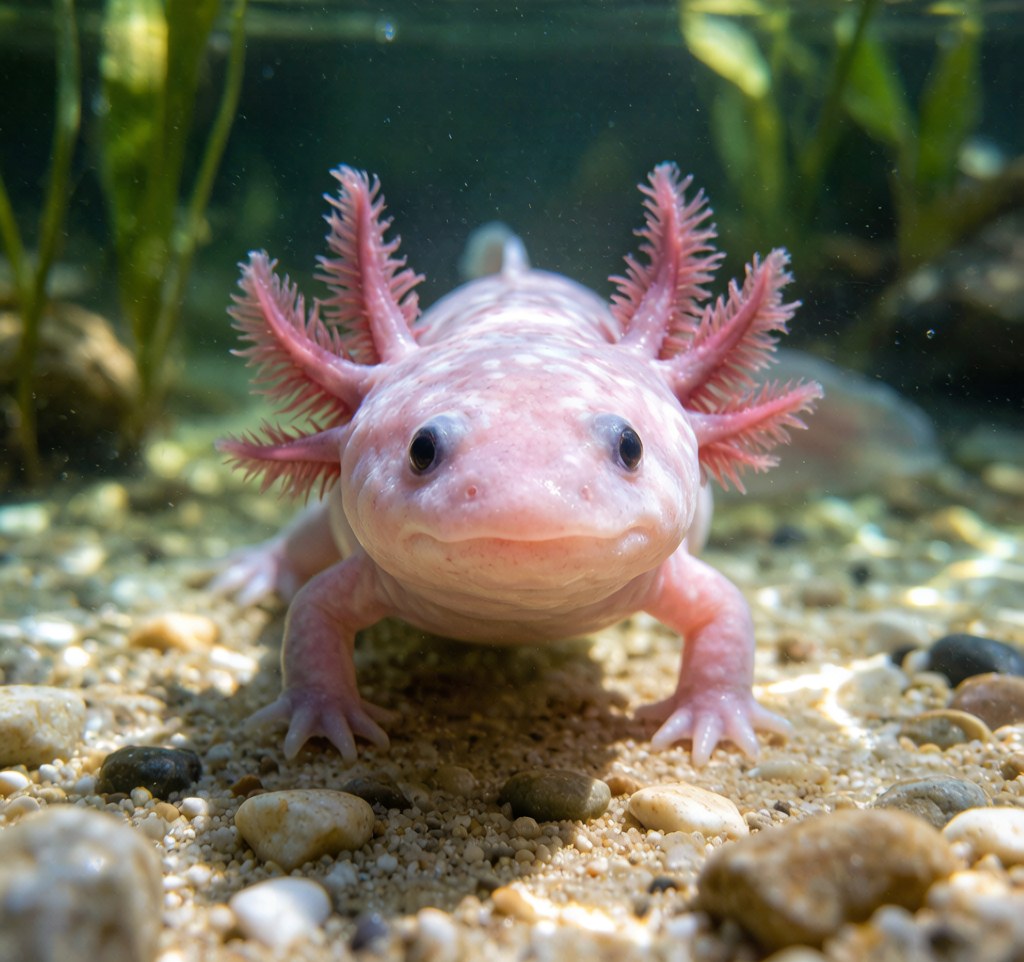
Introduction
The Axolotl (Ambystoma mexicanum) is one of the most extraordinary amphibians on Earth, famous for its remarkable neotenic characteristics — retaining juvenile features throughout life while reaching sexual maturity in a larval-like aquatic state. Endemic to the ancient canal system of Xochimilco in Mexico City, the Axolotl has become an emblem of Mexican biodiversity and a cornerstone of modern regenerative medicine research. Unlike most amphibians that metamorphose from aquatic larvae to terrestrial adults, the Axolotl remains permanently aquatic, maintaining external gill stalks and fins throughout its entire lifespan.
Taxonomy
The Axolotl belongs to the family Ambystomatidae, the mole salamanders of North America, and is the sole species in its genus exhibiting obligate neoteny — never undergoing spontaneous metamorphosis without hormonal intervention. Its closest relative is the tiger salamander (Ambystoma tigrinum), with which it shares a close evolutionary relationship and can produce viable hybrids. The neotenic state likely evolved as an adaptation to the stable aquatic environment of the Xochimilco canal system, where selective pressure for terrestrial dispersal was minimal. The species name mexicanum reflects its endemic Mexican range.
Physical Characteristics
Adult Axolotls reach 15 to 45 centimeters in length, with wild-type individuals displaying mottled dark brown and olive dorsal surfaces while captive populations exhibit white, pink, gold, and black morphs. The three pairs of external gill stalks projecting from behind the head are the species’ most distinctive feature — highly vascularized structures used for respiratory gas exchange in oxygen-poor canal waters. The broad, flattened head carries small, lidless eyes and a wide mouth giving a perpetual smile-like appearance. The laterally compressed tail provides propulsion through water, and four short limbs with four toes each enable bottom-dwelling locomotion.
Habitat
The Axolotl is endemic to the canal system of Xochimilco — a UNESCO World Heritage Site in southern Mexico City representing the remnant of the ancient Lake Xochimilco. Individuals occupy shallow, murky waters less than two meters deep, where dense aquatic vegetation provides cover from predators and supports the complex food web on which Axolotls depend. Water remains cool at approximately 18 to 20°C year-round, a characteristic that has shaped the species’ physiological tolerances over thousands of years. Water quality in Xochimilco has declined dramatically due to urbanization and pollution, making the Axolotl one of the most critically endangered amphibians globally.
Diet
The Axolotl is a carnivorous predator employing a sit-and-wait strategy supplemented by active foraging along the canal bottom. Its wild diet includes aquatic insects, worms, crustaceans, small fish, and mollusks, with larger individuals also consuming small amphibians and tadpoles. The wide, virtually toothless mouth relies on suction feeding — generating negative pressure within the oral cavity to draw prey items in. Seasonal diet variation is significant, with gut content studies documenting higher proportions of mollusks during periods of reduced prey availability. The Seahorse (Hippocampus spp.) shares with the Axolotl a reliance on suction feeding as the primary prey capture mechanism.
Reproduction
Axolotl reproduction occurs entirely in water, with spawning possible year-round when conditions are suitable. Males deposit spermatophores — cone-shaped sperm packages — onto the substrate, which females collect for internal fertilization. Following courtship displays, females lay between 100 and 1,000 eggs individually attached to aquatic plants, rocks, or other hard surfaces. Eggs incubate for approximately two to three weeks at typical water temperatures before hatching as fully formed miniature adults. The Hellbender (Cryptobranchus alleganiensis), North America’s largest salamander, shares a similar aquatic breeding strategy with external fertilization, offering an instructive comparison with the Axolotl’s canal-based reproduction.
Conservation
The Axolotl is classified as Critically Endangered on the IUCN Red List, with wild population surveys indicating a decline exceeding 90 percent over recent decades. Severe habitat degradation of the Xochimilco canal system through water pollution, sewage contamination, and chemical runoff represents the primary threat. Invasive species — particularly Nile tilapia and common carp — have dramatically altered the ecosystem by competing for food and preying on eggs, hatchlings, and adults. Conservation strategies include the chinampa restoration project, which revives traditional floating garden agriculture that naturally filters canal water while providing habitat.
Fun Facts
The Axolotl’s regenerative capabilities have revolutionized developmental biology, with researchers documenting near-perfect limb, tail, spinal cord, heart tissue, and even partial brain regeneration without the scarring that characterizes mammalian wound healing. Unlike mammals, Axolotls produce a blastema — a mass of dedifferentiated cells — at wound sites that organizes to rebuild lost structures. The species can accept organ transplants from other individuals with minimal rejection, a phenomenon linked to its unusually powerful immune system. Sacred in Aztec mythology, the Axolotl was associated with the deity Xolotl, believed to have transformed into the salamander to avoid sacrifice.
[…] People ate it and used it as medicine. They knew it as a common animal of the canals. Today the axolotl is found in the wild only in what is left of those same canals. The draining of the lake almost […]