 By st20113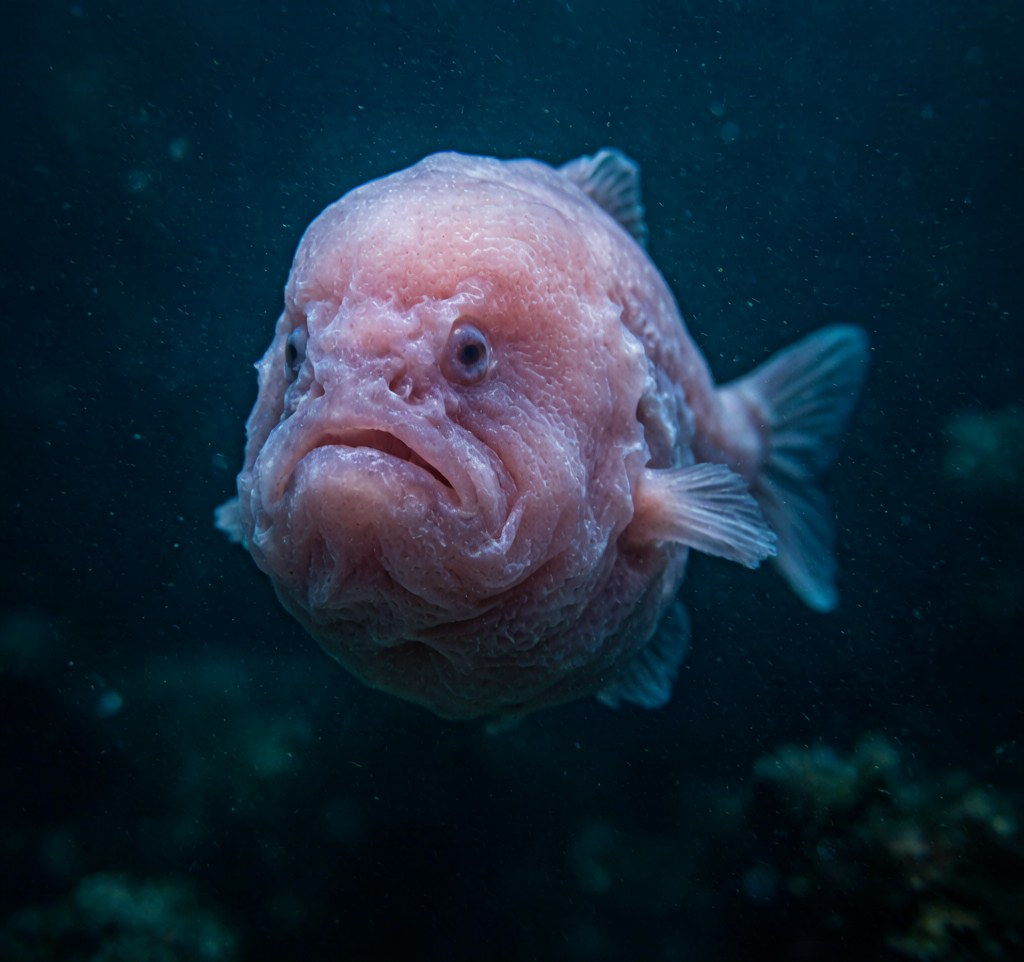
Introduction
The Blobfish (Psychrolutes marcidus) has become one of the most recognizable deep-sea species through internet fame as the world’s ugliest animal, a distinction that masks a fascinating biology perfectly adapted to one of Earth’s most extreme environments. Inhabiting deep waters off southeastern Australia, Tasmania, and New Zealand at depths between 600 and 1,200 meters, the Blobfish thrives under crushing pressures and near-freezing temperatures lethal to most marine organisms. The gelatinous, seemingly deflated appearance that inspired its viral fame is actually a remarkable adaptation to high-pressure environments at depth where the Blobfish appears perfectly normal.
Taxonomy
The Blobfish belongs to the family Psychrolutidae, the fathead sculpins, a group of marine ray-finned fish adapted to cold, deep-water environments across the world’s oceans. The genus Psychrolutes comprises approximately 10 recognized species, with P. marcidus being among the better-known members. The species name marcidus derives from Latin, meaning withered or drooping. Within the broader fish taxonomy, Psychrolutidae falls within the order Scorpaeniformes, the scorpionfishes and their relatives. The Seahorse (Hippocampus spp.) shares with the Blobfish the characteristic of belonging to marine groups whose members have evolved extraordinary body forms far removed from the typical fish silhouette.
Physical Characteristics
The Blobfish body consists primarily of a soft, gelatinous mass with a density slightly less than seawater, allowing neutral buoyancy at depth without energy expenditure on swimming. At surface pressure, individuals measure up to 30 centimeters and appear as a flaccid, pale pinkish-gray mass with a drooping expression. At depth, where pressure reaches 60 to 120 times atmospheric levels, the body is compressed into a more recognizable fish form. The Blobfish lacks a swim bladder and instead relies entirely on its gelatinous flesh, a structural solution impossible to implement with rigid gas-filled chambers under extreme pressure.
Habitat
The Blobfish inhabits the deep continental slope and abyssal plains of the southern Pacific Ocean around southeastern Australia, Tasmania, and New Zealand, where the continental shelf descends steeply into deep water. The species is most commonly recorded at depths between 600 and 1,200 meters, where water temperatures remain stable at approximately 2 to 4 degrees Celsius and ambient light is negligible. The seafloor consists of fine sediments and deep-sea mud, providing limited structural complexity compared to shallow-water reefs. The Giant Pacific Octopus (Enteroctopus dofleini) shares the Blobfish range in the deep waters off southeastern Australia and New Zealand.
Diet
The Blobfish employs a sit-and-wait foraging strategy, hovering just above the seafloor and waiting for prey to drift within range of its capacious mouth. Its diet consists primarily of small benthic and pelagic organisms including crustaceans such as crabs, sea urchins, and various mollusks inhabiting the deep seafloor. The upward-facing mouth enables efficient capture of prey carried past by deep-sea bottom currents, including zooplankton and small gelatinous organisms descending from shallower waters. The Blobfish relies on suction feeding rather than pursuit predation, creating negative oral pressure to draw in prey.
Reproduction
The reproductive biology of the Blobfish remains largely unobserved due to the extreme difficulty of studying the species in its natural deep-sea habitat. Like many deep-sea fish with naturally low population densities, Blobfish are believed to employ a strategy of low fecundity producing few offspring per spawning event paired with significant parental investment. The Blobfish is presumed oviparous, with females laying eggs fertilized externally before deposition, though specific egg-laying substrates remain unknown from direct observation. The slow growth and late maturity typical of deep-sea fish mean populations recover extremely slowly from increased mortality. Life span estimates suggest individuals may exceed 100 years, with maturity reached at approximately 20 to 30 years.
Conservation
The Blobfish is listed as Vulnerable on the IUCN Red List, with population assessments indicating substantial declines driven by bycatch from deep-sea trawl fisheries targeting commercially valuable species such as orange roughy. Because of its fragile, gelatinous body, the Blobfish is almost universally killed when captured in trawls. The Australian and New Zealand governments have implemented trawl restrictions in parts of the Blobfish range, though enforcement across vast oceanic areas remains challenging. Paradoxically, the species’ viral internet fame has generated significant public attention to deep-sea conservation issues. The Emperor Penguin (Aptenodytes forsteri), another species vulnerable to climate-driven habitat change, illustrates how environmental threats affect marine and polar biodiversity alike.
Fun Facts
The Blobfish rose to internet fame in 2013 when it was voted the world’s ugliest animal by the Ugly Animal Preservation Society. The viral photograph was taken by a marine biologist who brought the specimen to the surface from approximately 1,000 meters depth, the dramatic decompression giving it the characteristic gelatinous appearance. At its natural depth, the Blobfish appears reasonably fish-shaped, and the assumption that it perpetually looks like a frowning blob reflects a misunderstanding of how pressure governs living tissue form. The Great White Shark (Carcharodon carcharias), like the Blobfish, serves as an ambassador species whose iconic status drives public engagement with marine conservation issues.