 By st20113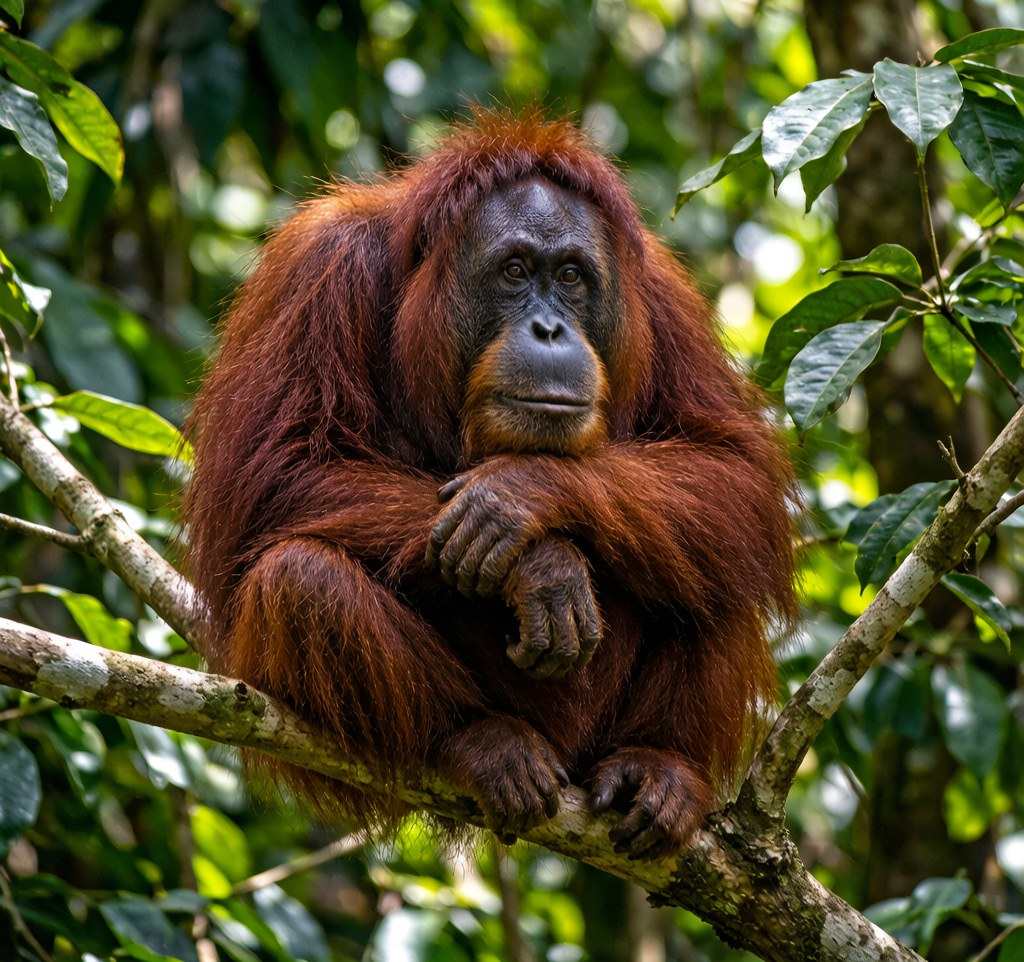
Introduction
The Bornean orangutan (Pongo pygmaeus) is one of three orangutan species native to the island of Borneo in Southeast Asia. These great apes are renowned for their distinctive reddish-brown fur, remarkable intelligence, and arboreal lifestyle. As one of humanity’s closest living relatives, sharing approximately 97 percent of their DNA with humans, Bornean orangutans play a vital role in the health of tropical rainforest ecosystems. The gorilla and orangutan share a common ancestry within the great ape family, yet orangutans are unique for being the only great apes native to Asia. Their name derives from the Malay and Indonesian phrase orang hutan, meaning person of the forest.
Taxonomy
The Bornean orangutan belongs to the family Hominidae, which includes all great apes. Swedish taxonomist Carl Linnaeus first described the species in 1760. Within the genus Pongo, three species are currently recognized: the Bornean orangutan (Pongo pygmaeus), the Sumatran orangutan (Pongo abelii), and the recently described Tapanuli orangutan (Pongo tapanuliensis). The Bornean species is further divided into three subspecies: Pongo pygmaeus pygmaeus (northwest populations), Pongo pygmaeus morio (east populations), and Pongo pygmaeus wurmbii (southwest populations). Compared to the chimpanzee, which is more closely related to humans, orangutans represent an older evolutionary lineage that split from the African ape family around 15 million years ago.
Physical Characteristics
Bornean orangutans display pronounced sexual dimorphism. Adult males can weigh between 50 and 100 kilograms and stand approximately 1.2 to 1.5 meters tall, while females are considerably smaller, weighing 30 to 50 kilograms. Their most distinctive feature is the long, shaggy coat of reddish-orange fur that covers most of their body. Mature males develop prominent cheek flanges, which are large fleshy pads on the sides of the face, and a throat sac used to produce deep resonant calls that travel through dense forest. Their arms are remarkably long, spanning up to 2 meters, allowing them to move effortlessly through the canopy. Unlike the powerful build of a tiger, orangutans have adapted their physique specifically for brachiation, or arm-swinging locomotion through trees.
Habitat
Bornean orangutans are endemic to the island of Borneo, divided among Malaysia, Indonesia, and Brunei. They inhabit lowland and hill tropical rainforests, including peat swamp forests, dipterocarp forests, and riparian forests. These apes are almost entirely arboreal, spending approximately 95 percent of their time in the trees. They build new sleeping nests each night by bending branches and leaves into platforms high in the canopy. Orangutans have the largest home range of any great ape species, with individual males covering up to 400 hectares. Deforestation and the expansion of palm oil plantations have severely fragmented their habitat, much like the threat faced by the giant panda in bamboo forests.
Diet
Bornean orangutans are primarily frugivorous, with fruit making up approximately 60 percent of their diet. They particularly favor figs, durians, and mangosteens. When fruit is scarce, they supplement their diet with leaves, bark, flowers, insects, and occasionally soil for minerals. Orangutans play a crucial ecological role as seed dispersers, as many rainforest trees rely on them to spread seeds across large distances. They possess remarkable spatial memory, remembering the location and fruiting season of hundreds of individual trees across their home range. Like the red panda, orangutans spend a significant portion of their day foraging for plant-based food in forest canopies.
Reproduction
Bornean orangutans have the slowest reproductive rate of any mammal. Females reach sexual maturity at around 15 years of age and give birth to a single infant after a gestation period of approximately eight and a half months. The inter-birth interval is typically seven to eight years, the longest of any primate. Infant orangutans are completely dependent on their mothers for the first two years and continue to nurse and travel with her for up to seven years. During this extended period, young orangutans learn essential survival skills including nest building, food identification, and social behaviors. This prolonged maternal investment, also seen in the brown bear, ensures that offspring develop the complex knowledge needed for independent survival.
Conservation
The Bornean orangutan is classified as Critically Endangered on the IUCN Red List, with populations declining by more than 60 percent over the past 60 years. The primary threats are habitat loss due to palm oil plantations, logging, and mining, as well as poaching and the illegal pet trade. Fewer than 100,000 individuals are estimated to remain in the wild. Conservation efforts include habitat protection through national parks, rehabilitation programs for orphaned and displaced orangutans, and sustainable palm oil certification initiatives. Protecting remaining forests is crucial not only for orangutans but for the countless other species that share their ecosystem. Public awareness campaigns have helped reduce demand for unsustainable palm oil products.
Fun Facts
- Orangutans are the heaviest tree-dwelling animals on Earth, yet they move through the canopy with astonishing grace.
- They use tools in the wild, including sticks to extract insects and leaves as makeshift umbrellas.
- The distinctive cheek flanges of dominant males can continue growing throughout their lifetime.
- Orangutans have been observed using medicinal plants to treat wounds, a behavior also seen in chimpanzee populations.
- Their grip strength is remarkable as they can support their entire body weight with their feet while feeding.