 By Iris
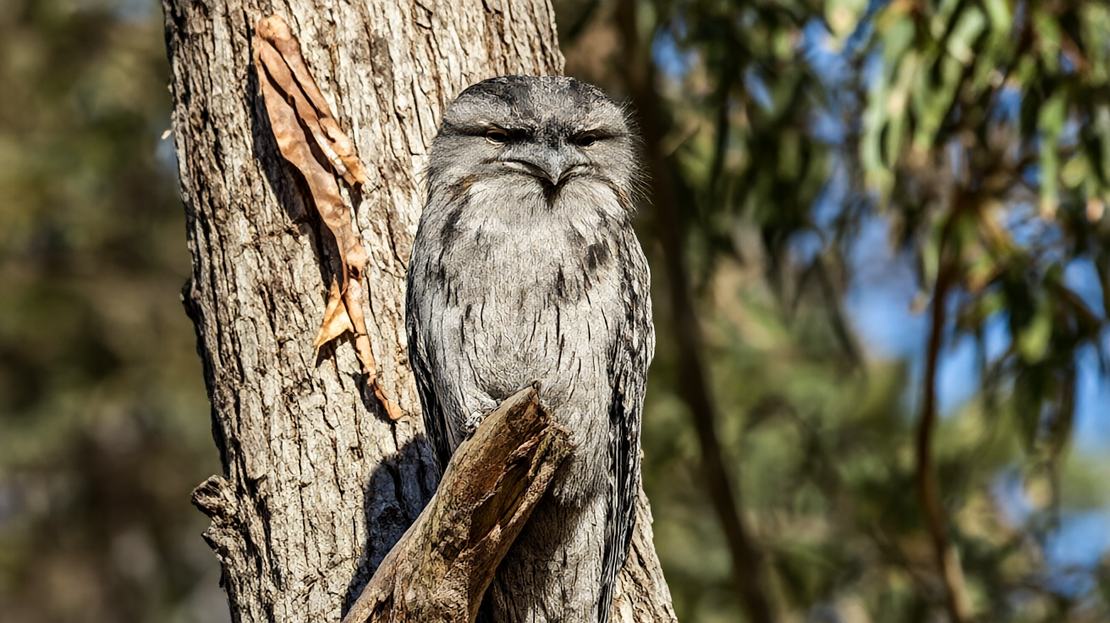
Podargus strigoides | Tawny Frogmouth
Species Profile · Podargidae
Tawny Frogmouth
A grey bird sits on a dead branch and looks like a broken stump.
Least Concern
Length
Weight
Bill
Clutch
Incubation
Rating
The Tawny Frogmouth
A stump that is not a stump
A grey bird sits on a dead branch and looks like a broken stump. That is the whole trick. The tawny frogmouth holds the pose for hours, with its bill tilted up.
Most people walk past the bird without noticing it, and that failure is the best proof the disguise works. Only the yellow eyes give it away, and only when they open. Because the bird never flies off, it relies on the costume rather than escape.
Family tree
Podargidae, and not an owl
Its proper name is Podargus strigoides, and it belongs to the frogmouth family. Podargidae sits near the nightjars, though the two groups split long ago. A European Nightjar shares the flat head and the very wide gape. Both birds hunt at night, and both rest flat against wood through the day.
Frogmouths are not owls. Owls grip their prey with talons and tear it apart, while a frogmouth can only strike with its broad beak. A Green Woodpecker also feeds on the ground, yet it climbs trunks instead of perching still.
A beak, not talons
How to tell one
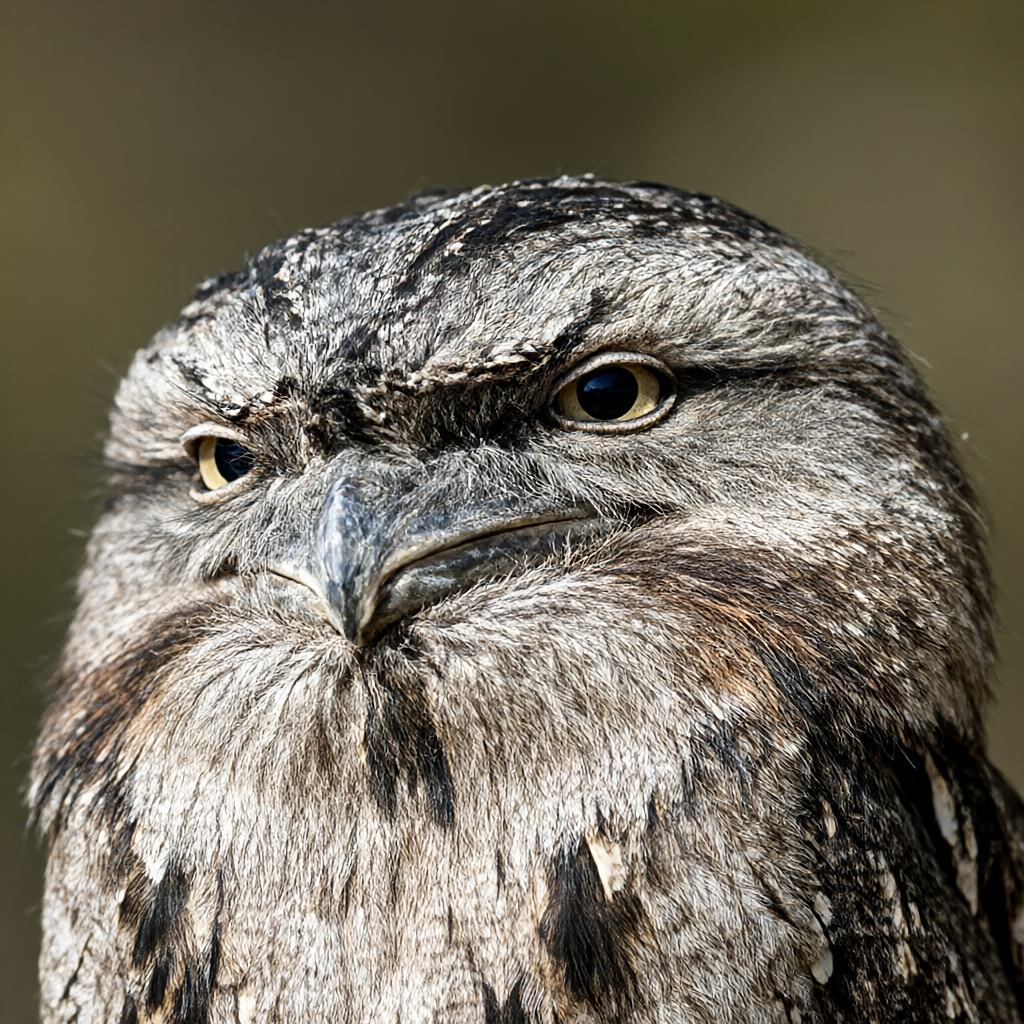
Length runs 34 to 53 cm, and weight falls between 150 and 550 g. Its plumage is silver-grey and mottled, with darker streaks across the back. The bill is broad and flat, and the gape reaches almost to the eyes.
Because the mouth opens that wide, the bird can swallow a moth or a beetle without breaking it apart. Its feet are weak, so it never carries prey in them. Feathers around the eyes form tufts that look like ears, though the real ears sit hidden behind them.
Powder down breaks into dust, which the bird uses to clean its plumage. The claws stay short and blunt.
1
2
3
Rough bark to match
Where it lives
Open woodland and savanna cover most of Australia. Dense rainforest and the driest interior stay empty. Eucalypts matter most.
Because the bird roosts in the open, it needs trees with rough bark. Town parks and suburban gardens suit it well. Where a dead branch leans at an angle, a frogmouth will use it.
Pairs often return to the same perch for years. No recognised subspecies exist.
Insects, taken on the ground
What it eats
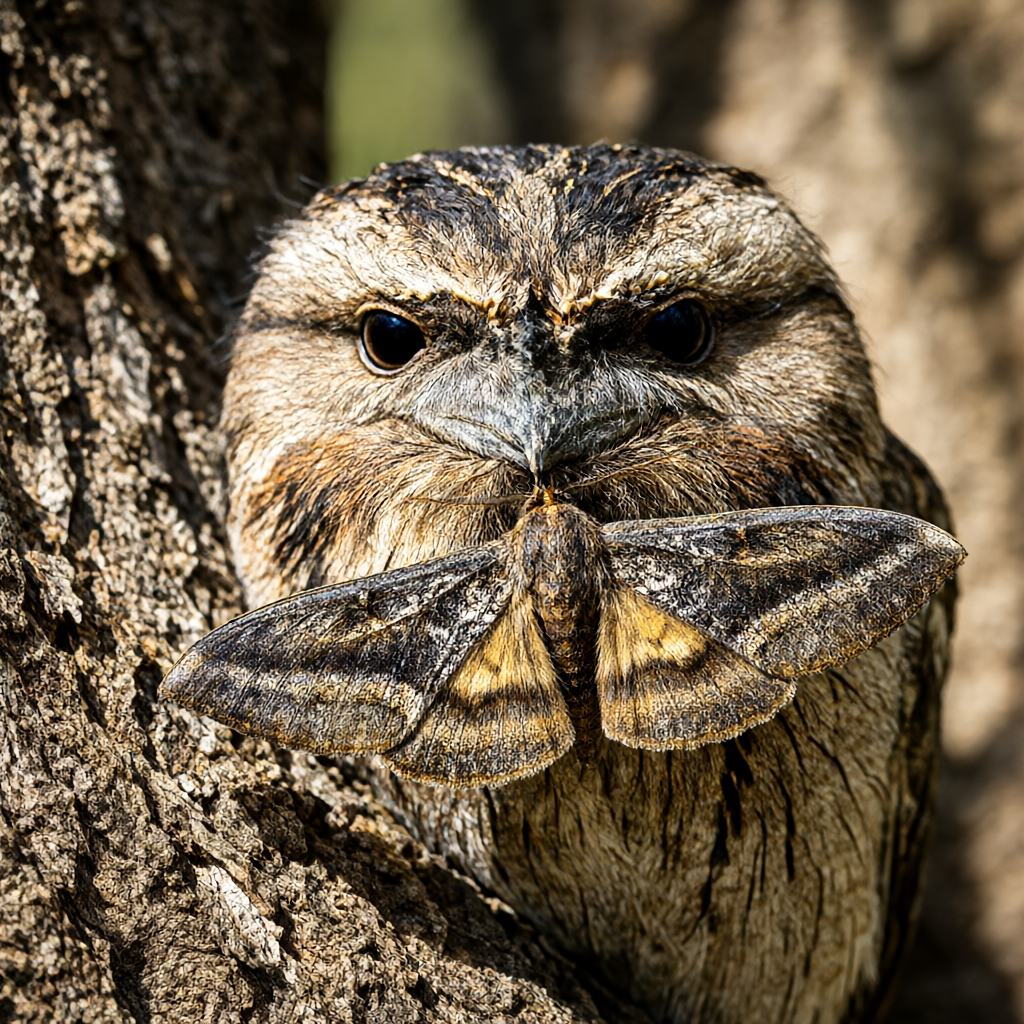
Insects dominate the food, especially moths, beetles and grasshoppers. Worms, slugs and centipedes come off the ground. Because the bird hunts from a perch, it drops rather than chases.
A larger frogmouth may take a small mammal or a frog. Prey dies fast against the branch, and then it goes down head first. It needs very little water, since the insects supply most of what it loses.
On hot days it drinks from puddles, and it bathes in light rain. Nothing in the diet is taken in flight.
Two or three eggs
The breeding cycle
Pairs stay together for several seasons. A loose platform of sticks serves as the nest, and it sits in a horizontal fork. Two or three eggs arrive in late winter or spring.
Because both adults incubate, the eggs stay covered through the day. Incubation runs about 30 days. Chicks hatch white and downy, then grow grey within weeks.
Both parents feed the chicks, and the male takes the larger share because the female leaves first. Young birds go after roughly a month, though they stay nearby.
Least Concern
Conservation
Red List status is Least Concern. The species remains common across the mainland. Because it tolerates gardens, it has lost little ground to cities.
Cars kill many birds, since frogmouths freeze in headlights. Pesticides reduce the insect supply on farmland. Cats take young birds from low perches, though the loss stays local.
The Tasmanian population has declined, and no clear cause has been found. Numbers elsewhere appear steady.
Side by side
How It Compares
| Trait | Tawny Frogmouth | European Nightjar |
|---|---|---|
| Family | Podargidae | Caprimulgidae |
| Bill | broad and flat | short, very wide gape |
| Feet | weak, no talons | small, for perching |
| Hunting | drops from a perch | hawks in open flight |
| Range | Australia | Europe to Central Asia |
| Rating | Least Concern | Least Concern |
Common misreadings
What People Get Wrong
- Not an owl, despite the eyes. No talons anywhere. Owls kill with their feet, while a frogmouth strikes with a broad beak and never carries anything in its claws.
- Not a bird that chases prey. It drops from a perch. Flight serves escape rather than hunting, and the animal waits until something moves below before it leaves the branch.
- Not a nest builder in any real sense. Sticks go down loose. The platform barely holds together, and the eggs show through from below while both adults take turns on the open fork.
Going further
Sources and Further Reading
Quick hits
Five things to remember
- A frogmouth can hold its freeze pose for hours, and it will not break even when a person lifts it.
- The wide gape looks like a yawn, but it is a threat display aimed at predators.
- It has no talons, so the beak does all the work.
- It drinks by scooping water in the lower bill, then tilting the head back.
- Its call is a low repeated oom, which carries far on a still night.
[…] percent of their DNA with humans, making them one of our closest living relatives alongside the Western Gorilla and the Common Chimpanzee. Their populations have shown encouraging recovery in recent […]