 By st20113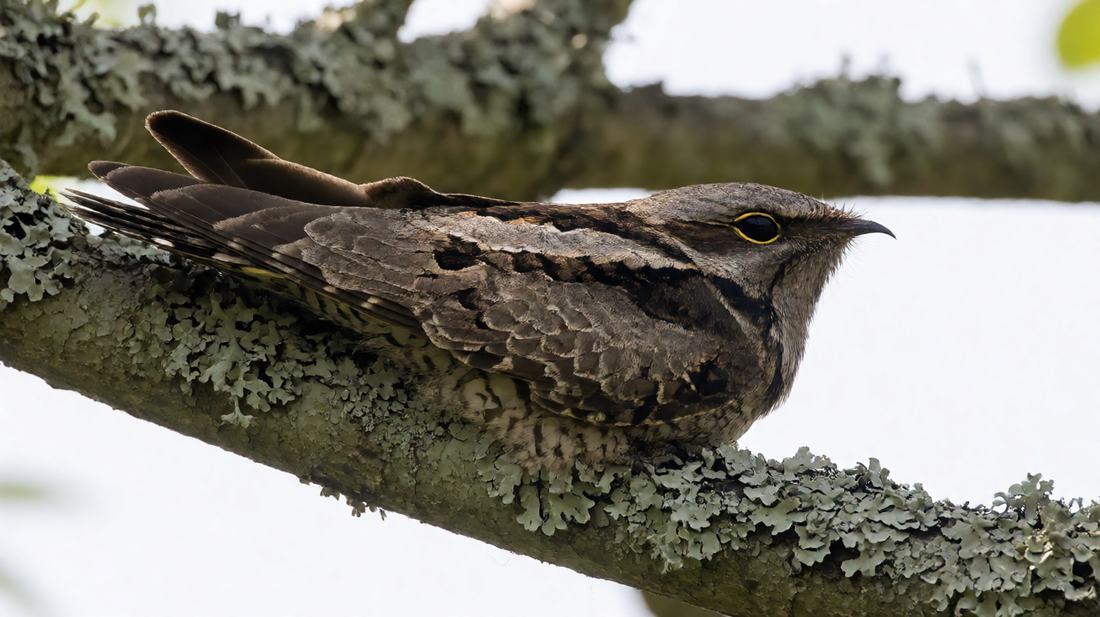
Caprimulgus europaeus | European Nightjar
Species Profile · Caprimulgidae
European Nightjar
The bird of the summer night whose churring fills the heath — a machine of camouflage that hunts the moths of the dusk with a mouth like a basket.
IUCN: Least Concern
Range
Length
Weight
Nest
Incubation
The bird of the summer night
A hunter of the dusk
The European nightjar is one of the best hidden birds of the whole of Europe. It is a long-winged and long-tailed bird of the night. It lives on the heath and in the young plantation and at the edge of the open wood. Its plumage of grey and brown and buff is finely mottled and barred. A bird crouched along a lichen-covered branch is almost impossible to see. It sits on the leaf litter of the wood floor and it does not move. The bird is only found when it moves or when the light catches the great dark eye. The species is a summer visitor to Europe. It arrives in May and leaves in August and September.
It spends the winter in the savanna and the scrub of Africa south of the Sahara. The bird is active at night. It feeds in the air on the night-flying moths and beetles of the dusk. It hunts in the half light and in the full dark. It rests on the ground or along a branch through the day. Most people know the bird by the sound rather than by the sight. The song of the male is a strange mechanical churring. It rises and falls and can go on without a pause for many minutes. The sound is made in the throat.
It is not a call in the ordinary sense. The churring carries a long way in the still air of a summer night. It is the sound of the heath of the south of England. It is the sound of the pine woods of the north. The bird likes bare and disturbed ground. It favours the newly felled wood and the burnt heath and the young plantation. So the changes in the way the forest is managed have cut both ways. The bird lost a great deal when the old heaths were planted with conifer. It has gained a great deal from the clear felling of the same woods.
Family tree
Caprimulgus, the nightjars
The European nightjar was described by Linnaeus in 1758. The modern treatment places it in the genus Caprimulgus. The genus holds the typical nightjars. The family is the Caprimulgidae. It is a large and a very widely spread group of birds of the night and of the dusk. The birds of the group share a soft and a hidden pattern of plumage. They share an enormous gape and a tiny bill. They share the long and stiff bristles that fringe the mouth. The order to which the nightjars belong has been argued over for a long time. The old treatment put the nightjars and the owls and the frogmouths together.
The modern work on the genes has shown something quite different. The nightjars are in fact close relatives of the swifts and of the hummingbirds. The group is now placed in the order Apodiformes in the broad sense. That result is a striking one. The nightjar of the heath and the swift of the summer sky look about as unlike one another as 2 birds can. The link is still one of the best supported findings of the recent taxonomy of the birds. The European nightjar is a close relative of the Common Swift (Apus apus). The 2 birds share the same long and narrow wing and the same small and weak foot. They both feed on the insects of the air. They differ in the time of day at which they work.
They differ in the build of the mouth. The swift has a small gape and sweeps the open sky. The nightjar has an enormous gape ringed with bristles and works the edge of the wood. The genus Caprimulgus holds between 30 and 40 species. The European nightjar is the most northerly and the best known of them. The modern treatment divides the species into 5 subspecies. The gaps between them are small. They rest on the depth of the ground colour and the width of the pale spots of the wing.
Camouflage and white spots
How to identify one
An adult European nightjar is between 24 and 28 centimetres long. Its wingspan is between 52 and 59 centimetres. Its mass is between about 50 and 100 grams. So the bird is about the size of a mistle thrush. It is much lighter in the body than its long wings suggest. The plumage is a soft and a very finely worked mix of grey and brown and buff. The crown and the mantle are streaked with the black and the pale of the bark. The wing carries a row of pale spots along the outer edge. That row shows as a broken line in the flight.
The male has 2 or 3 large white spots on the outer primaries. He also has a pair of white tips to the outer tail feathers. The female has none of that white. The white marks of the male are the only sure way to tell the 2 sexes apart in the field. The bill is very short and is almost hidden by the bristles. The gape is enormous and reaches back beyond the level of the eye. The bristles around it are stiff and pointed and curve forward. They trap the insects in the air. So the mouth of the bird is more like a basket than a pair of jaws.
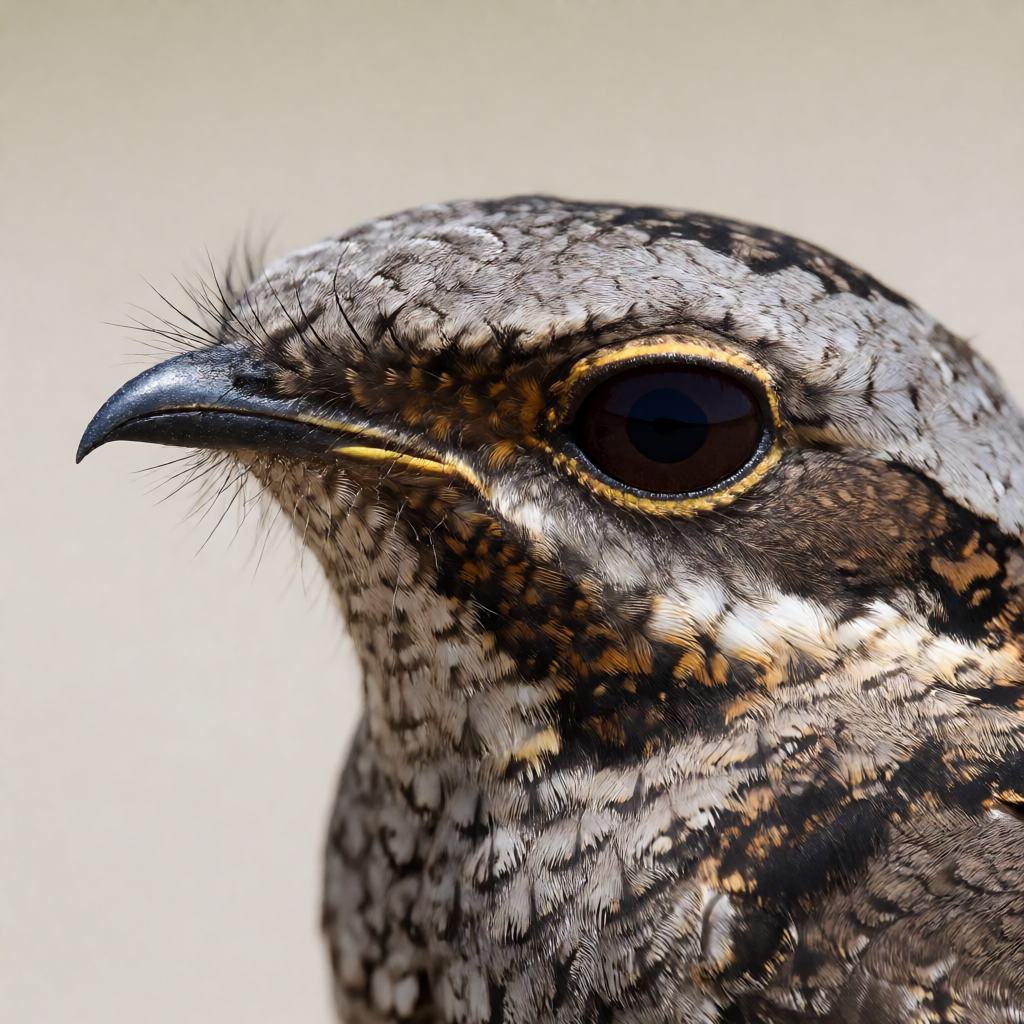
The eye is very large and is built for the low light of the dusk. The bird has a layer at the back of the eye that throws the light back. That layer gives the eye its brilliant shine in the beam of a lamp. The feet are small and weak. They are used for walking and perching and never for holding the prey. The middle claw of the foot has a comb-like edge. The bird dust bathes on the bare ground of the wood floor.
1
2
3
Heath, clearing and young plantation
Where it lives
The European nightjar wants dry and open ground. It wants a thin and a low cover of plants. It wants a good supply of night-flying insects. The bird is a species of the heath and the moor and the young plantation and the woodland clearing. It also uses the sandy and the pebbly waste. It has a great liking for bare and disturbed soil. The bare soil is warm. It gives the bird a place to sit and to dust bathe.
It is also the place where the moth and the beetle lay their eggs in the greatest numbers. The species is commonest in the lowlands of the south and centre of Europe. It is also common in the pine woods of the north and of the Baltic. In the Mediterranean it is a bird of the maquis and the open pine wood and the dry olive grove. In the far north it is a bird of the open birch scrub and the dry sandy pine heath. The bird is absent from the dense and closed forest. It is absent from the wet and marshy ground. It is absent from the tall and dense grassland.
The absence from the closed forest has mattered more over the last century. The planting of the open heath with conifer destroyed a great deal of the habitat. The damage was worst in the north of Europe. The stands of the modern forest are clear felled after between 40 and 60 years of growth. The species returns to the bare ground of the felling for a few years. So the conservation of the bird rests on a steady supply of the young and open stands. The managed forest must keep a share of those stands open.
A mouth like a basket
What it eats
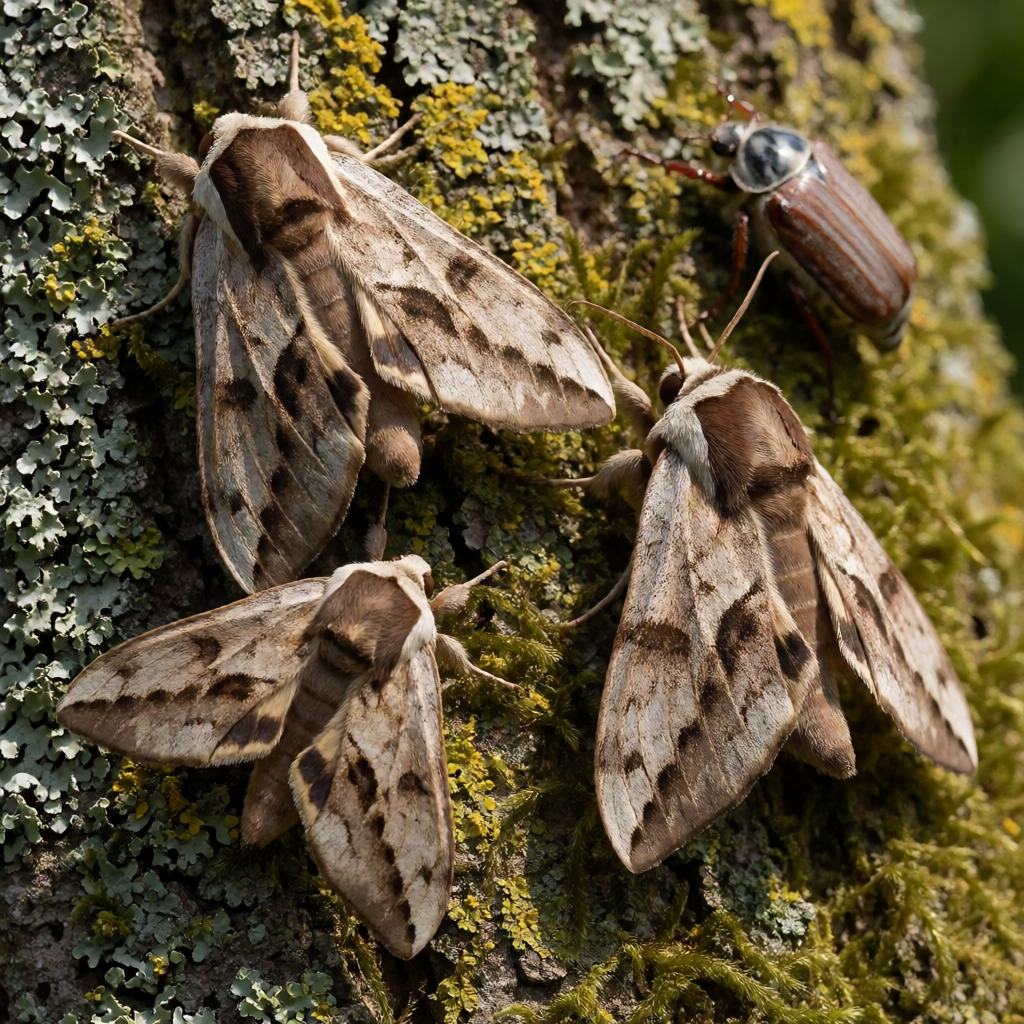
The European nightjar is a hunter of the air. The diet is made up almost wholly of the insects that fly in the dark. The moths form the greatest part of the prey over most of the range. The beetles come second. The species also takes caddisflies and mayflies and flies and bugs. It takes the small and the large flying ants as well. The mix of the diet changes with the weather and the season and the habitat. The birds of the heath take more of the beetles of the grass.
The birds of the broad-leaved wood take more of the moths. The way the bird hunts is unlike that of any other bird of Europe in one important way. It does not chase a single insect. It sweeps through the air with the mouth held open and takes whatever it meets. The enormous gape and the ring of bristles turn the mouth into a net. The bird flies with the wings held above the level of the back. It beats them in a light and a loose way. The flight looks like that of a butterfly or an owl.
The bird can turn and twist in the dark within a very small space. The species often hunts around street lamps and other artificial lights. The habit has grown with the spread of electric light in the countryside. The bird is sometimes killed in numbers by a single car. The road runs through a rich feeding area. The insects gather at the lights and the birds gather at the insects. That is one of the more unexpected links between the modern landscape and the wildlife. The bird drinks on the wing by skimming low over a pond or a stream with the bill open.
Two eggs on bare ground
The breeding cycle
The European nightjar returns to the breeding ground in the second half of May. The male arrives first and takes a territory. He begins to churr from a favourite branch. The churring of the male is the easiest sign that the species is present. It can be heard for several hundred metres in the still air of the night. The bird churrs most at dusk and in the hours before dawn. The male also claps the wings in a slow and a mechanical way in flight. He gives a series of sharp and repeated whistles. The species builds no nest at all.
The 2 eggs are laid straight on the bare ground. They may lie among the dead leaves or on the flat surface of the heath. The eggs are a pale grey with fine brown and grey marks that match the ground. A sitting bird and its clutch are found by chance rather than by search. The incubation lasts between 17 and 19 days. Both parents take part. The sitting bird is very unwilling to leave. It will allow a very close approach before it flushes at the last moment. The chicks are covered in a down that matches the ground.
They leave the nest site within a day of the hatching. The young are brooded and fed by the female while the male keeps bringing food. The young can fly at about 16 or 18 days of age. The family is fed by the parents for a period after the young fledge. The species usually raises a single brood in the north. It raises a second brood in the south. The second clutch is laid in the same simple scrape on the ground. The female sometimes moves the site a short way after the loss of the first clutch.
Falling, then recovering
Conservation
The European nightjar is assessed as Least Concern on the global Red List. The world population is a very large one. It runs into the millions of birds. The species has an enormous range. It covers the whole of the temperate and warm parts of Europe. It also reaches western Asia and the north of Africa. The bird is not thought to be close to the levels of any threatened class. The picture in Europe is still a mixed one. The species fell very heavily in the north and west of the continent.
The fall came in the middle of the last century. The open heath was planted with conifer. The rough grazing that kept the ground open was given up. The nightjar became a scarce and a very local bird in Britain. It went the same way in Denmark and in the north of Germany. The trend has been partly turned round in some of those countries since the 1990s. The recovery is put down to the clear felling of the conifer stands. The steady management of the heath for the species matters too. The warmer summers of the last decades have helped as well.
The bird is at risk from the disturbance of the nest site. Walkers and dogs and cyclists are the main cause. The eggs and the chicks lie on the bare ground. The parent birds have no defence other than their own camouflage. The species also suffers from the loss of the insect supply. The loss follows the use of farm chemicals in the wider landscape. The bird is killed on the roads in some numbers. The deaths come where a rich feeding area lies close to a busy road. The young and the unskilled birds are the most frequent victims.
Quick hits
Five things to remember
- The link between the nightjars and the swifts is one of the best supported surprises of modern bird taxonomy. The 2 groups look almost nothing alike.
- The English name of the family comes from an old and a mistaken belief. People once thought the birds fed from the udders of goats in the dusk.
- The male has 2 or 3 large white spots on the outer wing. He also has white tips to the outer tail feathers. The female has none of those marks.
- The bird has a layer in the back of the eye. It shines brightly in the beam of a lamp. That shine is one of the easiest ways to find a nightjar at night.
- The nightjar builds no nest at all. The 2 eggs are laid on the bare ground. The clutch is found by chance rather than by search.