 By Iris
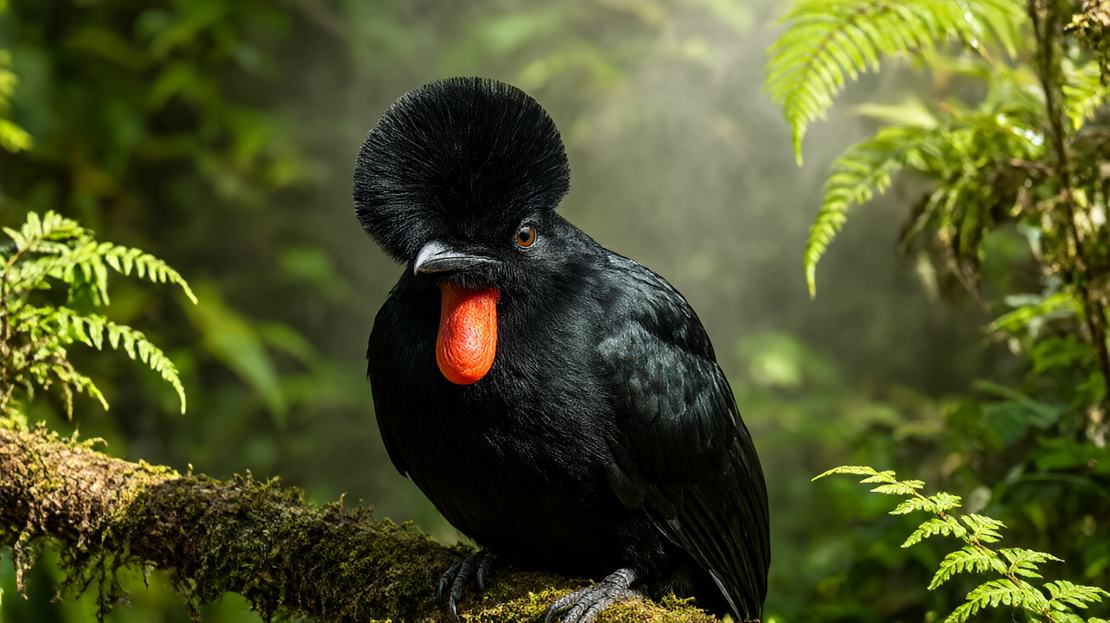
Cephalopterus penduliger | Long-wattled Umbrellabird
Species Profile · Cotingidae
Long-wattled Umbrellabird
A black bird sits on a branch.
Vulnerable
Length
Wattle
Crest
Clutch
Range
Rating
The Long-wattled Umbrellabird
A roof of feathers
A black bird sits on a branch. Feathers fan over its head like a roof. Below the beak hangs a long wattle.
It swings when the bird turns. Males carry that ornament, and females never grow one. It can run longer than the body.
Its range covers only the Chocó. Those forests run along one narrow coast. Its voice carries a low boom through the mist, and that sound gives the bird away long before it appears.
Family tree
Cotingidae, display above everything
Its proper name is Cephalopterus penduliger, one of three umbrellabirds. Cotingidae is the family, a group of fruit eaters found only in the Neotropics. A Raggiana Bird-of-paradise carries the same taste for display, though the two families evolved their ornaments apart.
Both build a show around a male who offers nothing but his appearance. A Toco Toucan shares the same forest and the same fruit trees. Both often feed within sight of each other, though neither takes much notice.
A wattle up to 35 cm
How to tell one
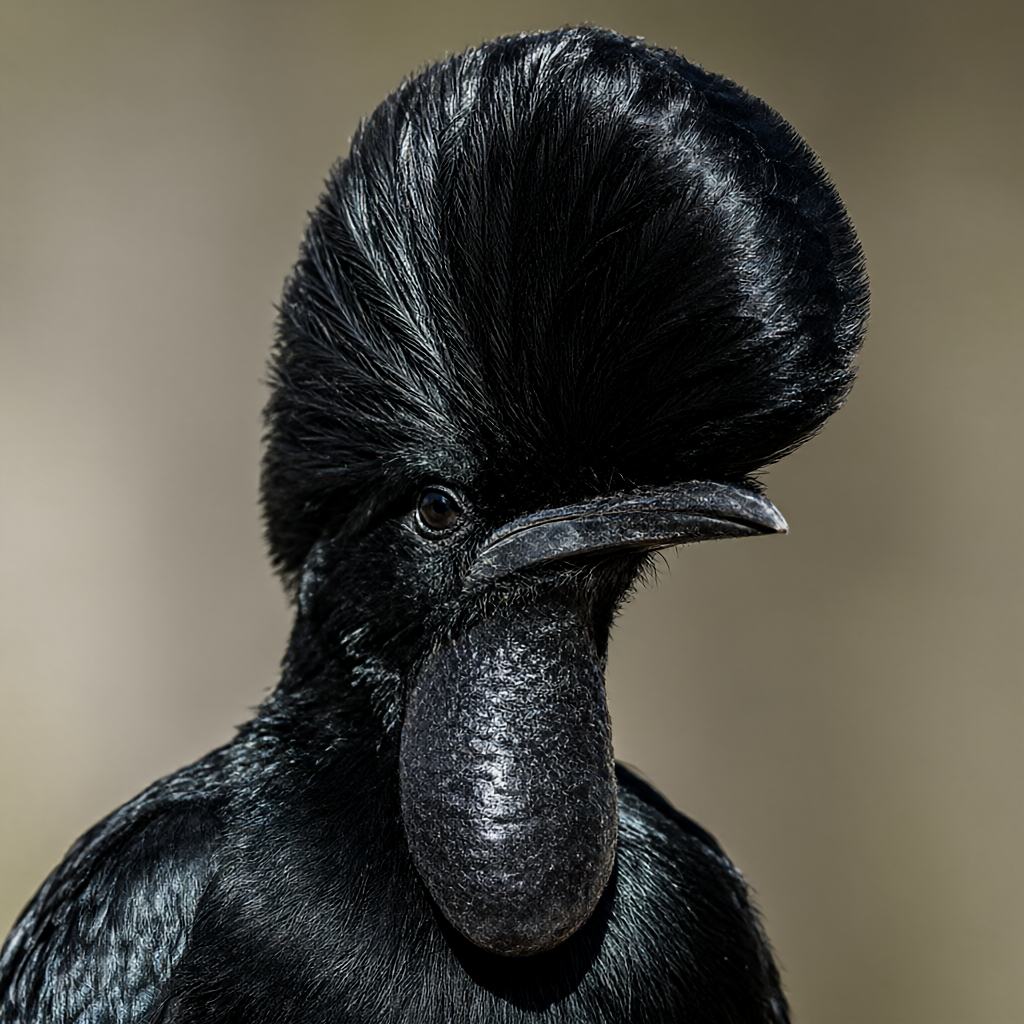
Males run 40 to 42 cm from beak to tail. Females stay smaller than their mates. They carry no wattle at all. A full-grown male carries one up to 35 cm long.
Feathers on the head form a broad umbrella. It spreads over the eyes like a hood. Because the crest covers the face, the bird can face forward and still hide its eyes from above. Its plumage is deep black with a blue gloss.
That gloss changes as the light shifts. Its beak is broad and short, and it suits fruit better than any kind of chase on the wing.
1
2
3
A narrow coastal strip
Where it lives
Foothill and lowland forest in western Ecuador and Colombia holds the whole population. That range stays narrow. Those forests sit between the Andes and the sea.
Wet ground with heavy rainfall suits the bird. Green canopy lasts all year here. Because the forests are cut into narrow strips, the bird now lives in fragments rather than one continuous block.
Streams and ridges create natural breaks. Those breaks have become hard edges where the trees end.
Fruit, swallowed whole
What it eats
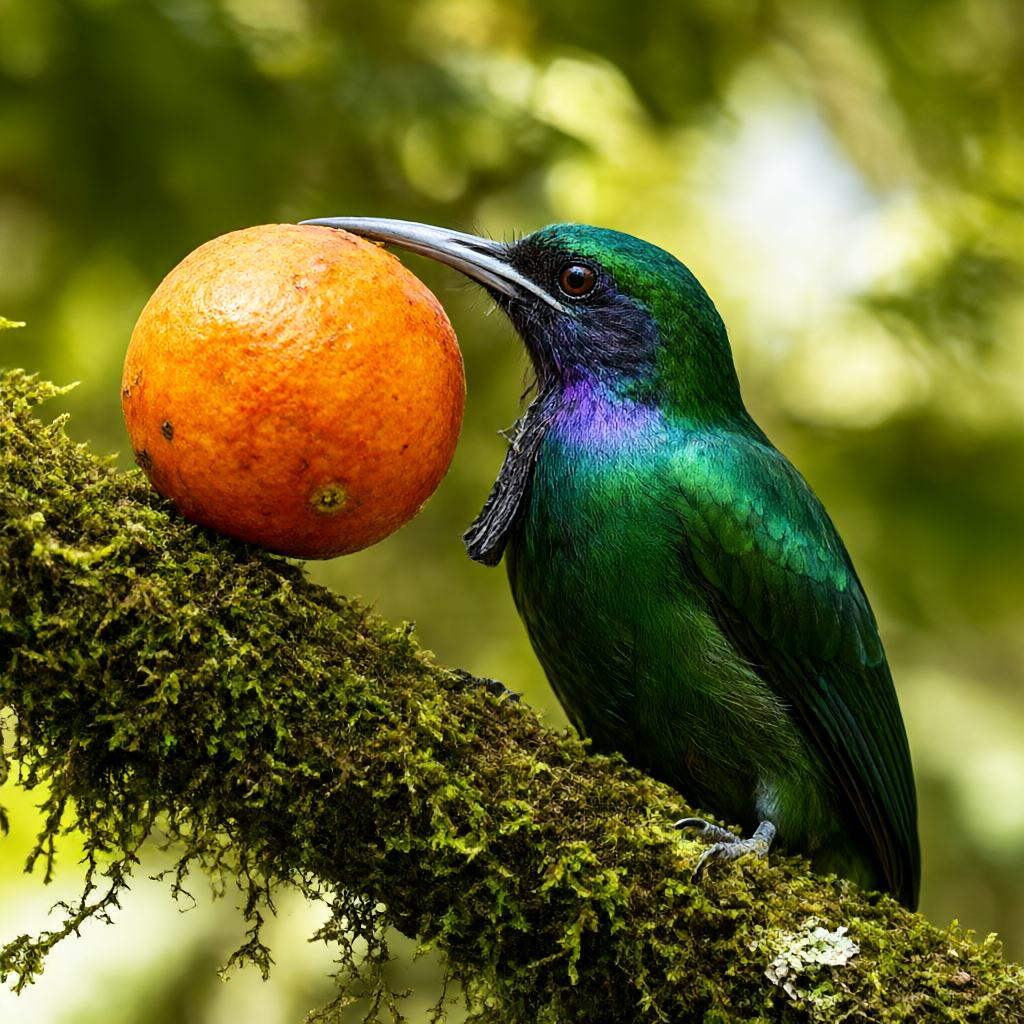
Fruit supplies most of the food. Large insects and small vertebrates fill the gap. Nestling birds may take more of them.
Fruit goes down whole, so the seeds pass through and drop far from the parent tree. Its feeding flights follow a daily round. A fruiting tree may draw several birds in one morning.
Most feeding happens alone or in loose pairs. Mixed flocks rarely include it.
Females build alone
The breeding cycle
Males gather at display sites and call with the wattle inflated. Each male keeps a small patch of branch, and he clears it of leaves. Those patches sit within earshot of each other, yet each male keeps to his own. Because the boom carries far through the trees, a female can find the group without seeing a single bird.
Females build the nest alone. One egg goes into a small cup, and the female incubates it without help. Chicks leave after several weeks, and nothing more is known with confidence.
Vulnerable and still falling
Conservation
Red List status is Vulnerable. Forest clearance drives the loss. Lowland cover has gone from much of the Chocó.
Because the range is so narrow, a single road can split a population that has no way around it. Hunting still takes birds for the wattle. That ornament looks striking enough to sell.
Protected reserves hold part of the range, though many of them sit at higher ground than the bird prefers. Enforcement remains uneven.
Side by side
How It Compares
| Trait | Long-wattled Umbrellabird | Raggiana Bird-of-paradise |
|---|---|---|
| Family | Cotingidae | Paradisaeidae |
| Ornament | umbrella crest and wattle | flank plumes |
| Range | Chocó, Ecuador and Colombia | New Guinea |
| Clutch | one egg | one to two eggs |
| Display | lek with a booming call | lek with a dance |
| Rating | Vulnerable | Least Concern |
Common misreadings
What People Get Wrong
- Not a bird of paradise, despite the crest. Families differ. Cotingidae evolved the umbrella on one side of the Pacific and Paradisaeidae evolved plumes on the other, so the resemblance comes from shared pressure.
- Not a fruit thief in the canopy. Fruit is taken where it hangs. The bird swallows whole fruit at every level of the tree, and the seeds pass through the gut far from the parent trunk.
- Not a loud bird by accident. The wattle amplifies the call. Air fills the hanging wattle while the male calls, and the sound leaves at a pitch low enough to travel through dense wet forest.
Going further
Sources and Further Reading
Quick hits
Five things to remember
- A male can inflate the wattle, so he looks far larger than his body.
- Its boom is one of the lowest sounds any bird in the forest makes.
- Feathers cover the eyes, which leaves the bird staring through a fringe.
- A male offers nothing to a female but a branch and a loud voice.
- Seeds swallowed whole come out far from the tree that grew the fruit.
Golden Retriever belongs to the family Canidae and is a domesticated subspecies of the gray wolf. Its scientific name is Canis lupus familiaris, reflecting its status as a domesticated canine. The