 By st20113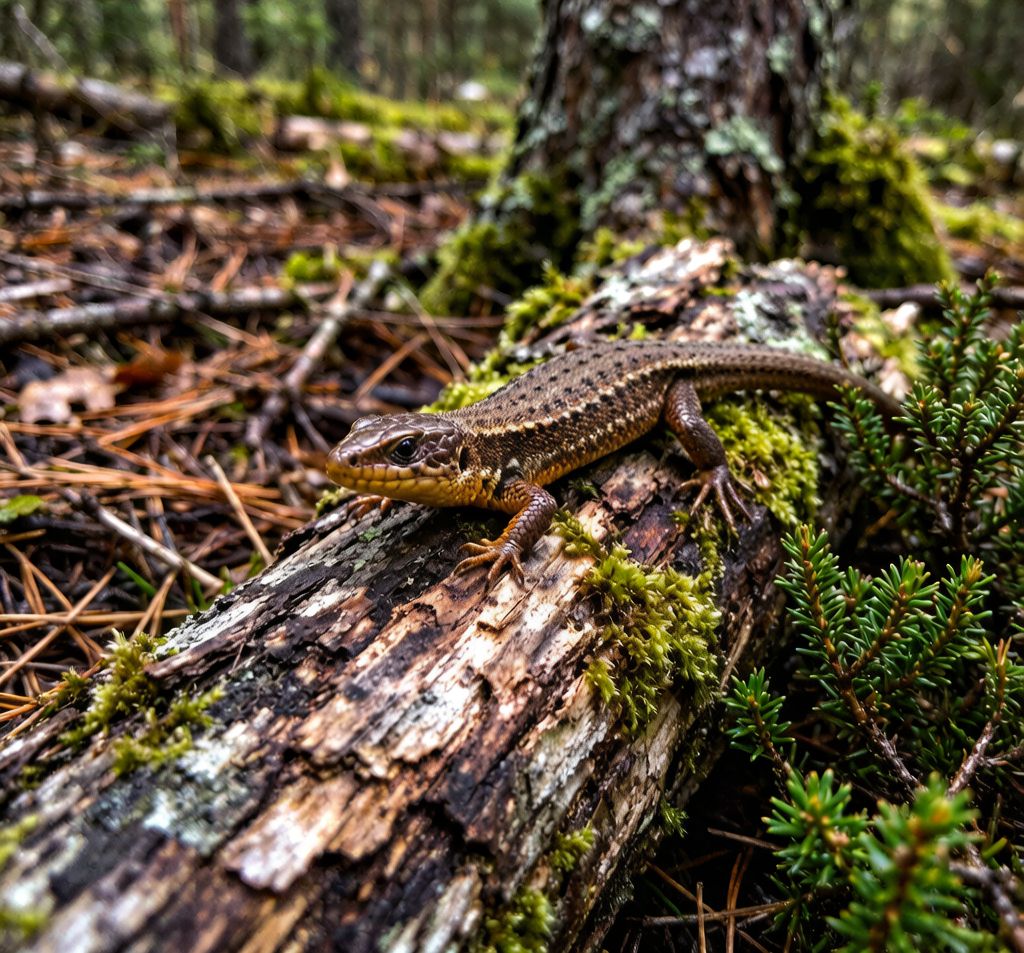
The viviparous lizard, also known as the common lizard, is a small lacertid reptile remarkably adapted to cold climates, being the most northerly distributed reptile in the world. Found from Ireland and the Iberian Peninsula eastwards across the entire Eurasian landmass to Sakhalin Island, it occupies bogs, moorlands, meadows, and even subarctic tundra. Its name reflects its most remarkable trait: unlike most reptiles, it gives birth to live young rather than laying eggs. It can be active at temperatures as low as 12 degrees Celsius and continues feeding in conditions that would keep most other reptiles torpid. The smooth newt shares many of the same cool, damp habitats as the viviparous lizard across Europe..
Taxonomy
The viviparous lizard (Zootoca vivipara) belongs to the family Lacertidae, order Squamata. The genus Zootoca is monotypic, containing only this single species, making it phylogenetically distinct from other European lacertids. The species was formally described by Georg Franz von Liehmann in 1783. Two subspecies are currently recognised: the nominate Z. v. vivipara across most of the range, and Z. v. louislantzi in northern Spain and the Pyrenees, which is oviparous rather than viviparous. Mitochondrial DNA studies indicate that the viviparous condition has evolved independently in this species from egg-laying ancestors on at least two separate occasions.
Physical Characteristics
The viviparous lizard is one of the smaller European lacertids, with adults measuring 10-18 cm in total length. Males are generally smaller than females. Dorsal colouration is highly variable, ranging from yellowish-brown to dark grey or black, often overlaid with longitudinal lines or rows of dark spots. The belly is orange-yellow in males and pale yellow in females, often with dark spots. Some high-altitude and northern populations are almost uniformly dark, an adaptation to absorb maximum heat in cool environments. A key diagnostic feature is the homogeneous, smooth dorsal scales, which distinguish it from the slow worm.
Habitat
The viviparous lizard occupies cool, moist habitats across its enormous range, from sea level to altitudes exceeding 2,500 m in the Alps and Carpathians. It is found in heathland, bog and moorland, peat bogs, wet meadows, forest edges, and even subarctic tundra. Unlike most reptiles, it tolerates and even thrives in permanently damp environments. Individuals bask at lower body temperatures than most other reptiles, becoming active at air temperatures as low as 12-15 degrees Celsius. In the far north and at high altitudes, hibernation may last up to eight months of the year.
Diet
The diet of the viviparous lizard consists primarily of small invertebrates, with insects and their larvae being the dominant prey. Crickets, grasshoppers, flies, caterpillars, beetles, spiders, and earthworms are all taken. Prey is hunted actively during daylight hours. Cannibalism on smaller conspecifics has been documented occasionally, particularly in dense populations. Adults and juveniles are vulnerable to a wide range of predators including birds, small mammals, and larger reptiles such as the grass snake.
Reproduction
The name viviparous refers to the species’ unique mode of reproduction: females retain eggs internally and give birth to fully formed live young after a gestation of approximately two to three months. This allows eggs to develop within the female body, where temperature can be regulated through basking behaviour. Litter size ranges from two to 12 young, correlating with female body size and geographic latitude. Birth occurs from July through September. The Pyrenean subspecies Z. v. louislantzi lays eggs rather than giving birth live, reflecting the warmer climate. Sexual maturity is reached at two to three years.
Conservation
The viviparous lizard is listed as a species of Least Concern by the IUCN due to its enormous range and large, stable population. However, specific populations in western and southern Europe face habitat loss, particularly where peat bogs and heathlands have been drained for agriculture. In Britain it is considered a Priority Species under the UK Biodiversity Action Plan due to documented declines in lowland heathland populations. Climate change poses a paradoxical threat: warmer conditions may expand the northern range, but populations in southern Europe may be at risk from heat stress and drought.
Fun Facts
The viviparous lizard is the world’s most northerly distributed reptile, with populations recorded north of the Arctic Circle in Scandinavia and Russia. It is one of very few reptiles that give birth to live young rather than laying eggs, an adaptation that has allowed it to colonise cold environments unavailable to egg-laying competitors. In parts of Ireland and Scotland, viviparous lizards were historically believed to be a different species from the egg-laying lizards found on the continent. Like other salamanders and newts, viviparous lizards can regrow lost tails through a process of cell dedifferentiation.