 By Iris
Velella velella | By-the-wind Sailor
Species Profile · Porpitidae
By-the-wind Sailor
A floating colony of polyps that sails the open ocean on a stiff chitin sail, carried by wind and current and completely unable to steer.
Not Evaluated
Float length
Sail height
Dry weight
Depth
Sail forms
Cycle length
A raft with a sail
A sailor that cannot steer
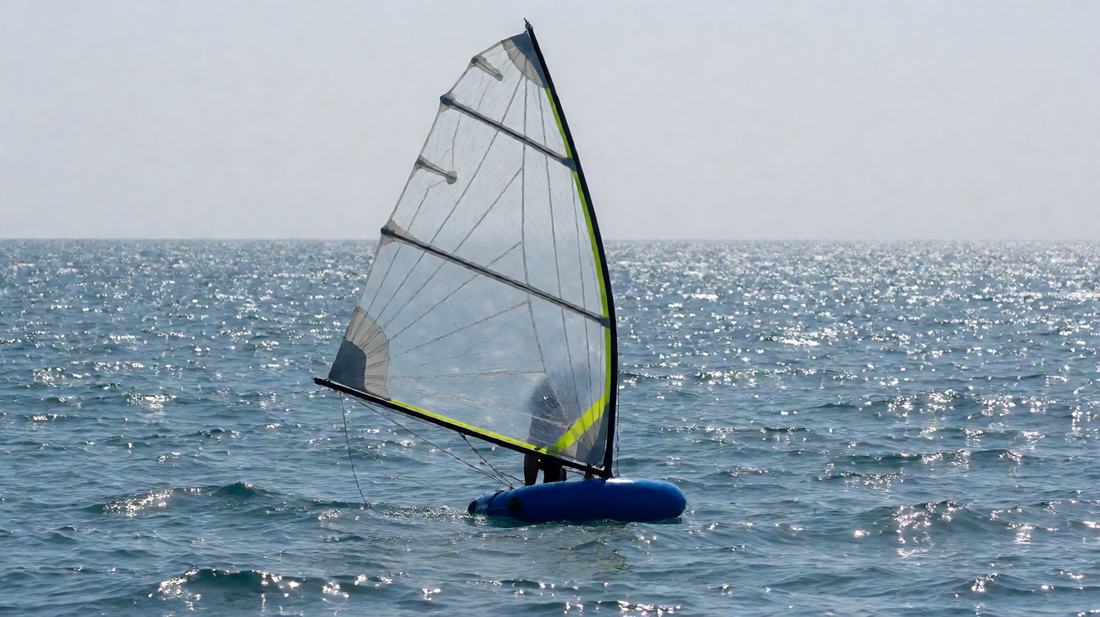
A small blue raft drifts across the sea surface. Up from its deck stands a stiff triangular sail. Wind alone decides where it goes. The drifter cannot swim against the current.
It cannot steer either. Millions of them may travel as one fleet. Beaches in California and Wales sometimes vanish under them. Each “jellyfish” a visitor picks up is really a crowd, because the whole thing is a floating group of many small polyps.
Of course, stranded sailors dry out and die within hours. Their rotting bodies smell strongly. Children often take them for broken blue glass.
Family tree
Porpitidae, the floating hydroids
Sea rafts of this kind sit in the phylum Cnidaria. Their class is Hydrozoa, the hydroids and their floating kin. A genus of its own, Velella, holds the species. That name comes from the Latin word for sail. In fact, the Portuguese man o’ war is a distant cousin. That drifter is far larger and far more dangerous.
Like the moon jellyfish, this one carries stinging cells in its flesh. Unlike the box jellyfish, its sting cannot pierce human skin. The likeness to a true jellyfish is shallow. A jellyfish is one animal, while this one is a group. Several kinds of polyp share the raft. One polyp forms the float.
Another digests the food. Others catch prey with stinging threads. Because each polyp is built for a single job, the whole thing acts more like one body than like a crowd of small animals. Experts call this a zooid group.
Two mirror sail forms
How to tell one
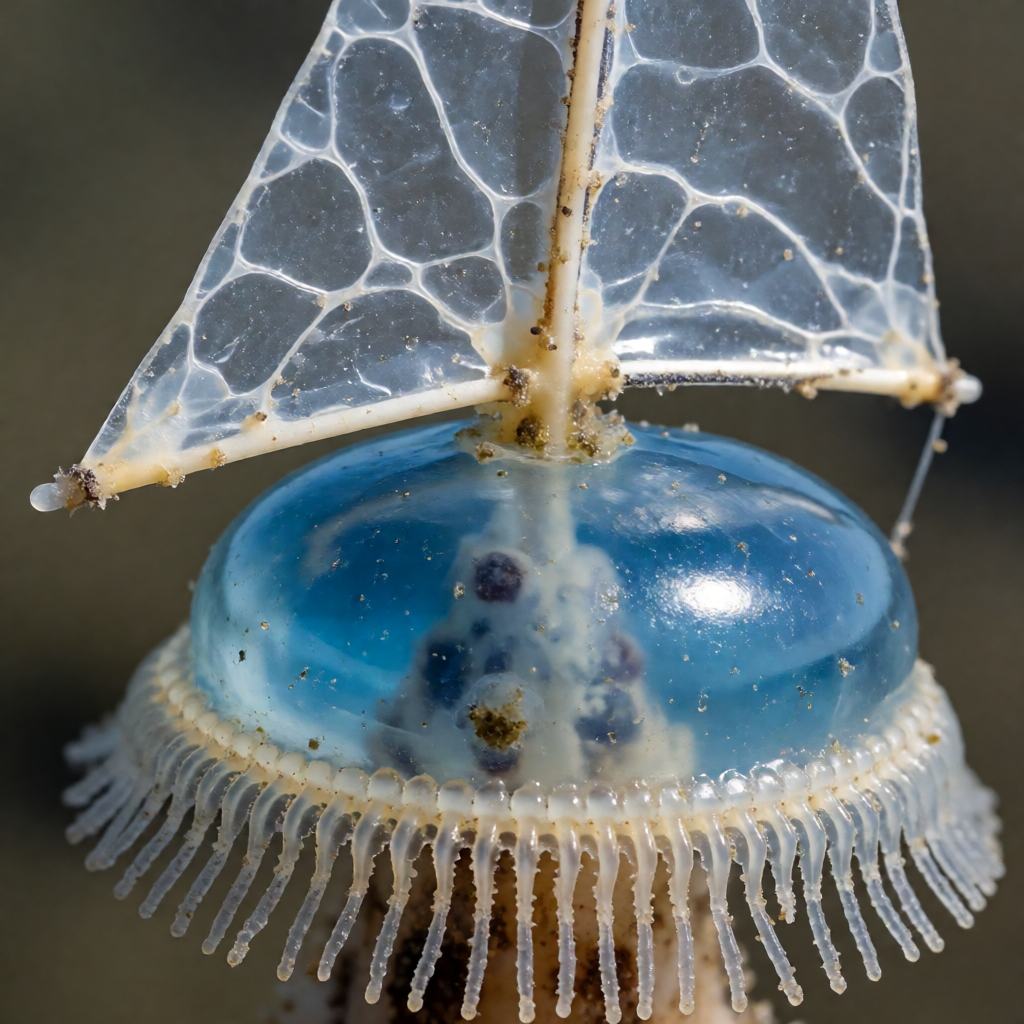
The float is an oval disc with a hollow centre. It runs about 7 cm to 10 cm long. Its sail stands roughly 5 cm tall. Dry weight comes to about 0.09 g. A thin rim of flesh carries the stinging threads. Pigment gives the raft its deep blue and purple tone.
That colour works as sun cream. It soaks up and turns back UV light. Of course, the pigment also hides the drifter from above. Two mirror forms exist in the species. One form carries its sail angled to the left. Its mirror form leans the other way.
Northern colonies mostly belong to one form. Southern colonies mostly belong to the other. Since the sail angle is set by genes, each form drifts on a different course and strands on different coasts. By contrast, both forms look the same to a casual eye.
1
2
3
The open ocean surface layer
Where it lives
Rafts of this kind live on the open sea surface. They drift through warm and mild waters worldwide. Records come from the Atlantic, Pacific and Indian Oceans. Most sit in the top few centimetres of water. Experts call that layer the neuston.
Few animals live there all year. Sargassum weed shares the same layer. So do several small snails and crabs. Given that this zone lies beyond every national boundary, almost no single country can guard it or police it. Floating plastic gathers in the same layer.
As a result, tiny plastic bits clog the feeding polyps. Oil slicks harm the flesh. Meanwhile, warming water shifts where the fleets travel. Shifting winds push more of them ashore than before. Such strandings may now outpace the numbers the species can replace.
Plankton and fish eggs
What it eats
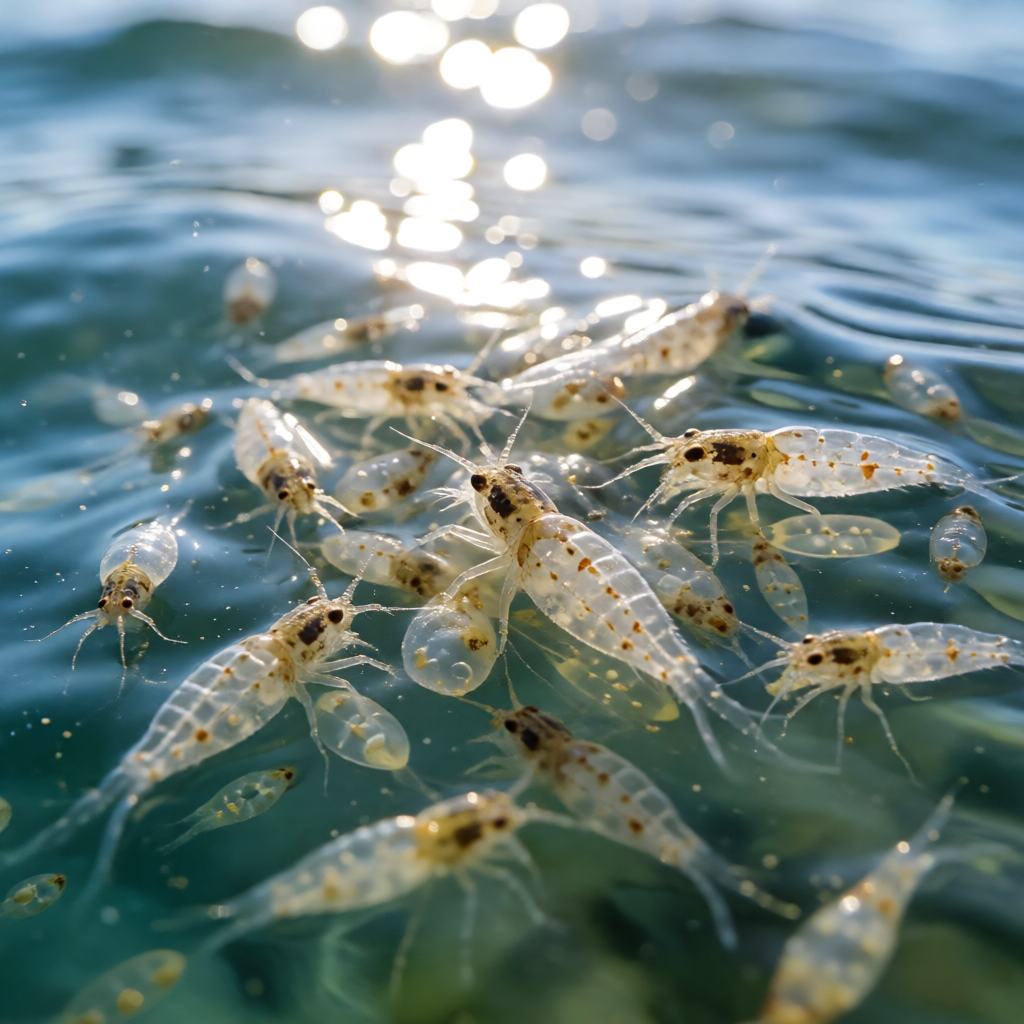
Small plankton forms the main food. Fish eggs and crab larvae are taken too. Copepods show up often in the diet. Tiny molluscs are eaten as well. Stinging threads on the rim stun the prey.
Those threads then pass the food to the central polyp. That polyp shares the meal with the whole raft. In addition, algae live inside the flesh and add sugar. Since those algae make food from light, the raft gains extra fuel without ever catching anything at all. Feeding goes on whenever prey touches a thread.
There is no hunting and no chasing. Waiting is the whole strategy. Certain sea slugs eat the rafts and keep the stings. They store the stolen stings in their own bodies. Since it cannot run from those slugs, the only defence the raft can carry is a mild venom.
A cycle of under 1 year
The breeding cycle
Every raft starts life as a bud. Special polyps produce tiny medusae. Those medusae sink below the surface. Each one releases sperm or eggs. Eggs meet sperm in open water.
What follows is a small larva called a planula. That larva settles and grows into a new raft. Because the whole cycle takes under a year, numbers climb fast only when both food and heat allow it. Most rafts die before their first winter. Storms sink many more.
However, the output of young is enormous. One bloom can cover hundreds of kilometres of sea. From a boat the surface turns pale blue. Sailors once read that colour as a sign of steady winds.
Never assessed, and legally unowned
Conservation
This species has never been assessed by the IUCN. No CITES listing covers it either. Its legal spot is odd. Populations sit past every national line. The High Seas Treaty agreed in 2023 may change that in time.
Moreover, counting drifting rafts from a ship is costly and slow. Monitoring is nearly impossible. Citizen science fills part of the gap. Beachcombers photograph strandings and post the records. Because the species is listed nowhere at all, no recovery plan exists and no public funds follow it.
Numbers are unknown. Still, huge blooms hint at no sudden collapse. Yet plastic and warming stay open risks. For now the best shield for these rafts is a cleaner ocean rather than a law aimed at one species.
Side by side
How It Compares
| Trait | By-the-wind Sailor | Moon Jellyfish |
|---|---|---|
| Body plan | a crowd of zooids sharing one raft | a single animal with one bell |
| How it moves | wind on a stiff sail | pulsing the bell |
| Size | 7 cm to 10 cm long | a bell 25 cm to 40 cm across |
| Where it sits | the top few centimetres of water | open water at many depths |
| Sting | cannot pierce human skin | mild, and harmless to most people |
| Colour | deep blue and purple | translucent white with four rings |
| Best known for | mass strandings on windy coasts | the jellyfish of aquariums |
Common misreadings
What People Get Wrong
- Most beachcombers call this animal a jellyfish, yet it is really a colony of many small polyps sharing one raft. Still, the sting is mild enough that bare hands are safe.
- Some reports treat the two sail forms as two separate species, since they look different in the hand. In turn, genetic work shows one species with two mirror shapes.
- Many stranded rafts are reported as a single giant animal, though each one is a separate colony the size of a coin. Yet no survey has ever counted them properly.
Going further
Sources and Further Reading
- Wikipedia, Velella
- SeaLifeBase. Velella velella (Linnaeus, 1758).
- GBIF, Global Biodiversity Information Facility. Velella velella (Linnaeus, 1758).
- IUCN. The IUCN Red List of Threatened Species: Velella velella has no global assessment (searched 2026).
Quick hits
Five things to remember
- The sail is made of stiff chitin, not bone.
- Every “animal” is really a group of polyps.
- The two sail forms strand on opposite coasts.
- Violet sea snails float on rafts of bubbles to hunt them.
- One stranding can dump billions on a single coast.