 By st20113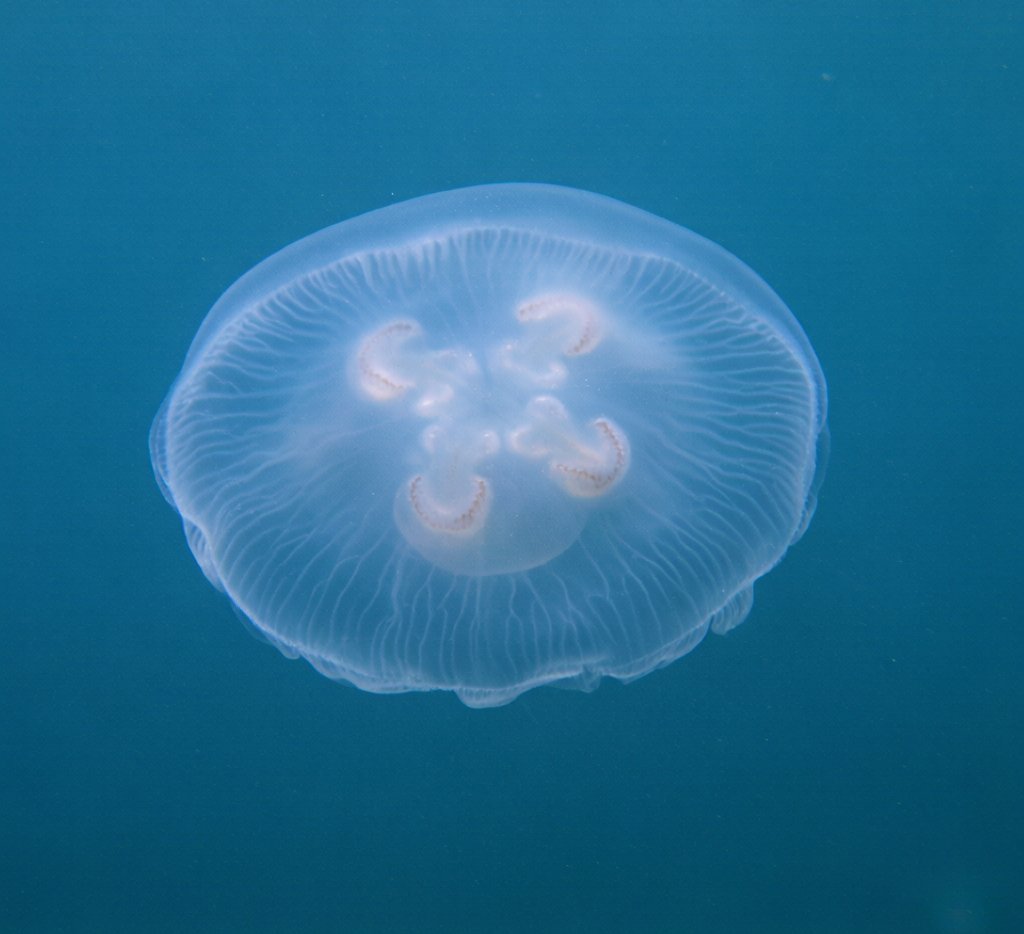
Introduction
The moon jellyfish is one of the most common and widely distributed jellyfish species in the world’s oceans. Recognizable by its translucent, saucer-shaped bell and four horseshoe-shaped gonads visible through its dome, this gelatinous creature drifts through coastal waters worldwide, from temperate seas to tropical latitudes. Despite its simple anatomy, the moon jellyfish plays a significant ecological role as both predator and prey in marine food webs. Its mild sting makes it a relatively harmless visitor to beaches, though large blooms can still disrupt coastal ecosystems and human activities.
Taxonomy
The moon jellyfish belongs to the family Ulmaridae, order Semaeostomeae, and genus Aurelia. The species name aurita comes from the Latin for “eared,” referring to the distinctive oral arms that flank its mouth. While Aurelia aurita is the most familiar species in its genus, the taxonomy of the Aurelia group has undergone significant revision in recent years, with genetic studies revealing that what was once considered a single species may in fact comprise multiple distinct species with overlapping distributions.
Physical Characteristics
The moon jellyfish has a translucent, saucer-shaped bell that can reach 25 to 40 centimeters in diameter. Its four pink or purple horseshoe-shaped gonads are visible through the dome, giving the species one of its most recognizable features. The bell is fringed with numerous short tentacles that carry stinging cells used for capturing prey. Four long, frilly oral arms hang from the center of the underside of the bell, aiding in both feeding and locomotion. The body is composed of more than 95 percent water, making it almost invisible in the ocean.
Habitat
Moon jellyfish are found in coastal waters and sheltered bays across temperate and tropical oceans worldwide, including the Atlantic, Pacific, and Indian Oceans. They prefer cooler water temperatures between 9 and 19 degrees Celsius and are often encountered near coastlines during the warmer months when they reproduce. They are strong swimmers for a jellyfish, capable of moving vertically through the water column by contracting their bell, though they are largely at the mercy of ocean currents for horizontal movement.
Diet
The diet of the moon jellyfish consists mainly of zooplankton, including small crustaceans, fish eggs, larvae, and other microscopic organisms. Prey is captured by the stinging cells on the bell’s margins and oral arms, then transported to the mouth by ciliary action. The moon jellyfish’s sting is relatively mild compared to many other jellyfish species, and while it can cause minor irritation to human skin, it rarely results in serious stings. A single moon jellyfish can consume thousands of zooplankton individuals per day, making them significant regulators of plankton populations.
Reproduction
Moon jellyfish have a complex life cycle that includes both sexual and asexual reproductive phases. Adults release sperm and eggs into the water, where fertilization occurs. The resulting planula larvae settle on hard substrates and develop into sessile polyps called scyphistomae, which reproduce asexually by strobilation—producing stacked discs that bud off as juvenile medusae called ephyrae. These ephyrae grow into adult medusae over several months, completing the cycle. In some populations, this entire cycle can occur within a single year.
Conservation
The moon jellyfish is not currently evaluated by the IUCN, as it is considered one of the most abundant and widespread jellyfish species globally. However, increasing evidence suggests that climate change, overfishing, and nutrient pollution are contributing to larger and more frequent jellyfish blooms worldwide. These blooms can have significant negative impacts on fisheries, aquaculture operations, and tourism, and they may also indicate broader disruptions to marine ecosystems driven by human activity.
Fun Facts
Moon jellyfish have no brain, heart, blood, or bones—instead relying on a simple nerve net to detect light, smell, and respond to their environment. They are strong swimmers for their body type and can pulse their bell up to 30 times per minute to move through the water. Despite their simple biology, moon jellyfish have proven remarkably resilient: laboratory studies have shown that they can revert from an adult medusa back to a juvenile polyp stage when stressed, effectively making them biologically immortal under the right conditions.
[…] clams can be mistaken for a hazard, but they close far too slowly to trap a swimmer. Beside the jellyfish, few reef animals are as visually […]
[…] the southern and western coasts of Australia, it is a close relative of seahorses and pipefish. The jellyfish and other drifting organisms share its slow, gentle world, but the seadragon is unique in its […]
[…] is Semaeostomeae. Its family is Pelagiidae. Its closest well-known kin in European waters is the Moon Jellyfish. The moon jellyfish is a far gentler kind. It has a flatter, almost clear bell. Its short fringe […]
[…] name is still used for all of them. The mauve stinger shares the class Scyphozoa with the moon jellyfish. That animal is much flatter and paler. It has a clear four-ring pattern on the bell. The two are […]