 By Iris
Tachybaptus ruficollis | Little Grebe
Species Profile · Podicipedidae
Little Grebe
The smallest grebe in Europe, a bird more often heard than seen — and one that has quietly turned the garden pond and the gravel pit into a home.
IUCN: Least Concern
Range
Length
Weight
Nest
Incubation
The voice of the small pond
A diving bird of the reedy edge
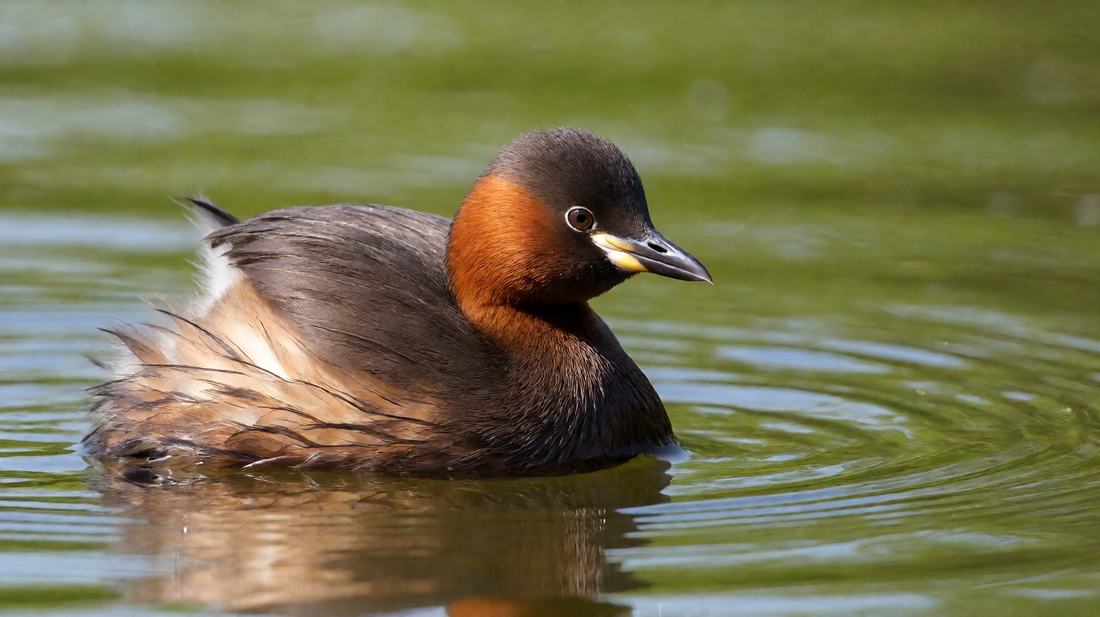
The Little Grebe is the smallest grebe in Europe. It is a round-bodied, almost tailless diving bird. It is far more often heard than seen. Its loud trilling whinny comes from waterside plants. That sound marks small ponds, canals and quiet rivers. It is usually the first hint that a bird is there. The bird is 23 to 29 cm long. Its wings span only 40 to 45 cm. It weighs 130 to 235 g. Its shape is as distinctive as its size. The body is compact and dumpy. The neck is short and the bill is short and straight. The tail is reduced almost to nothing.
The rear ends in a tuft of silvery-white fluffy feathers. These come from the powder down. The tuft looks like an afterthought. In spring the cheeks and neck sides turn rich chestnut. That colour contrasts with the dark brown crown and back. The base of the bill carries a small pale yellow patch. That patch is the quickest way to name this bird. It works even when other small grebes are in dull plumage. The cheek colour fades first in late summer. Then the whole bird turns washed-out greyish brown. The Little Grebe is an extremely reluctant flyer. That is why it is under-recorded. If it feels threatened it sinks beneath the surface.
It submerges with barely a ripple. It reappears among the reeds some distance away. That habit makes it easy to lose. It happens even after a close watch. Only in extreme cases will it fly. Then it shows a weak, fast, whirring flight. The feet trail and the body looks heavy for such small wings. The species lives across Europe, much of Africa and southern Asia. It is classed as Least Concern on the global Red List. In many places it uses the smallest wetlands that people create. These include garden ponds, gravel pits and flooded industrial corners. It is one of the few waterbirds helped rather than harmed by human activity.
Family tree
Tachybaptus, the small grebes
The Little Grebe belongs to the family Podicipedidae, the grebes. This is a group of diving waterbirds. Modern classifications place them near the flamingos. Grebes have lobed feet rather than webbed ones. Their plumage is dense and waterproof. They moult once a year. Most lose the power of flight for a period each year. Its larger relatives share these traits to some degree. The Great Crested Grebe is in the same family. It is a very different bird in size and look. The Great Cormorant lives on the same waters.
It belongs to a separate order. It catches fish underwater in a completely different way. The genus Tachybaptus is small. It holds about 6 species across the warmer Old World and Australia. The Little Grebe is by far the most widespread. It ranges from western Europe across Asia to Japan. It also occurs through much of Africa and southern Asia. Several subspecies are recognised across that range. They differ mainly in size and in the depth of chestnut on the neck. The scientific name is unusually descriptive. Tachybaptus comes from Greek words for swift and to dive.
Ruficollis is Latin for red-necked. The full name means the red-necked one that dives quickly. That is a fair summary of how people meet it. Within its family the bird is small and short-billed. It prefers very small bodies of water. Its position has been revised more than once. Earlier authors placed it in the genus Podiceps. That grouping is now abandoned. The differences in anatomy, voice and breeding are too great. The family is an ancient one. Grebes form one of the more isolated branches of the waterbird tree.
Chestnut face, yellow bill base
How to identify one
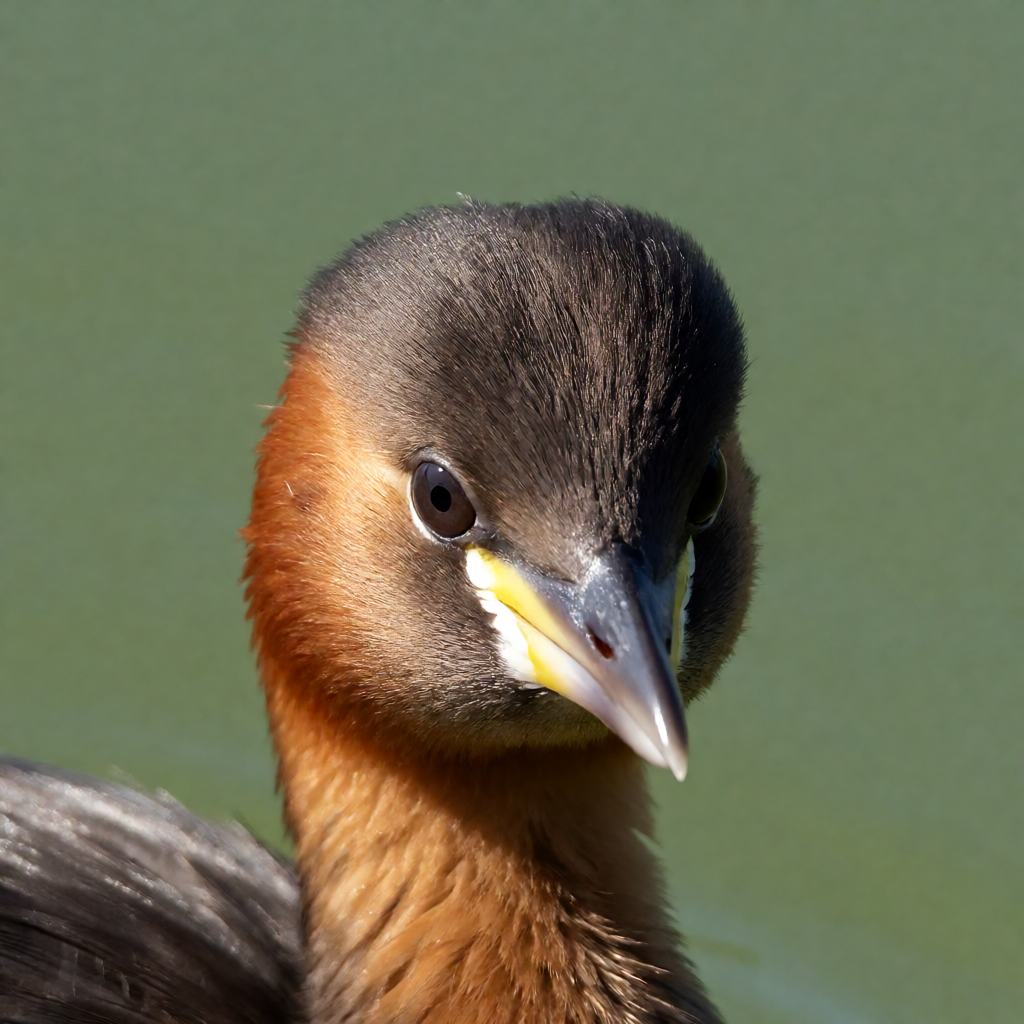
An adult is 23 to 29 cm from bill tip to tail end. Its wings span 40 to 45 cm. It weighs about 130 g at the light end and 235 g at the heavy end. The bird is about the size of a small duckling. It is lighter than almost any other waterbird it could be confused with. The bill is short, straight and dark. A small pale patch sits at its base. In breeding plumage that patch becomes a bright yellow spot. It serves as a signal between pair members. The eye is dark. In summer the face is suffused with chestnut. That colour runs from the bill to the back of the neck. The back is dark brown. It looks almost black when wet.
The flanks are a lighter greyish brown. The underparts are paler and tinged with grey. The plumage is so dense that the bird looks sleek. It is almost waterproof. That is exactly what it needs to be. The tail is so short that it is invisible. The rear carries a tuft of silvery-white fluffy feathers. These come from the powder down patches. The bird uses them in preening to keep its plumage in good order. The tuft gives the rear a pale, cotton-like finish. It is often the only part of a sitting bird above the water. The feet sit very far back on the body. That gives the bird its diving power. It also makes the bird almost helpless on land.
There it shuffles rather than walks. It can be caught by hand if cornered away from water. The legs and toe lobes are dark greenish grey. In the water the bird is a low, rounded shape. The head is held close to the body. That is quite unlike the long-necked Great Crested Grebe. Young birds look like non-breeding adults. They carry dark stripes on the head and neck. The stripes fade as the bird matures. Both sexes are alike at every age. There are no seasonal size differences and only slight differences in voice. A bird that finds a good pond may stay there for years.
1
2
3
Pond, canal and gravel pit
Where it lives
The Little Grebe is a bird of small, shallow, productive waters. It is most numerous on ponds, lakes, canals, ditches and slow rivers. Such places carry a fringe of reeds, rushes and floating leaves. The bird needs those plants as nest cover. It also needs them as hunting ground for its insect prey. It tolerates tiny water bodies far better than most diving waterbirds. A pond only a few metres across can hold a pair. That is why it appears in unlikely places. These include village duck ponds and garden lakes. They include the flooded gravel pits and clay pits of the European lowlands.
They include reservoirs, sewage farms and the moats of old buildings. Depth matters less than clarity and food supply. The bird is a shallow diver. It rarely goes below 1 or 2 m. It prefers warm water rich in insects. It avoids cold, deep, sterile lakes where there is nothing to find. It favours a soft, muddy bottom and a good growth of submerged plants. In rivers it keeps to slower reaches, backwaters and side channels. In the milder parts of its range it is largely resident. Even in northern Europe it moves only as far as it must.
Hard winters drive birds from frozen ponds to larger lakes. Some reach estuaries and even the coast. There they are surprisingly hard to pick out among other small waterbirds. The bird flies low and weakly and rarely travels far. Local populations are therefore discrete. Recolonising a pond after a local loss may take years. That is why draining or polluting even a very small wetland has a lasting effect. It is also why new ponds and restored old ones are such effective conservation.
An insect eater of the shallows
What it eats
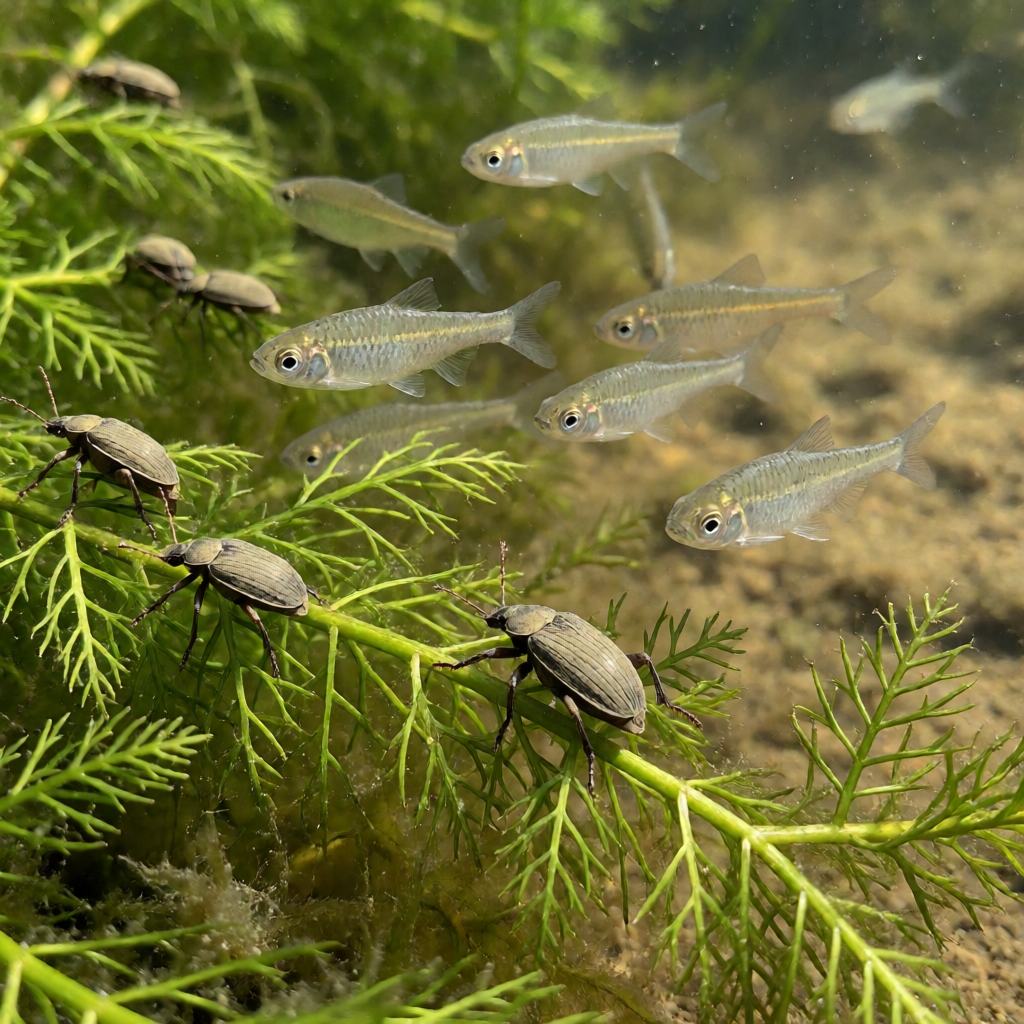
The Little Grebe eats a mix of small aquatic animals. It takes fish when it can. It is far more of an insect eater than its larger relatives. Its prey includes water beetles and their larvae. It takes dragonfly and damselfly nymphs. It takes caddis larvae, water bugs, small crustaceans and molluscs. It eats tadpoles and frogs’ eggs. Its fish rarely exceed about 11 cm. Most are very much smaller. It hunts almost entirely by diving. It moves through the water with its feet alone. It uses its wings to change direction.
It can stay under for about 10 to 30 seconds on one breath. That is ample time to search a patch of weed. It is enough for the muddy bottom of a pond. The short, straight bill seizes the prey. The bird works it in the mouth before swallowing. Anything with a hard shell is handled until it can pass. So the bird deals with beetles, snails and small crayfish. It handles soft-bodied larvae just as easily. One habit is shared by the whole grebe family. A Little Grebe deliberately swallows its own feathers. It packs them into the stomach. There they form a dense plug.
The plug acts as a filter. It traps the hard, indigestible parts of the prey. Fish bones are the main target. The bird then coughs them up in pellets. Adults also feed feathers to their chicks from the first days. That suggests the habit is instinctive rather than learned. It appears to protect the young from bone fragments. The bird feeds mostly in the early morning and late afternoon. Otherwise it floats quietly among the vegetation. It sinks out of sight at the slightest alarm. That makes its total hunting time very hard to measure.
A raft of weed on the water
The breeding cycle
The breeding season runs from March or April into July or August. It lasts longer in the milder parts of the range. The species often raises 2 and sometimes 3 broods a year. That is a great advantage for a small bird with heavy losses. Display is loud and conspicuous for such a secretive species. Pairs rush fast across the water shoulder to shoulder. They also face each other and rear up. The chestnut neck feathers are fully spread. The nest itself is concealed rather than advertised. It is a floating mound of aquatic plants. It is anchored to a stem or a clump of reeds.
It rises and falls with the water level. It is often half hidden among the vegetation. Between 4 and 6 white eggs are laid. They stain brown in the wet nest material. That makes them extremely hard to see. This helps a bird that often leaves the clutch alone. Both members of the pair share incubation. It lasts between 20 and 21 days. The chicks are striped and downy. They leave the nest within hours of hatching. They ride on the back of the adults.
They shelter under the wings. That keeps them warm and safe from large fish and herons. They start to dive for themselves at about 2 to 3 weeks. They can catch their own insects soon after that. Losses are heavy for such a small bird. The main predators are pike and other large fish. Grey herons, mink and rats take chicks and sometimes adults. Marsh harriers do the same. The species compensates by breeding early and often. It renests quickly after a failure. It will sometimes nest in the same pond year after year.
Common, but losing ponds
Conservation
The Little Grebe is assessed as Least Concern on the global Red List. Its huge range and large population place it well outside the threat thresholds. It is one of the few European waterbirds whose numbers have not collapsed. That picture still hides regional losses. Several dangers act together. The drainage, infilling and pollution of ponds and ditches removes nesting sites at scale. The clearance of marginal vegetation takes away cover. The bird cannot do without that cover.
Stocking ponds with large fish removes its insect prey. It also adds a predator at the same time. Heavy recreational use disturbs the birds in the breeding season. That causes repeated clutch failure. Hard winters add further pressure. Small ponds can freeze for long periods. That kills a share of the birds, mainly in northern and continental Europe. Numbers recover quickly when conditions improve.
The bird has no trouble with a warming climate. It has gained from the many artificial water bodies people make. These include gravel pits, farm reservoirs and fishing ponds. It has spread into areas where it was once absent. What it cannot survive is the loss of small water bodies as a class. The species is a useful sign of the health of a district’s small wetlands. A pond that holds a pair almost always holds a great deal else. Keeping those ponds unfrozen, clean and ringed with native plants is the whole of its conservation.
Quick hits
Five things to remember
- It is the smallest grebe in Europe.
- It swallows its own feathers to build a stomach filter that blocks fish bones.
- A bird that is startled sinks out of sight rather than taking wing.
- Two or 3 broods a year are normal, and the striped chicks ride on their parents’ backs.
- The pale yellow patch at the base of the bill is the mark to check when the chestnut neck has faded.