 By st20113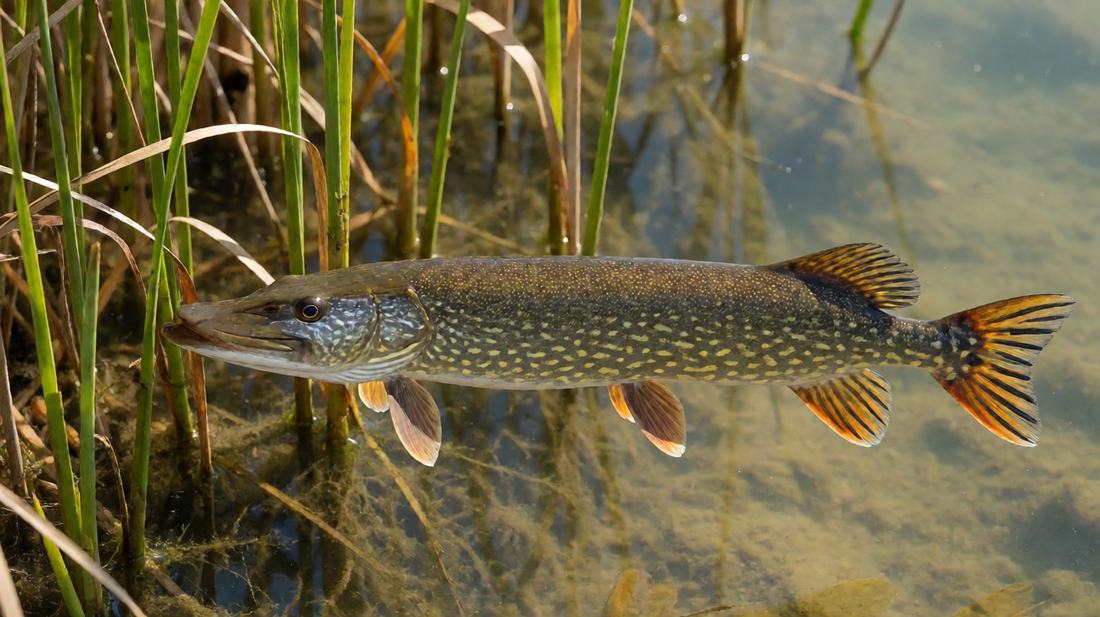
Esox lucius | Northern Pike
Species Profile · Esocidae
Northern Pike
The long green ambush hunter of northern lakes and rivers — a duck-billed predator with backward teeth that eats almost anything that swims.
IUCN: Least Concern
Range
Length
Top size
Eggs
Spawning
The ambush hunter
A predator built for one lunge
The northern pike is a long, green, duck-billed hunter. It lies still among the reeds of northern lakes and rivers. Then it explodes at anything that swims past. It is the classic ambush hunter of fresh water in the northern hemisphere. It lives across Europe, Asia and North America. Its shape is built for one kind of attack. The body is a long torpedo. The fins sit far back near the tail.
The snout is broad and flat and full of sharp teeth. The fish does not chase. It holds still among plants and uses its camouflage. Then it speeds up in one burst from a standstill. Almost anything it can fit into its mouth is food. That includes other pike. The species lives in slow rivers, lakes, ponds, marshes and canals. It also lives in the brackish edges of the Baltic.
It is one of the few large freshwater fish still common over most of its natural range. It is one of the top sport fish in Europe and North America. It is also one of the most studied. It is easy to catch and easy to keep in hatcheries. It is big enough to be worth managing. Where people have moved it outside its range it has done serious harm to native fish.
Family tree
Esocidae, the pikes
The northern pike is in the family Esocidae and the genus Esox. Linnaeus named the species in 1758. The genus name is Latin for pike. Esocidae is a small family. The pikes, pickerels and muskellunge are almost all of it. All the living species sit in the genus Esox. That holds the northern pike, the muskellunge, the chain pickerel, the redfin pickerel, the grass pickerel and the Amur pike.
The northern pike is the only member with a natural range in both North America and Eurasia. Very few freshwater fish share that pattern. It reflects the links between the continents during the ice ages. The family sits in the order Esociformes and the class Actinopterygii, the ray-finned fishes. Fossil esocids are known from the Cretaceous. The group has kept its basic hunting shape for a very long time. Hybridisation between pike species happens where people bring them together.
The tiger muskellunge is a pike crossed with a muskellunge. It is produced on purpose for stocking. The northern pike shares the class Actinopterygii with the European perch. That is a much smaller spiny-finned fish that pike eat in large numbers. The two are only distant kin within that huge class. In most waters the link between them is simply predator and prey.
Bill, teeth and rear fins
How to identify one
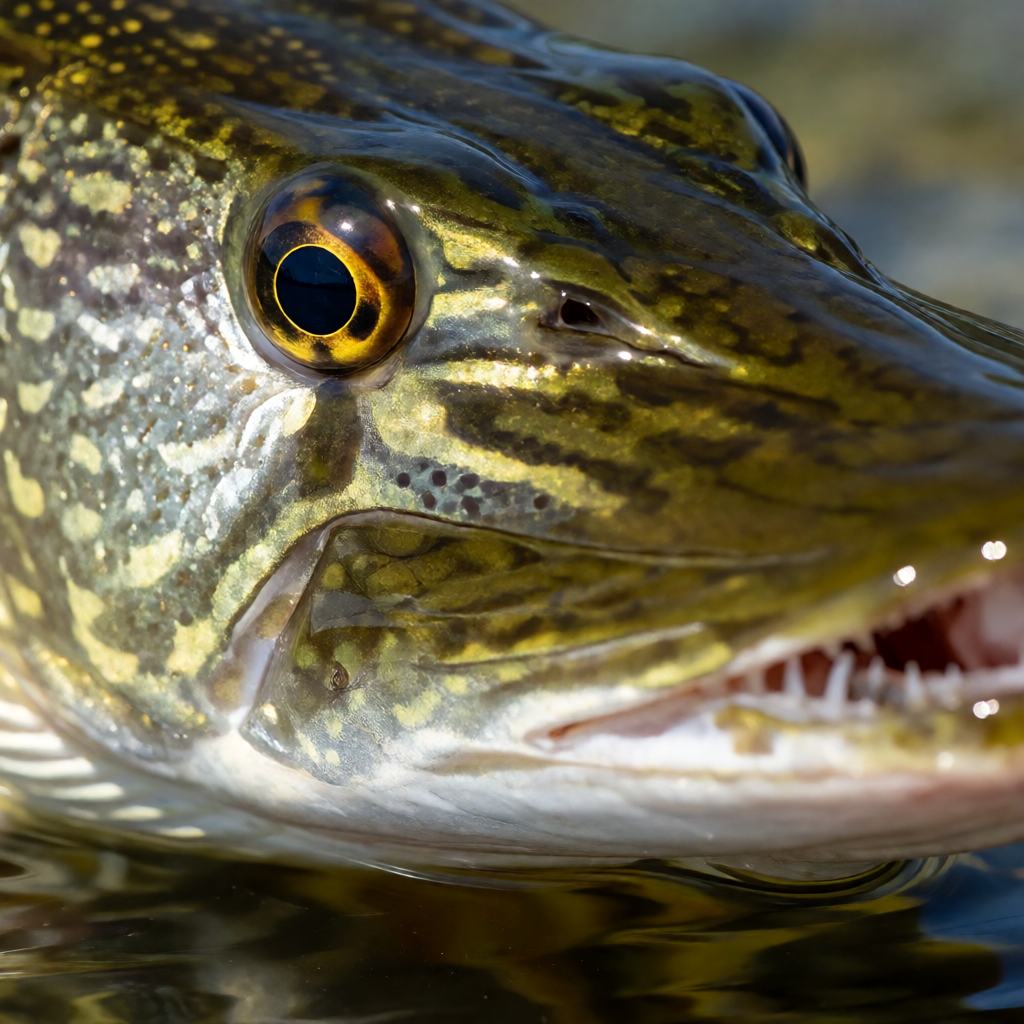
A northern pike has a long, round body and a large flat head. The head ends in a broad, duck-like bill. The mouth is huge. The lower jaw sticks out a little. Both jaws carry many sharp teeth. The teeth on the roof of the mouth and on the tongue point backwards. So prey can be pushed towards the throat but cannot work its way back out. The dorsal fin and the anal fin sit far back on the body, close to the tail.
That gives the fish its thrust for a sudden lunge. It lets the fish speed up from a standstill. The colour is olive-green to grey-green on the back. The flanks carry rows of pale oval spots and short bars that run up and down. The belly is white or yellow. The fins are often tinged with red or orange. The pattern changes with the water. Fish in clear weedy water are more strongly marked.
Those in cloudy water are plainer and paler. Size varies a great deal. Most adults are 40 to 70 cm. A large female can pass 120 cm. The biggest checked fish have been close to 150 cm and about 25 kg. Females grow much bigger than males. The scales are small and the skin is covered in slime. That is why a pike is hard to hold.
1
2
3
Weedy water, slow and still
Where it lives
The northern pike is a fish of still and slow water with plenty of cover. It lives in lakes, ponds, reservoirs and slow lowland rivers. It lives in canals, marshes, bogs and flooded gravel pits. It also lives in the fresher parts of estuaries. It stands brackish water in the Baltic. Plants are the key need. The fish hunts by ambush. It depends on reed beds, water lilies, submerged weed, fallen trees and overhanging banks to hide in.
Young fish use shallow weedy margins almost all the time. They need them for cover and for food. Adults use deeper water in summer. They move shallow in spring and autumn. Spawning habitat is different again and it is essential. The fish need shallow, flooded, planted ground. That is usually wet grassland, marsh or reedbed covered by high water in early spring. The range covers most of the northern hemisphere.
It runs from Britain and France across Europe and Asia to the Pacific. It runs across Canada, Alaska and the northern United States. The fish is absent from Iceland. It is absent from most of the Iberian Peninsula and from the far north. People have moved it to Spain, Italy, southern Africa, New Zealand and parts of North America. The results for native fish have usually been bad.
Fish, and anything else
What it eats
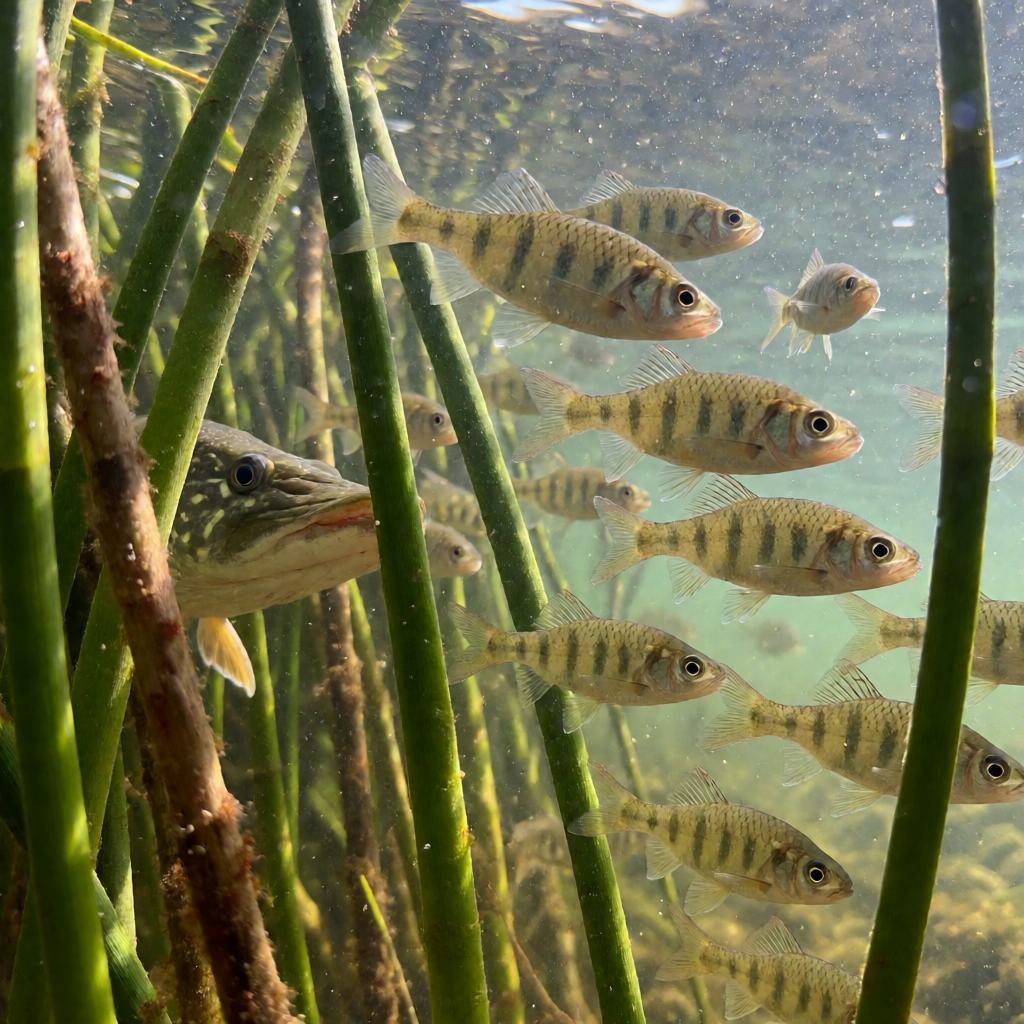
The northern pike is a carnivore. In most waters it is the top predator. Fish make up the bulk of the diet once the animal is past its first year. It takes whatever is most at hand. It takes roach, rudd, perch, bream, tench, eel, trout, salmon and whitefish. It takes other pike. Cannibalism is normal and it can matter a lot. A big pike eating a smaller pike is one of the easiest meals it can find. Beyond fish the animal takes frogs and newts.
It takes crayfish, water voles and other small mammals that swim. It takes ducklings and other waterbirds. It takes large aquatic insects. Young pike start on plankton. Then they move to invertebrate prey. They switch to fish at a few centimetres long. That switch is the sharpest bottleneck in the life cycle. The fish is a sit-and-wait hunter. It holds its place among cover, often quite still.
Then it makes a fast lunge powered by the tail and the rear fins. Prey is seized sideways. Then it is turned and swallowed head first. A pike can swallow prey up to about half its own length. Digestion is slow. The fish can go for days between big meals. Feeding drops in the heat of summer. It almost stops in the coldest part of winter.
Sticky eggs on flooded grass
The breeding cycle
Spawning happens in early spring. It is usually between February and May, depending on latitude. Rising water temperature triggers it. So does the presence of flooded plants. The fish move into shallow water. That is often only 10 to 30 cm deep. They go over grass, reeds or flooded meadow. Several males follow a female. The group thrashes about while eggs and sperm are released together. The eggs are large and sticky.
They are about 3 mm across. They stick to the plants in strings and clumps. A female of average size lays 10000 to 200000 eggs. A very large female can produce more than 500000. There is no nest. There is no parental care. The eggs hatch in 1 to 3 weeks, depending on temperature. The fry stay fixed to the plants by a sticky gland on the head for the first few days. They take in the yolk sac at that time. Then they start to feed on plankton and tiny crustaceans.
Survival through the first weeks is very low. A small change in water level can strand the eggs. That can wipe out a whole year class. Males mature at 1 to 2 years. Females mature at 2 to 4. Pike can live past 20 years. Most wild fish are much younger. The largest fish are nearly always old females.
Least Concern, locally blocked
Conservation
The northern pike is listed as Least Concern on the global Red List. It is still abundant and widespread across a huge natural range in the northern hemisphere. The local picture is less comfortable in places. Numbers in heavily modified lowland river systems have fallen. The main cause is that the shallow flooded spawning habitat has been cut off. Flood defences, embankments and drainage have done this. So has the loss of wet grassland and reedbed.
Adult fish cannot reach the places they need to spawn. A river can hold pike that never breed well. Barriers such as weirs and sluices block the movement between the river and its floodplain. Water abstraction lowers the levels that flood the spawning grounds. Pollution and the loss of submerged plants remove the cover the fish hunt from. Overfishing is a real pressure where there is no size limit or closed season. The biggest fish make the most eggs.
They are the first to be taken out. Outside its natural range the species is a serious problem. Pike that people have moved have caused the collapse of native fish in Spain, Italy, southern Africa, New Zealand and parts of western North America. Management works on reconnecting rivers to their floodplains. It protects reedbed and wet grassland. It sets size limits and closed seasons.
Quick hits
Five things to remember
- The teeth point backwards, and the roof of the mouth and the tongue carry more of them, so a fish once taken cannot work its way back out.
- The dorsal and anal fins sit far back next to the tail, which is what lets the animal speed up from a standstill in one lunge.
- Cannibalism is normal, and in many waters other pike are among the most important food of a large adult.
- Spawning happens in shallow flooded grassland and reedbed, and the sticky eggs would fall to the bottom and die without plants to hold them.
- The largest fish are nearly always old females, and pike can live past 20 years, with checked fish close to 150 cm and about 25 kg.
[…] fish shares the family with the Northern Pike. That fish grows smaller and more slender. It has pale spots on a dark green body. Our fish grows […]