 By st20113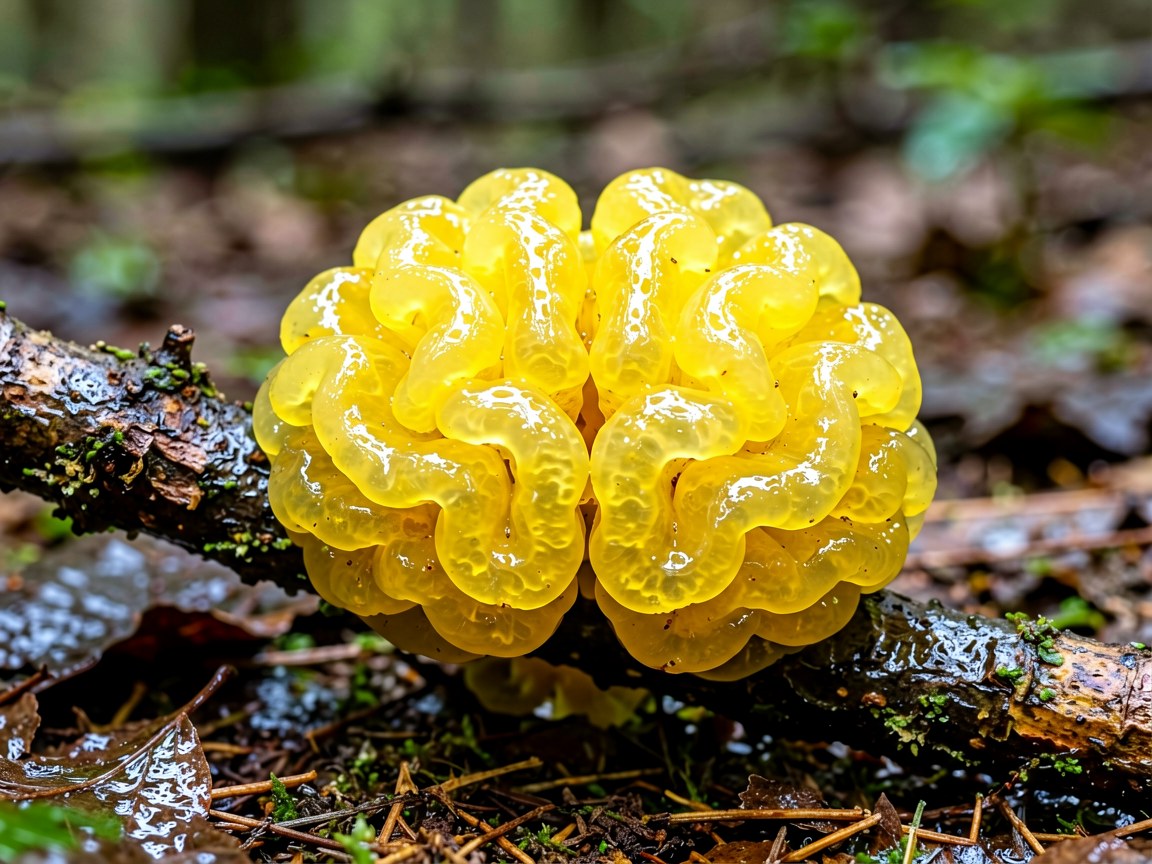
Tremella mesenterica | Yellow Brain Fungus
Introduction
The yellow brain fungus (Tremella mesenterica) is a bright, glossy, golden-yellow, translucent jelly that appears on dead branches in winter and looks exactly like what its name suggests: a lump of soft, convoluted brains stuck to the twig. It is at its best in wet weather, when it swells into a wobbling, shining mass; in dry spells it shrivels to a thin, dark, shrivelled crust and seems to disappear, only to swell back to full size after the next rain. It is one of the most conspicuous fungi of the cold months, when most people assume there is nothing about, and it is also a biological curiosity of the first order, because it is a parasite on another fungus: it does not eat the wood of the branch it sits on, it eats the fungus that does.
Taxonomy
Tremella mesenterica is a basidiomycete in the class Tremellomycetes and the family Tremellaceae, the jelly fungi, a group whose members produce gelatinous fruit bodies with basidia that are divided by internal cross-walls. The genus name refers to the trembling, jelly-like consistency, and the specific epithet mesenterica means “like a mesentery”, the folded membrane that holds the gut in place — a reference to the brain-like or intestine-like folds of the fruit body. It is the type species of the genus. Its life involves a second fungus: it parasitises the mycelium of crust fungi in the genus Peniophora, which are themselves the organisms actually decaying the dead wood, and this relationship is now well established. As a basidiomycete it produces spores externally on club-shaped basidia, as does Amanita muscaria, but its basidia are longitudinally divided into four cells rather than being single, club-shaped structures, and the whole fruit body is built of a gelatinous matrix rather than of flesh.
Physical Characteristics
The fruit body is an irregular, soft, gelatinous mass, typically two to seven centimetres across, sometimes larger, and one to three centimetres deep. It is brain-like or lobed, with rounded, convoluted, folded, and often slightly translucent lobes whose surface is smooth and shining when wet. The colour is a bright, clear golden-yellow to orange-yellow, sometimes with a paler, almost whitish edge or with a slightly more orange centre, and it is one of the few genuinely bright things to be found in woodland in midwinter. The consistency is soft, trembling, and rubbery-gelatinous when fresh, rather like a firm jelly; in dry weather the whole thing contracts and hardens into a thin, shrivelled, orange-brown or almost black crust that looks quite dead, and it revives completely when wetted. The spores are small, oval, smooth, and hyaline, produced over the whole surface, and the spore print is whitish to pale yellow. The smell and taste are mild and not distinctive.
Habitat
It grows on dead attached and fallen branches of broadleaf trees, particularly oak, beech, hazel, gorse, and various other deciduous species, and it is most often seen on branches still hanging on the tree or lying in a hedge bottom, hedgerow, or woodland. It is very rarely on conifer wood. Its real habitat is the crust fungus growing within that wood, which is why it appears on relatively small branches, on recently dead wood, and in the damp, shaded conditions that suit its host. It is found throughout the northern hemisphere and beyond, in Europe, Asia, North and South America, and Australia, and it is common throughout Britain and Ireland. Fruiting is mainly from autumn through winter and into early spring, and it is at its most conspicuous in mild, wet spells, precisely when there is least other fungal activity.
Diet
The yellow brain fungus does not decay wood. It is a parasite of other fungi, and in particular of species of Peniophora, a genus of thin, crust-like, wood-decaying basidiomycetes that grow beneath bark and on the surface of dead branches. The Tremella mycelium grows within the mycelium of its host, forming specialised contact structures through which it draws nutrients, and in doing so it weakens and eventually replaces the host’s tissue in the invaded area. This arrangement — a fungus that parasitises another fungus — is known as mycoparasitism, and it is surprisingly common among the jelly fungi, several of which attack other wood-decaying species in the same way. The host, in turn, is the organism actually breaking down the cellulose and lignin of the branch, so the chain of feeding runs from the dead wood to the crust fungus to the jelly fungus, with the bright yellow fruit body two steps removed from the real work. This dependence explains several otherwise puzzling details: why the jelly fungus appears on particular branches and not others, why it is associated with fairly recently dead wood rather than with well-rotted timber, and why it often fruits in the same place year after year as long as the host below it survives. It also means the fungus is effectively tied to the ecology of the bark and wood surface rather than to the tree species itself.
Reproduction
Spores are produced over the whole exposed surface of the fruit body, on basidia that are characteristically divided lengthwise into four cells, each of which bears a long, slender, finger-like outgrowth with a spore at its tip. The spores are released into the air and are also spread by water running over the surface; their fate is unusual, because to establish themselves they must encounter not wood but the mycelium of a suitable host fungus, and a spore landing on bare wood will simply fail. Once contact is made, the resulting mycelium grows into and through that of the host. The fungus can also produce asexual spores, which are thought to help it spread locally and to persist, and it is now understood that many jelly fungi have a yeast-like phase in their life cycle, in which the fungus exists as single cells that can be dispersed in water and in association with insects. The fruit body appears only when the host is well established and conditions are damp and cool.
Conservation
The species is common, widespread, and not threatened, and it is one of the fungi that does well in ordinary, managed countryside, since hedgerows, scrub, gardens, and parks all supply the dead branches it needs. It is a standard species in winter fungal surveys and is often one of the first that beginners learn, because it is bright, distinctive, and abundant at a time of year when little else is fruiting. Local declines follow the removal of dead wood: the tidying of hedgerows, the clearing of dead branches from woodland and gardens, and the burning or chipping of prunings all remove the substrate of its host and hence the fungus itself. Leaving some dead branches in hedges and on the woodland floor is enough to maintain it almost everywhere.
Fun Facts
- It does not eat wood; it is a parasite on another fungus that does the actual decaying.
- It shrivels to a dark crust in dry weather and swells back to a glossy jelly after rain.
- Its basidia are divided into four cells, unlike the single club-shaped basidia of a normal mushroom.
- It fruits mainly in winter, and is one of the brightest things in woodland at that season.
- The name mesenterica refers to the folded, membrane-like appearance of the fruit body.