 By st20113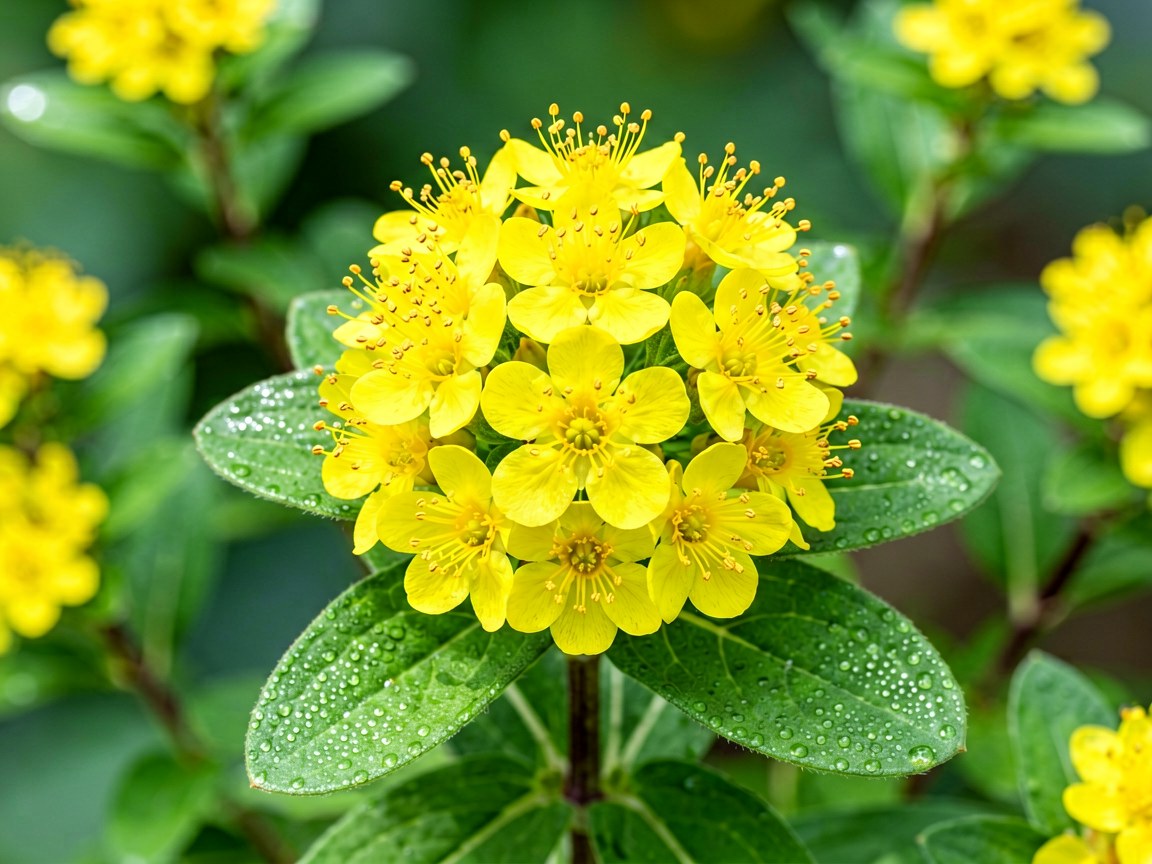
Hypericum perforatum | St John’s Wort
Introduction
St John’s wort (Hypericum perforatum) is the bright yellow-flowered perennial of rough grassland, roadside verges, and woodland edges that has been gathered on Midsummer Day since antiquity and is now one of the most widely used herbal medicines in the world. Its flowers, when crushed, release a dark red juice, and its leaves, held up to the light, are dotted with tiny transparent glands — the “perforations” of its name. It is a familiar and rather handsome plant, upright and much-branched, carrying a flat-topped cluster of starry yellow flowers with a prominent brush of stamens, and it flowers around the feast of St John the Baptist in late June, which is where the English name comes from. Behind the folklore lies a genuinely active plant: extracts of it are among the most studied of all herbal remedies, and they are also responsible for one of the best-known problems in herbal medicine, because the plant interacts with a long list of prescription drugs.
Taxonomy
Hypericum perforatum belongs to the family Hypericaceae, the St John’s wort family, which was formerly included within the Clusiaceae and before that treated as a subfamily of the Guttiferae. The genus Hypericum is large, with several hundred species of herbs and shrubs distributed almost worldwide, and it includes the taller, shrubby St John’s worts of gardens as well as a number of smaller native species such as trailing St John’s wort and marsh St John’s wort, which differ in their stem shape and in the details of their sepals and glands. The specific epithet perforatum refers to the translucent dots in the leaves, which look like pinholes when held to the light. As a green plant it depends on Photosynthesis, but a large part of what it manufactures goes into the naphthodianthrones and phloroglucinol derivatives — hypericin and hyperforin among them — that give the plant its medicinal activity, its red juice, and its chemical defences.
Physical Characteristics
The plant is an erect, much-branched, hairless perennial, thirty to ninety centimetres tall, arising from a woody rootstock with creeping runners. The stems are round below but distinctly two-ridged, with two raised lines running down opposite sides, which is one of the characters used to distinguish it from its relatives; they are woody at the base and often reddish. The leaves are opposite, oval to oblong, one to three centimetres long, stalkless, smooth-edged, and dotted with the small, translucent, pale glands that give the species its name, along with scattered black glands on the undersurface and on the sepals and petals. The flowers are borne in a branched, flat-topped cluster; each is about two centimetres across, with five bright golden-yellow petals that are noticeably asymmetrical, with a fringe of tiny black dots along their outer margins, and a dense central brush of numerous stamens united at the base into three bundles. Crushing a flower bud or a petal releases a dark red or purple juice. The fruit is a dry, oval capsule that splits into three, containing numerous small, dark, cylindrical, strongly pitted seeds.
Habitat
It grows in rough grassland, on roadside and railway verges, at woodland edges and in rides and clearings, on heathland, in scrub, on banks, on waste ground, and in unimproved pasture, favouring well-drained, moderately fertile, neutral to base-rich soils and open, sunny positions. It does not tolerate deep shade, waterlogging, or heavy competition from tall grass, and it is most characteristic of the lightly grazed or lightly disturbed ground where there are gaps in the sward. Native to Europe, western Asia, and north Africa, it has been introduced to North America, Australia, New Zealand, and parts of South America, and in several of those places it is regarded as a serious invasive weed of pasture and rangeland, where it forms dense stands and poisons livestock. It is common through most of Britain and Ireland, though it becomes scarcer in the far north and in the wetter west.
Diet
St John’s wort is autotrophic, and it is a plant of open, sunny situations that grows best where it can put its leaves in full light. It is not a demanding feeder and does well on moderately poor, well-drained soils, and it is a characteristic plant of unimproved ground rather than of enriched pasture; heavy fertiliser tends to encourage competitive grasses that shade it out. It forms associations with arbuscular mycorrhizal fungi, and it spreads locally by means of shallow, creeping runners as well as by seed. Its chemistry is its most notable investment: the hypericin and related compounds in the flowers and leaves are photodynamic — they become toxic to cells when exposed to light — and this is thought to defend the plant against insects and grazing mammals. It is also the reason why livestock that eat the plant in quantity, particularly pale-skinned animals, develop severe inflammation and blistering of the skin in sunlight, a condition known as photosensitisation.
Reproduction
The flowers open from June to September, peaking around Midsummer Day, and are visited by a range of insects, chiefly bees and hoverflies, which come for pollen; the plant produces no nectar, and the flowers are essentially pollen-only rewards. The numerous stamens and the prominent three-branched style make the flowers easy for a variety of visitors to work. Although insect visits occur, the plant is largely self-compatible and is capable of setting abundant seed without cross-pollination, and it can also produce seed apomictically — without fertilisation at all — which is one reason it has been so successful as a colonist in countries where its pollinators are absent. The small, hard, pitted seeds are produced in great quantity and are dispersed by wind, by water, and in mud on animals and vehicles; they can remain viable in the soil for years. Vegetative spread by the creeping runners is important locally and allows a single plant to form a sizeable patch.
Conservation
The species is common and widespread and is not threatened in its native range, where it is a familiar and well-liked component of rough grassland and of the verges and edges that make up so much semi-natural habitat. It declines where grassland is improved or heavily grazed and where verges are mown too frequently to allow it to flower, and it is one of the species that suffers from the tidying of roadside and railway land. Outside its native range it is a major problem: in North America, Australia, and New Zealand it is classed as a noxious weed, forming dense stands in pasture that displace useful forage and poison stock, and control has relied on the introduction of host-specific European beetles as biological control agents, which have been effective in many areas. Conservation interest in its native range centres on the rough, unimproved, flower-rich grassland that it characterises.
Fun Facts
- The leaves are dotted with tiny translucent glands that look like pinholes when held up to the light.
- Crushing a flower bud releases a dark red juice, which was linked to the blood of St John.
- It flowers around Midsummer Day, the feast of St John the Baptist, which gives the plant its name.
- Eating it makes pale-skinned animals severely sensitive to sunlight, and it is a serious pasture weed in some countries.
- Extracts of the plant are among the most studied herbal remedies, and they interact dangerously with many prescription drugs.