 By st20113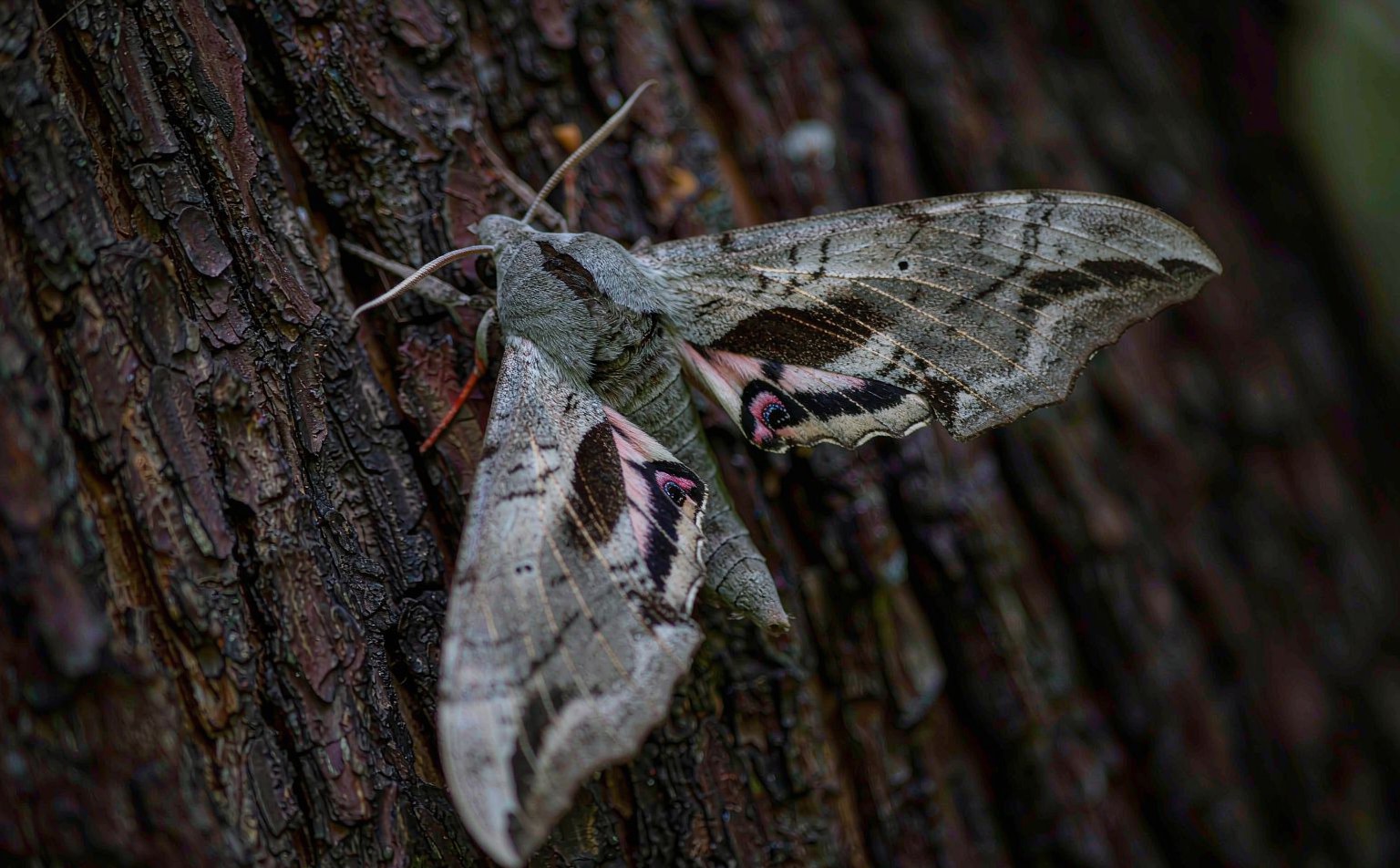
Sphinx ligustri | Privet Hawk-moth
Introduction
The Privet Hawk-moth (Sphinx ligustri) is the largest resident hawk-moth of much of Europe, a heavy-bodied, powerful flier whose padded, grey-and-pink hindwings flash as it hovers at dusk before trumpet-shaped flowers. Despite its size it is a master of stealth, resting by day against tree trunks where its bark-like pattern vanishes. The fat, horned caterpillar that feeds on privet and lilac is a familiar sight in late summer gardens. It is a highlight of any moth trap and a symbol of warm, flower-rich nights.
Taxonomy
Sphinx ligustri was described by Linnaeus in 1758 and is the type species of the genus Sphinx within the family Sphingidae, the hawk-moths. It is a close cousin of the Hummingbird Hawk-moth, though that species hovers by day while the privet hawk-moth flies at night. The family also includes the giant Atlas Moth‘s relatives among the silk moths, though those belong to a different family. Hawk-moths are among the most specialised nectar-feeders of the insect world.
Physical Characteristics
The adult has a wingspan of 9 to 12 centimetres, with narrow, pointed forewings marked in grey-brown with darker bands and pale blotches, and hindwings of rosy-pink crossed by black bars—a startling flash in flight. The body is stout and furry, grey with pink bands, and the head bears feathery antennae in the male. The proboscis is long, suited to deep flowers. The caterpillar is plump, green with purple-and-white diagonal stripes and a yellow horn at the tail; it can reach 10 centimetres before pupating. The chrysalis is glossy brown, formed underground.
Habitat
Privet Hawk-moths occupy a wide range of woody habitats: gardens, parks, hedgerows, orchard edges, woodland margins and warm scrub, wherever the larval food plants—privet, lilac, ash and related shrubs—grow. They are strongly associated with human settlements because privet hedges are common there, yet they also occur in wild bushy places. They favour warm lowlands and are absent from cold northern and mountain zones, though they range widely across temperate Europe.
Diet
Adults feed on nectar from tubular, night-opening flowers such as honeysuckle, jasmine, petunia and tobacco plant, hovering motionless like hummingbirds to sip. The caterpillars eat the leaves of privet, lilac, ash, lilac and related Oleaceae shrubs, often defoliating a branch by late summer. Because the adult feeds mainly at night and the larva on common garden shrubs, the species fits neatly into both wild and suburban landscapes.
Reproduction
Females lay glossy green eggs singly on the underside of host leaves in early summer. The caterpillars feed through several moults, growing rapidly and developing the horned tail typical of sphingids, then burrow into soil to pupate. Depending on latitude there may be one generation in the north and two in the south; northern pupae overwinter and adults emerge the following year. The adult’s brief, nectar-driven life is devoted to mating and egg-laying.
Conservation
The Privet Hawk-moth is common and of Least Concern across its range, and garden privet hedges have probably aided its abundance. It faces the usual moth pressures—light pollution, pesticide use and loss of hedgerow shrubs—but remains widespread. Recording it in moth traps helps track the health of nocturnal pollinator communities, and leaving some untrimmed privet in late summer supports its caterpillars.
Fun Facts
- The caterpillar’s tail “horn” is harmless—a bluff that startles predators, not a sting.
- It can hover perfectly still in front of a flower, just like a hummingbird.
- The pink hindwings are hidden at rest and revealed only in flight, a flash defence.
- A single female may lay more than a hundred eggs across a season.
- Its loud, buzzing flight at dusk is often mistaken for a bat or a large bee.
[…] defined by anatomy, pheromone chemistry and DNA. Its closest relative in European gardens is the privet hawk-moth. The two share a family but not their habits. Beginners often confuse them, and the difference is […]